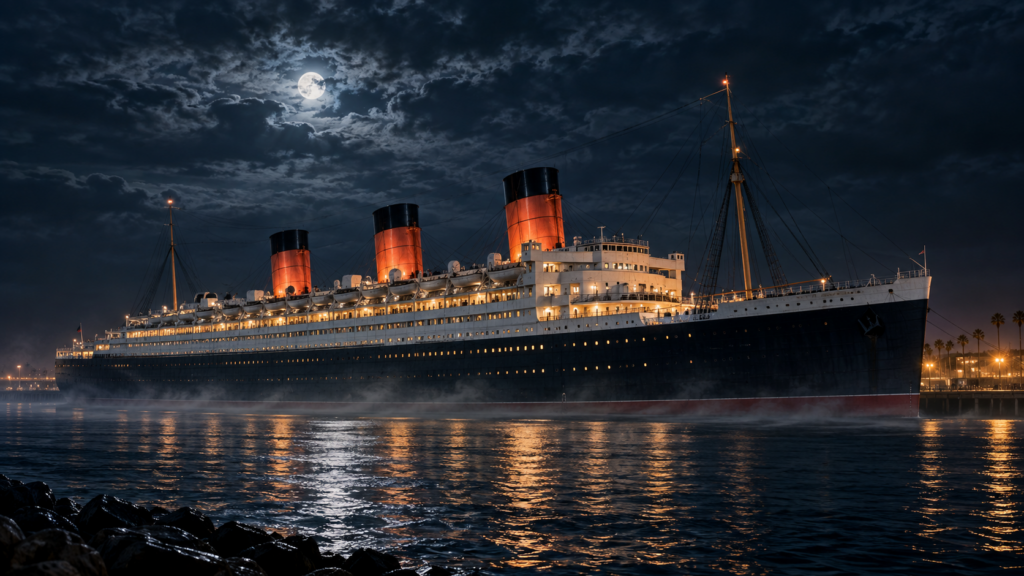
The RMS Queen Mary is one of America’s most famous haunted places. After midnight, the Queen Mary feels less like a hotel and more like a ship holding its breath.
Its engines are silent.
The swimming pool empty.
Long corridors end at sealed doors, and the harbor lights reach only so far through the portholes.
One might hear footsteps—or a wrench striking metal near a watertight door—and the old liner seems occupied again.
The Queen Mary’s reputation combines real maritime history, documented deaths, decades of visitor stories, and a tourism industry that openly invites its guests to look for ghosts.
From Ocean Liner to the “Grey Ghost”
The Queen Mary began as a monument to speed and luxury. Built by John Brown & Company in Clydebank, Scotland, the ship made her maiden voyage from Southampton on May 27, 1936. She carried passengers across the North Atlantic in an Art Deco world of ballrooms, cocktail bars, dining rooms, and indoor pools.
During World War II, the liner was painted gray and converted to carry troops. The official Queen Mary history says she transported more than 800,000 military personnel during the war. Her speed made her difficult for submarines to catch, and the enormous gray vessel became known as the “Grey Ghost.”
After returning to passenger service, the Queen Mary continued crossing the Atlantic until 1967. The City of Long Beach purchased the ship, and she arrived in California that December. Today the vessel operates as a hotel, museum, event venue, and historic attraction. The National Register of Historic Places recognizes her importance to military, recreational, and social history.
Why Is the Queen Mary Said to Be Haunted?
A ship this large contains thousands of rooms, miles of passageways, and machinery designed to groan, vibrate, and carry sound.
It also carried millions of people through wartime and peace.
Some died aboard. Those facts give the ghost stories a convincing frame, even when the details become difficult to verify.
Three locations appear prominently in Queen Mary ghost stories:
- Door 13 in the engine-room area
- Stateroom B340
- The first-class swimming pool
Watertight Door 13
If you’re looking for a ghost story, Door 13 is one of the first places on the Queen Mary to look. It’s linked to one of the ship’s best-known documented tragedies in 1966.
The door closed on a crew member, crushing him during a drill.
Now, ghost stories tell of this young man standing near the door. Others tell of disappearing footsteps, metallic knocks, or the sound of a wrench striking steel.
The Queen Mary’s own exhibit information now identifies Door 13 as a paranormal landmark and tells visitors that guests often report a wrench banging against it.
Stateroom B340
B340 has become the ship’s signature haunted room.
Guests have reported faucets turning on, covers being pulled from the bed, knocks, lights changing, and shadowy figures.
The room is now presented as a paranormal experience rather than an ordinary hotel stay.
The story can be traced back to the ship’s-log entry about a passenger found dead in the cabin area in September 1949.
Other, more elaborate stories repeat claims about murder, madness, or a room sealed because it was “too haunted.”
B340 itself was created from multiple earlier cabins during the ship’s conversion in Long Beach, which complicates claims that every story happened in one unchanged room.
The First-Class Swimming Pool
The drained Art Deco pool may be the most atmospheric place aboard.
Visitors and investigators report splashing, wet footprints, a woman in old-fashioned swimwear, and the voice of a little girl usually called Jackie.
The setting may be doing much of the ghostly work here.
Tiled walls reflect small noises, empty changing rooms invite the imagination, and a pool without water already feels haunted.
The Queen Mary promotes the space as one of its most visited paranormal locations, but the familiar claim that Jackie drowned there is not supported by a publicly documented death record.
What Is Documented—and What Is Legend?
The Queen Mary is historically real.
She crossed the Atlantic hundreds of times and became a landmark after retirement.
Accidents and deaths occurred aboard, as they did on other large working ships.
The haunting claims consist of personal experiences, tour traditions, television investigations, recordings open to interpretation, and stories retold after the ship became a hotel.
These accounts are meaningful folklore, but they don’t necessarily prove that spirits caused the reported events.
Mechanical sounds, plumbing, vibration, drafts, reflections, and the unusual acoustics of a steel vessel offer ordinary explanations for many experiences.
But nothing can explain every report from every witness.
The Queen Mary has a real documented past and a richly documented haunting tradition.
Just keep in mind: those are not the same thing.
How the Queen Mary Became a Haunted Icon
The ship’s reputation grew through an accumulation of stories.
Employees told visitors about odd incidents. Then guests added their own encounters.
Paranormal investigators came and television programs made the pool, Door 13, and B340 recognizable far beyond Long Beach.
The retired vessel also needed visitors to survive, so it incorporated the stories into its tours and exhibits, offering overnight stays and seasonal events.
This doesn’t offer evidence that the legends are false. But it does mean the Queen Mary is both the setting of the folklore and one of its principal storytellers.
Every ghost story shares what the next visitor should notice: footsteps, knocks at the door, a ghostly child answering.
Expectation is a powerful force, and it’s part of the Queen Mary experience before anything paranormal occurs.
Visiting the Queen Mary Today
The Queen Mary is docked at 1126 Queens Highway in Long Beach.
Visitors explore historical exhibits through guided tours. Guests may dine aboard or stay overnight.
Tour routes, access, prices, and schedules change. So check the official Queen Mary website before visiting, especially if you want to see a specific area. Some historic spaces involve stairs, darkness, narrow passages, or restricted access.
Sophie’s Closing Note
The Queen Mary is most unsettling where the ship’s two lives overlap.
In daylight, Door 13 is machinery. B340 is a hotel room. The pool is an empty chamber lined with tile.
At night, every ordinary explanation remains available—but the ship makes you work harder to believe it.
Steel carries a sound around a corner. Pipes speak inside a wall. A vessel that once crossed an ocean moves slightly against a pier, and for one second it feels as if she has remembered how to sail.
That is where I’m leaving the file.
— Sophie Vale
Frequently Asked Questions About the Queen Mary
Is the Queen Mary really haunted?
The Queen Mary has a long history of reported paranormal experiences. The ship’s history is documented; the hauntings remain folklore and personal testimony.
What is the most haunted room on the Queen Mary?
Stateroom B340 is the ship’s most haunted room, with reports of moving bedcovers, unexplained knocks, changing lights, faucets, and shadow figures.
Who haunts Door 13?
Stories connect Door 13 with a young crew member who died in a watertight-door accident in 1966. Visitors report a worker-like apparition, footsteps, and metallic sounds nearby.
Can you stay overnight on the Queen Mary?
Yes. The Queen Mary operates as a hotel in Long Beach. Availability and access to individual rooms can change, so check the official site when planning a stay.
Related Urban Legends and Haunted Places
- The Vanishing Hitchhiker
- What Is an Apparition?
- Urban Legend Creatures
- Explore the Complete List of Urban Legends