Urban Legends Archive · Case File 002
Chupacabra
The monster that changed shape
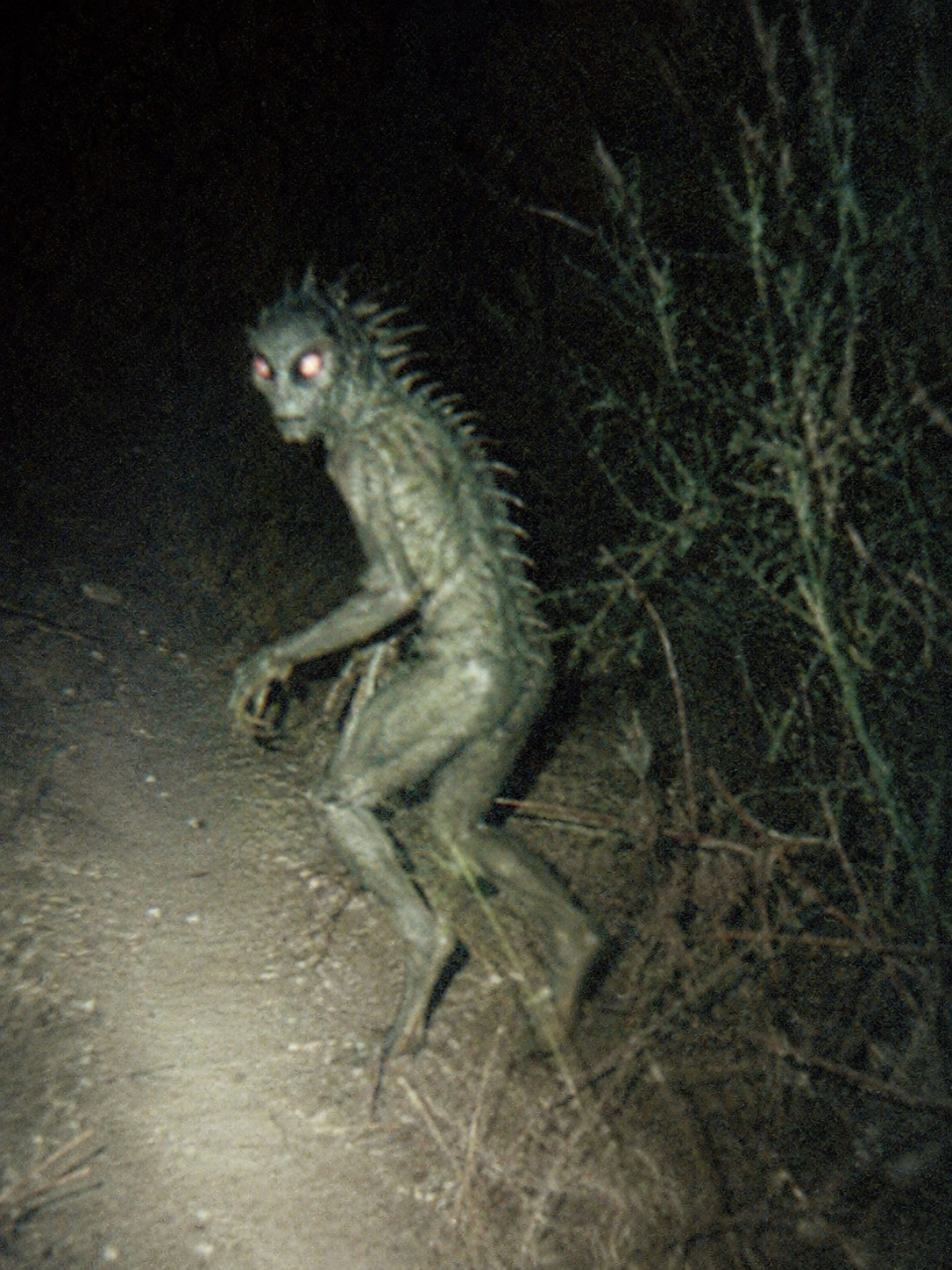
In 1995, livestock deaths in Puerto Rico acquired a name, a face, and a story. Within five years, the Chupacabra had crossed borders and changed from a spiny, upright being into a hairless canine. Because its formation unfolded through newspapers, radio, television, drawings, expeditions, carcasses, DNA tests, and the early internet, we can watch a modern monster being made—and then watch it change.
Investigated by Sophie Vale · File status: Open
Case summary
Chupacabra quick facts
- Origin
- Puerto Rico
- First wave
- 1995
- Legend type
- Contemporary creature legend
- Original form
- Upright, large-eyed, spiny-backed figure
- Later form
- Hairless four-legged canid
- Case status
- Open · No verified unknown species
01
The direct answer
What is the Chupacabra?
The Chupacabra is a modern legend that emerged during a wave of reported livestock attacks in Puerto Rico in 1995. The original creature was described as an upright, roughly three- to four-foot figure with large eyes and spines or feather-like structures along its back. Beginning around 2000, the name was increasingly applied in the United States to hairless, four-legged animals later identified as coyotes, dogs, or other canids—often suffering from mange. The animal deaths, witness reports, media coverage, and later carcasses are real parts of the historical record. None has produced verified physical evidence of an unknown blood-draining species.
02
Before the Chupacabra
The mystery existed before the name.
In February 1975, two decades before the modern Chupacabra panic, Puerto Rico had already experienced a livestock mystery remembered as the Vampire of Moca. Reports described fifteen cows, three goats, two sheep, and a pig with deep circular wounds and apparent blood loss. No one called the attacker a Chupacabra. That word—and the creature now attached to it—had not yet entered the record.
The same year, newspapers across the continental United States were reporting a broader cattle-mutilation panic. In Colorado and at least ten other states, ranchers and law-enforcement officers investigated carcasses with missing tissue, little visible blood, and few obvious tracks. UFOs, secret government operations, cults, predators, insects, and decomposition all entered the argument.
These earlier cases do not prove that the same animal later appeared in Puerto Rico. They establish something subtler: when the Chupacabra emerged in 1995, it entered a world that already knew the story of mysteriously injured, apparently bloodless livestock.
The name arrived after the fear.
The modern story did not begin with a monster standing in a road. It began with animals. In March 1995, reports from Orocovis and Morovis described livestock found dead with small wounds and surprisingly little visible blood. The cause was uncertain, but uncertainty does not remain empty for long. It attracts explanations.
By the second week of August, Madelyne Tolentino reported seeing a strange creature in Barrio Campo Rico, Canóvanas. Her description—large eyes, an upright body, claws, and structures rising from its back—became the template most people now recognize as the original Puerto Rican Chupacabra. A drawing created with researcher Jorge Martín appeared on the front page of El Nuevo Día on September 12 and gave the invisible attacker a reproducible body.
Around the same period, the word chupacabra entered public use. It is often credited to radio personality Silverio Pérez, although the attribution is disputed and Ismael Aguayo has also been credited. The uncertainty over who coined it does not diminish what the word accomplished. It gathered scattered animal deaths, rumors, witnesses, and explanations into one shared creature.
“The label did not simply describe the creature. It helped create the creature as a public fact.”
— Sophie Vale
04
A documented influence
Was the monster born in a movie theater?
The evidence supports a careful conclusion: the livestock panic began before Species, but the film may have supplied the body that the panic eventually wore.
Species opened on July 7, 1995. Its alien-human creature, Sil, was designed with a pronounced spiny back and other visual features that strongly resemble the later Chupacabra image. The film’s opening sequence takes place at the Arecibo Observatory in Puerto Rico, making its setting unusually immediate for Puerto Rican audiences.
Tolentino’s defining sighting followed roughly five weeks later. In a 1996 interview, she herself directed attention to Species, describing its creature as looking like the Chupacabra and saying the resemblance was impressive. Her later accounts also changed in significant ways, which makes the earliest surviving versions especially important.
This does not explain every livestock death, rumor, or later witness report. It explains something narrower and historically powerful: the best-known physical image of the Chupacabra can be traced to one defining witness shortly after she saw a strikingly similar movie creature.
05
Chronology
One summer, then the world.
The formation of the modern Chupacabra can be followed with unusual precision: an older antecedent, a livestock panic, a film release, a defining witness, a newspaper drawing, official searches, autopsies, international transmission, and finally a completely different body.
The Vampire of Moca
Feb. 1975Puerto Rican livestock deaths involving deep circular wounds are remembered under an older name. They were not called Chupacabra attacks at the time.
A continental mutilation panic
1975Colorado and at least ten other states report cattle mutilations amid competing theories involving predators, cults, UFOs, and government activity.
The modern panic begins
March 1995Livestock deaths in Orocovis and Morovis are described as involving puncture wounds and apparent blood loss.
Species reaches theaters
July 7, 1995The film features Sil, a spiny-backed alien-human creature, and opens at Puerto Rico’s Arecibo Observatory.
Madelyne Tolentino reports a creature
Aug. 7–11, 1995Her daytime Canóvanas account becomes the most influential physical description associated with the legend.
The creature acquires an image
Sept. 12, 1995A drawing developed with Jorge Martín appears on the front page of El Nuevo Día and becomes the standard depiction.
Chemo Soto leads public searches
Oct. 29, 1995The mayor of Canóvanas organizes armed search parties as reports and media attention intensify.
Autopsies challenge the blood claim
Jan. 26, 1996After approximately twenty government examinations, veterinarian Dr. Héctor García reports that the dead animals contained the expected amount of blood.
The story crosses borders
Spring 1996Reports spread through Mexico and into the United States through newspapers, television, radio, conferences, VHS tapes, and the early internet.
The first dead-canid version appears
2000A carcass on a ranch outside Managua, Nicaragua marks the documented pivot toward the hairless four-legged form.
The Elmendorf Creature
2004A hairless Texas animal promoted as unusual is identified as a coyote with mange, establishing the pattern followed by later U.S. cases.
The Cuero carcass is recovered
July 14, 2007Phylis Canion preserves a hairless, fanged animal found near her Texas ranch and seeks testing.
DNA returns coyote
Nov. 1, 2007Testing at Texas State University–San Marcos identifies the widely publicized Cuero specimen as a coyote. Canion disputes the conclusion, and the legend survives the result.
06
Comparative file
The legend contains two different creatures.
The original Puerto Rican figure and the later American canine are so different that treating them as one stable description conceals the most revealing part of the story: the creature changed as the kind of evidence changed.
The spiny biped
- Upright and approximately three to four feet tall
- Large dark or red eyes
- Spines, feathers, or fan-like structures along the back
- Reported hopping, floating, or moving with an unusual gait
- Associated with aliens, laboratories, and secret government activity
- Preserved through testimony, drawings, journalism, and television
The original creature was visually specific but left no verified specimen.
The hairless canine
- Four-legged and doglike
- Thin body with pronounced ribs and fangs
- Gray or blue-gray skin
- Often found dead rather than reported as an upright attacker
- Associated with coyotes, dogs, mutation, or disease
- Available for photography, necropsy, and DNA testing
The creature became less exotic as the evidence became more testable.
07
The human record
The people are part of the evidence.
The Chupacabra did not travel by itself. Witnesses, journalists, researchers, politicians, ranchers, scientists, and collectors carried the story—sometimes preserving evidence, sometimes interpreting it, and sometimes changing what later audiences believed had happened. Their testimony does not all carry equal evidentiary weight, but each person left part of the historical trail.
Madelyne Tolentino
Her 1995 Canóvanas report supplied the physical description that became internationally recognizable. Later versions contain important differences, and her comparison to Species remains central to skeptical interpretations.
Luis Guadalupe
A January 1996 New York Times report recorded his description of huge elongated red eyes and a gray back that appeared to change colors. His account matters because the historical record was not limited to Tolentino alone.
Carmen Jovet
Her contemporary television reporting preserved witnesses, officials, veterinarians, and investigators while the panic was still unfolding.
Jorge Martín
Martín helped develop the iconic drawing and appears throughout the early investigative network connecting witnesses, television, and field researchers.
José “Chemo” Soto
Soto organized searches and became one of the public faces of the panic. His involvement was reported seriously, satirized politically, and absorbed into the legend.
Marc Davenport and Joyce Murphy
Their Beyond Boundaries expedition traveled through Puerto Rico in February 1996, recording interviews and producing hours of footage later presented and advertised on VHS.
Phylis Canion
Canion preserved Texas carcasses, sought DNA testing, and kept a specimen after scientists identified one animal as a coyote.
08
Investigation threshold
The expedition itself is evidence.
Beyond Boundaries goes to Puerto Rico.
The team traveled, interviewed witnesses, met public figures and researchers, visited alleged activity sites, collected material, and returned with hours of videotape.
What the commitment tells us
The expedition itself is evidence.
Not evidence of a cryptid.
Evidence that knowledgeable people of the time judged the situation important enough to investigate directly.
That is a historical fact. It does not tell us whether they were ultimately right, but it tells us the event crossed a threshold where experienced investigators decided it warranted real resources: travel, equipment, interviews, fieldwork, public presentations, and the production of a commercial videotape.
Their conclusions still have to be tested. Their effort should not be erased simply because some of those conclusions were speculative.
09
Archive search
The search for the missing footage.
Contemporary records establish that the expedition footage existed, was shown publicly, and was offered for sale. The unanswered question is not whether the tape was made. It is where the surviving copies went.
Miami Dade College’s Wolfson Archives is relevant to the broader search because its moving-image collection preserves more than 35,000 hours of videotape and 23 million feet of film documenting Florida history.
Hours were recorded.
A surviving expedition report identifies the team, dates, interviews, and field locations.
MUFON saw the tape.
A May 18, 1996 Clearwater meeting report describes Davenport presenting unedited footage.
The VHS was advertised.
A contemporary online advertisement offered footage featuring interviews with Chemo Soto, Dr. Carlos Soto, and others.
The archive search continues.
An inquiry has been submitted to MUFON’s Project Aquarius regarding the presentation and expedition footage.
10
Southwestern transmission
Did the Chupacabra attach itself to an older mystery?
Before it had a name
Did the Chupacabra attach itself to an older mystery?
When Chupacabra reports reached northern Mexico and Arizona in 1996, they entered a region already familiar with unexplained livestock deaths. During the 1970s, ranchers and law-enforcement agencies across the American West had investigated cattle found with missing tissue, little visible blood, and few obvious tracks. Those cases were discussed as mutilations, predator activity, cult crimes, government operations, or UFO-related events—not as Chupacabra attacks.
The overlap is not proof of one animal moving through history. It is evidence of a narrative lineage. Both panics joined mysterious livestock injuries to claims of blood loss, invisible attackers, official uncertainty, and extraordinary explanations.
The new legend supplied what the older panic lacked: a memorable Spanish name and a reproducible body. Once those existed, a strangely injured animal no longer had to remain an isolated mystery. It could be placed inside a story already moving through border communities, Spanish-language media, television, merchandise, and the early internet.
11
Evidence review
Documented does not always mean true.
A newspaper can document that a witness spoke. An autopsy can document what was inside a carcass. An expedition can document that investigators committed resources. Those facts are different from proof that the witness’s explanation was correct.
A genuine 1995 panic occurred.
Contemporary reports record livestock deaths, public concern, government examinations, organized searches, named witnesses, and extensive media coverage in Puerto Rico.
The visual template has a traceable origin.
Tolentino’s August account and the September 12 drawing created the defining spiny-backed form. Her own 1996 comments identify Species as a striking comparison.
The blood claim was challenged immediately.
After examining approximately twenty victims, Dr. Héctor García reported in January 1996 that the dead animals contained the expected amount of blood. Other contemporary veterinary reporting found blood absent near wounds while remaining elsewhere in the bodies.
Investigators committed real resources.
Journalists, officials, veterinarians, researchers, and the Beyond Boundaries expedition conducted interviews, examinations, searches, fieldwork, public presentations, and archival recording.
Later bodies were testable animals.
Prominent carcasses promoted as American Chupacabras have been identified as coyotes, dogs, raccoons, or related animals, frequently displaying severe mange.
The legend survived contrary results.
The 2007 Cuero DNA result returned coyote. Canion disputed the test, illustrating why a solved specimen does not necessarily close a living legend.
Complete exsanguination.
Little visible blood at a scene is not equivalent to medically verified drainage. No located laboratory report demonstrates that an alleged victim was emptied of blood by an attacker.
An unknown species.
No verified specimen, DNA sequence, skeleton, tissue sample, or repeatable biological evidence has demonstrated a distinct blood-draining animal corresponding to the Puerto Rican description.
An alien or escaped experiment.
Extraterrestrial and laboratory narratives were widespread explanations, but no physical evidence has established either origin.
An ancient or Indigenous pedigree.
No verifiable pre-1990s reference to the modern creature has been established. Alleged Taíno, Zuni, and colonial pedigrees cited in later works are recent constructions rather than demonstrated historical traditions.
The monster we can watch being made.
The Chupacabra is unusual because so much of its formation survives. We can identify the earlier livestock mysteries. We can identify the 1995 panic. We can identify the film that may have influenced the defining witness. We can identify the drawing, the journalists, the radio programs, the mayor’s searches, the government autopsies, the first websites, the expedition, the VHS advertisement, and the later carcasses.
That record does not make the extraordinary explanation true. It gives us something nearly as rare: a modern legend whose birth, transmission, mutation, and resistance to disproof can be studied in public.
“The creature became less exotic as the evidence became better—and the name survived every body placed beneath it.”
— Sophie Vale
13
Still unresolved
The file remains open.
A skeptical conclusion does not eliminate every historical question. Some of the most compelling mysteries concern missing records, changing testimony, and transmission of the legend itself.
Where are the surviving copies of the Beyond Boundaries expedition footage?
Archive question 01What do the earliest Puerto Rican broadcasts show before the story became standardized?
Archive question 02Was Silverio Pérez the first to use the name—or did Ismael Aguayo or another voice place it into circulation?
Archive question 03How did the Vampire of Moca and older cattle-mutilation stories change after the Chupacabra name reached Arizona and the wider Southwest?
Archive question 04How many witnesses described independent experiences—and how many responded to the published image?
Archive question 05What did the original investigators preserve that has not yet been digitized?
Archive question 06Questions from the reading room
Chupacabra questions.
The archive keeps the animal, the evidence, and the legend separate.
Is the Chupacabra real?
Where did the legend begin?
Did Species create the Chupacabra?
Why does the Texas Chupacabra look like a dog?
Were the victims really drained of blood?
Source ledger
Selected sources and archives.
Contemporary reporting reconstructs what was said and done at the time; later scientific and skeptical work evaluates physical claims.
- Benjamin Radford, Tracking the Chupacabra: The Vampire Beast in Fact, Fiction, and Folklore (University of New Mexico Press, 2011), including the Tolentino, Species, naming, and predation analysis.
- Benjamin Radford, “Chupacabra Revisited: Dueling Origin Stories of the Hispanic Vampire,” Skeptical Inquirer (2025).
- Jan Harold Brunvand, Encyclopedia of Urban Legends, 2nd ed., “Chupacabra,” Type 03225.
- Mireya Navarro, “Animals Killed, An Island Is Abuzz,” The New York Times, January 26, 1996—Luis Guadalupe, government autopsies, and Dr. Héctor García’s blood findings.
- Los Angeles Times/Associated Press, December 3, 1995—Canóvanas searches and contemporary government explanations.
- The Washington Post, May 10, 1996—veterinary blood findings and the Mexico wave.
- Linda Moulton Howe, Puerto Rico field interviews (1997), used primarily as a record of interviews.
- Carmen Jovet, contemporary Puerto Rican television documentary and interviews.
- Bill Stanley, “Marc Davenport Reports on the Mysterious Chupacabras,” May 18, 1996 MUFON meeting report.
- Beyond Boundaries expedition report, February 10–17, 1996.
- Asher Elbein, “Chasing the Chupacabra, a Lone Star State Legend,” Texas Observer (2016).
- The Cuero Record, July 25, 2007, and Texas State University–San Marcos reporting concerning the 2007 Cuero carcass and coyote DNA result.
- Texas A&M AgriLife Extension EWF-099 (2017), Jim Tomeček, Scott Henke, and Curtis Hensley—severe mange and the physical traits of reported U.S. Chupacabras.
- Caesar Kleberg Wildlife Research Institute / Scott Henke material concerning the February 1975 Vampire of Moca antecedent.
- Grace Lichtenstein, “11 States Baffled by Mutilation of Cattle,” The New York Times (1975).
- Gregory McNamee and Luis Alberto Urrea, Tucson Weekly cover story (May 30–June 5, 1996).
- Lynn and Louis Wolfson II Florida Moving Image Archives, Miami Dade College.
- MUFON Project Aquarius Digital Library—active archival inquiry submitted regarding the Davenport presentation and expedition footage.
Editorial note: living witnesses and researchers should be described factually and with attribution. Do not reproduce imagery from Species or H. R. Giger-derived designs without permission; use original interpretive artwork.