Monster File · Manticore
Manticore
Mythology, Origin, Appearance, and Meaning
Today, the manticore is a monster in table top games, video games and novels. But ancient writers described it as a flesh-and-blood predator from India
Pausanias, an ancient traveler offered a skeptical explanation almost two thousand years before modern folklorists arrived at the same question. Perhaps the manticore was never a supernatural creature at all. Perhaps it simply transformed as its story traveled west.
Case Identification
Quick Facts
Pronunciation: MAN-tih-kor
01
What Is a Manticore?
Many people ask me the same question: what is a manticore?
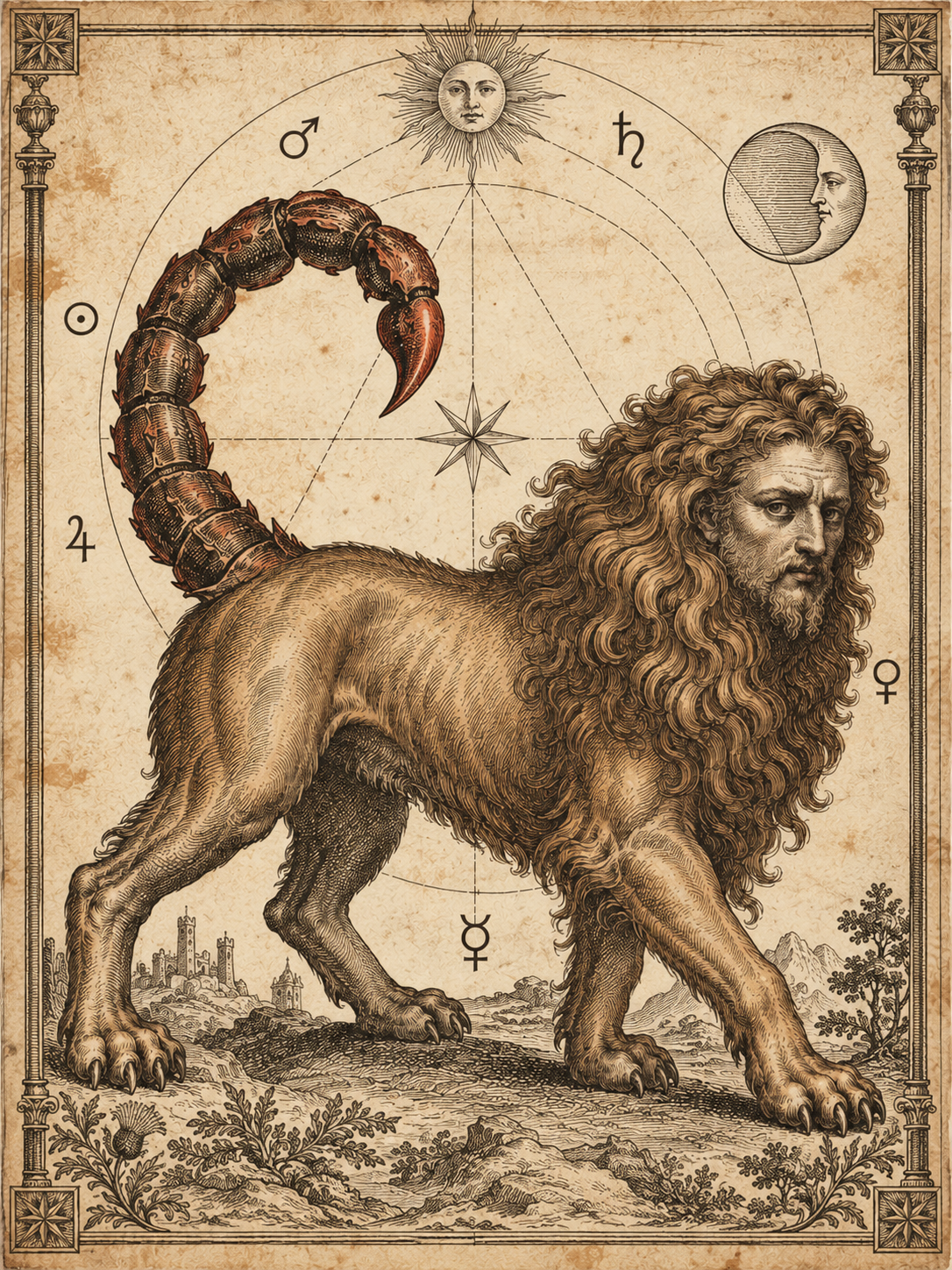
A manticore is a legendary man-eater described with a humanlike face, a lion’s body, and a scorpion-like tail. Its earliest surviving trail passes from India through the Persian court and into Greek and Roman writing.
My research into the manticore began with Indica, written by the Greek physician Ctesias around 400 BCE. The original book has been lost, so its creature reaches us through later writers who preserved the account.
Those writers describe a blood-red animal the size of a lion, with a human face, three rows of teeth, and a scorpion’s tail that could fire spikes.
Nearly five centuries later, Pliny described the creature in his Natural History, noting a voice like a flute and a trumpet sounding together.
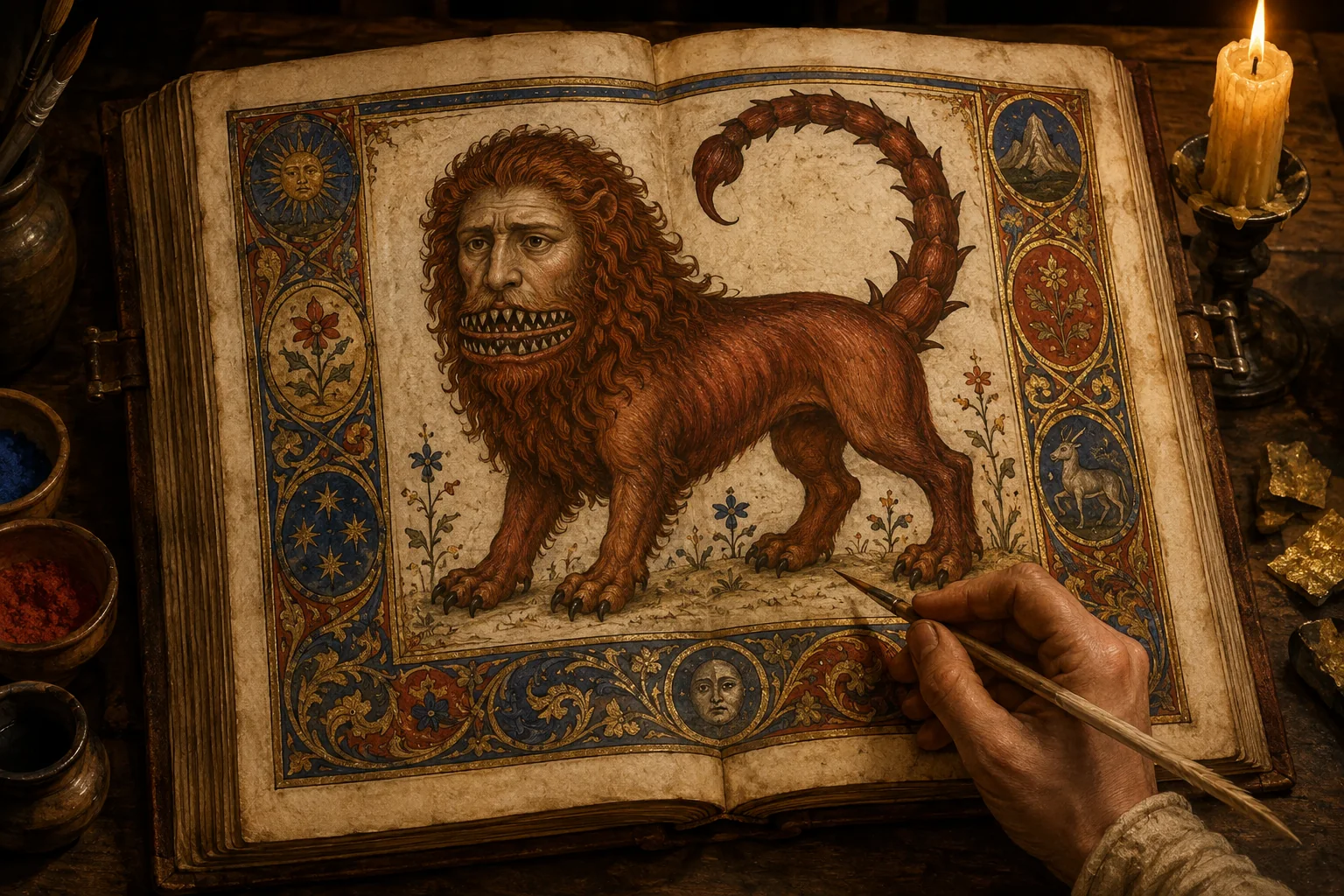
By the late twelfth century, the manticore had entered English bestiaries. British Library Additional Manuscript 11283 repeats the human face, lion’s body, triple teeth, scorpion tail, and pipe-like voice. Medieval scribes carried the ancient description forward, while illustrators had to turn a creature known only through copied words into something readers could see.
02
What Does a Manticore Look Like?
The manticore is about the size of a lion and red all over. The face, ears, and blue-grey eyes seem human. The paws and body belong to a lion, while each jaw carries three rows of teeth.
Behind it curls a scorpion-like tail with a sting at the tip and more spikes along the sides. Pliny adds one of the stranger details: a voice that sounds like a flute and trumpet played together.
Wings are absent from the principal descriptions preserved by Aelian and Pliny. They belong to the creature’s later life in art, games, and fantasy fiction.
Behavior and Powers
Ancient writers describe the manticore as an exceptionally fast hunter with an appetite for human flesh.
Aelian gives it the ability to fire tail-spikes in either direction and grow replacements; he claims that only an elephant could withstand the attack.
03
The Creature in the Ancient Report
The manticore is often described as a creature of Persian mythology, but the surviving records are more complicated.
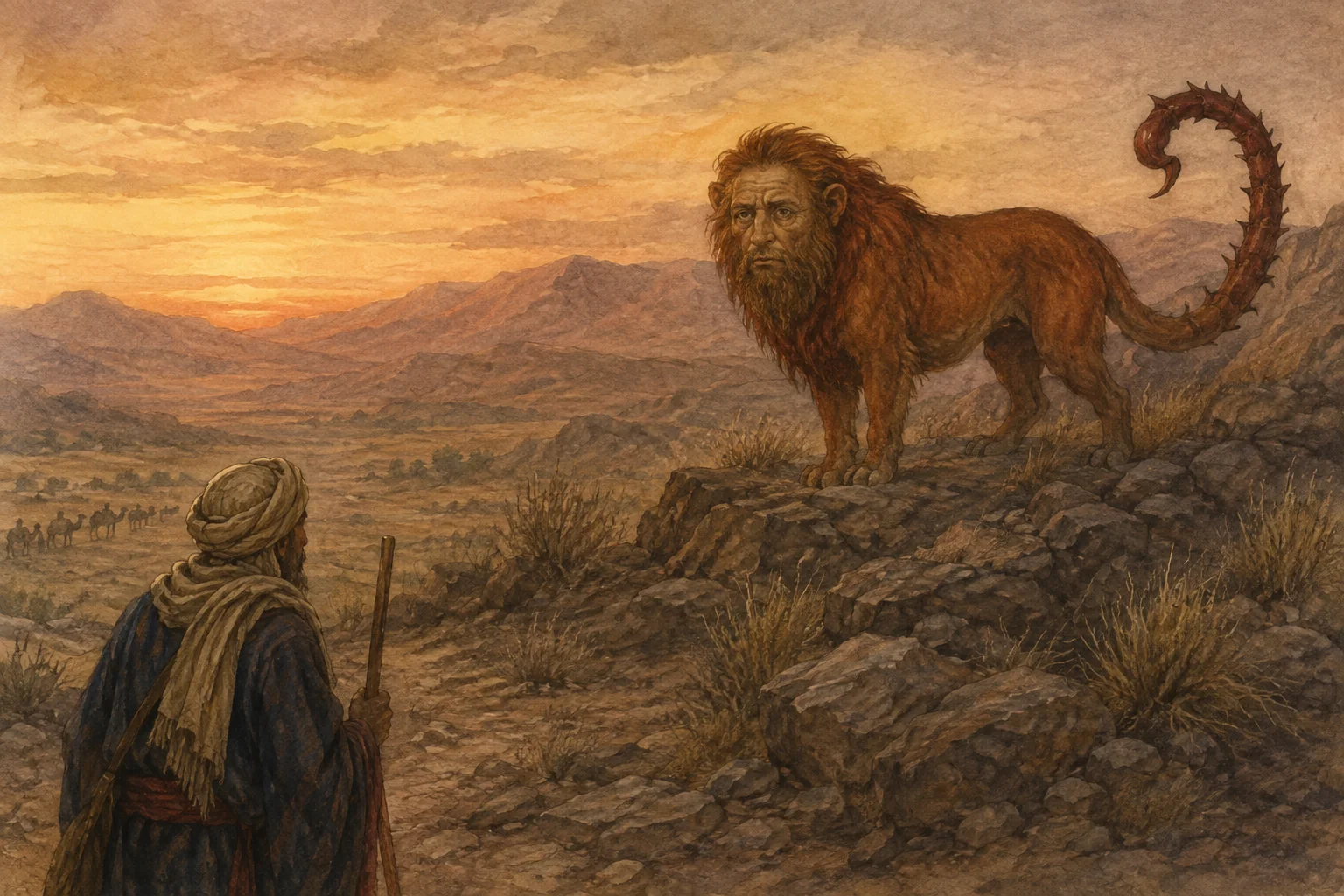
Its earliest known reporter was Ctesias, a Greek physician who spent years at the Persian royal court. His book about India, the Indica, no longer survives intact. What we know comes from authors who quoted or summarized it centuries later.
In the fullest surviving classical description, the Roman writer Aelian says the creature was as large as the biggest lion and covered in shaggy, bright-red hair. Its face, ears, and blue-grey eyes resembled a human being’s, while its feet and claws belonged to a lion. Three rows of oversized teeth filled each jaw.
Then came the tail.
The tip carried a scorpion-like sting, while additional spikes grew along both sides. The beast could supposedly bend its tail forward or backward and fire those spikes over a distance. New ones grew in their place. Only the elephant was said to survive a hit.
Aelian also preserves Ctesias’s most dramatic claim: the physician said he had personally seen one in Persia after it was brought from India as a gift for the Persian king. Aelian repeated the story but ended the passage with a conspicuous note of doubt about whether Ctesias deserved to be believed.
04
A Monster Whose Name Was a Warning
The older form of the creature’s name, martichoras, is generally traced to Iranian words for “man” and “eater.” The name made man-eating part of the animal’s identity long before later storytellers inherited it.
The name may also explain why the manticore has no single defining adventure comparable to the Minotaur’s labyrinth or Medusa’s confrontation with Perseus. The earliest accounts do not place it in a sacred myth or heroic cycle. They present it as a dangerous wildlife creature from the edge of the known world.
05
How the Description Traveled
Pliny the Elder shares his account of the manticore in Natural History in the first century CE. His description includes:
- Human face
- Lion’s body
- Triple teeth
- Blood-red color
- Scorpion tail
- Terrifying speed
- A voice like a flute and trumpet sounding together
Bestiaries in the Middle Ages placed the manticore alongside lions, elephants, crocodiles, phoenixes, and unicorns. Many interpretations and symbols connected to the manticore reflect the Christian moral perspective of this period.
Artists drew the manticore in different ways. With no visual references, these artists relied upon the words written in previous records to determine what the manticore would look like when drawn.
06
The Ancient Tiger Theory
In the second century CE, the Greek traveler Pausanias considered Ctesias’s account of the manticore. In Book 9, Chapter 21, Sections 4–5 of the Description of Greece Vol. 4, he concludes:
“The beast described by Ctesias in his Indian history, which he says is called martichoras by the Indians and man-eater by the Greeks, I am inclined to think is the tiger.”
Fear had inspired the mythical stories. Its powers were mere inventions. Sunlight and rapid movement might have made the tiger’s coat appear uniformly red to distant observers.
Pausanias’s explanation remains unproved. He looked for a real animal beneath the accumulated details instead of dismissing the tale outright.
The tiger theory fits several parts of the report:
- The creature was associated with India.
- It was large, fast, and capable of killing people.
- It had a reddish coat.
- Tigers were also “man-eaters.”
However, some details don’t fit. Tigers don’t have human faces, three rows of teeth, or projectile tails. But those could be exaggerations.
07
What Does the Manticore Symbolize?
The manticore combines three forms of fear into one body.
The lion gives it power.
The scorpion gives it venom.
The human face gives it intention.
That face may be the creature’s most unsettling feature. A tiger kills because it is a tiger. The manticore looks back at its prey with something almost familiar.
08
Frequently Asked Questions
What does “manticore” mean?
The name is generally traced to an Old Iranian compound meaning “man-eater.” Its older Greek form, martichoras, preserves part of the route by which the report traveled from the Persian world into Greek literature.
What does a manticore look like?
The manticore is described as a blood-red animal with a humanlike face, a lion’s body, three rows of teeth, and a scorpion-like tail armed with spikes. Wings became common in later fantasy depictions.
What is a manticore?
A manticore is a legendary man-eating creature usually depicted with a humanlike face, a lion’s body, and a scorpion-like tail. Ancient descriptions also give it three rows of teeth, red coloring, and tail-spikes that can be fired like arrows.
Is the manticore Persian or Greek?
Its name appears to be Iranian, and the earliest reporter encountered the tradition while connected to the Persian court. However, the creature is described as an animal from India, and the surviving literary tradition comes mainly through Greek and Roman authors. Calling it simply Persian or Greek hides that cross-cultural route.
Was the manticore a tiger?
We don’t know for sure. Pausanias argued that fear had enlarged a real predator into the impossible anatomy of the manticore.
Did ancient people agree that the manticore existed?
No. Not everyone agreed that the manticore was real.
What does a manticore symbolize?
Lion strength, scorpion venom, and a human face on a predator said to hunt people.
Who killed the manticore in Greek mythology?
There is actually no Greek hero credited with killing the manticore.
09
Sources and Further Reading
- Aelian. On Animals, 4.21 — the fullest surviving classical description attributed to Ctesias. Read the translated text.
- Pliny the Elder. Natural History, Book 8 — a Roman version of the manticore account. Read the translated text.
- Pausanias. Description of Greece, 9.21.4–5 — the ancient tiger explanation. Read the translation.
- The American Heritage Dictionary. “Manticore” — the word’s Old Iranian roots and “man-eater” meaning. Read the dictionary entry.
- Encyclopaedia Iranica. “Ctesias” — background on Ctesias, his surviving fragments, and his reputation as a source. Read the reference entry.
- The British Library. “Weird and Wonderful Creatures of the Bestiary” — examples of medieval manticore imagery. View the manuscript discussion.
- The Metropolitan Museum of Art. Manticore, Vienna, ca. 1735. Public Domain. View the object record.