Cryptid File 002
Jackalope
The Horned Rabbit That Existed Before Its Origin Story
A jackalope is not a known species of antlered rabbit. But real rabbits can grow hornlike tumors, mounted antlered rabbits were circulating before Douglas, Wyoming claimed to invent the creature, and the familiar Herrick origin story is far less documented—and far more interesting—than it first appears.
“The closer I got to the supposed moment of invention, the more the story began behaving like folklore.”
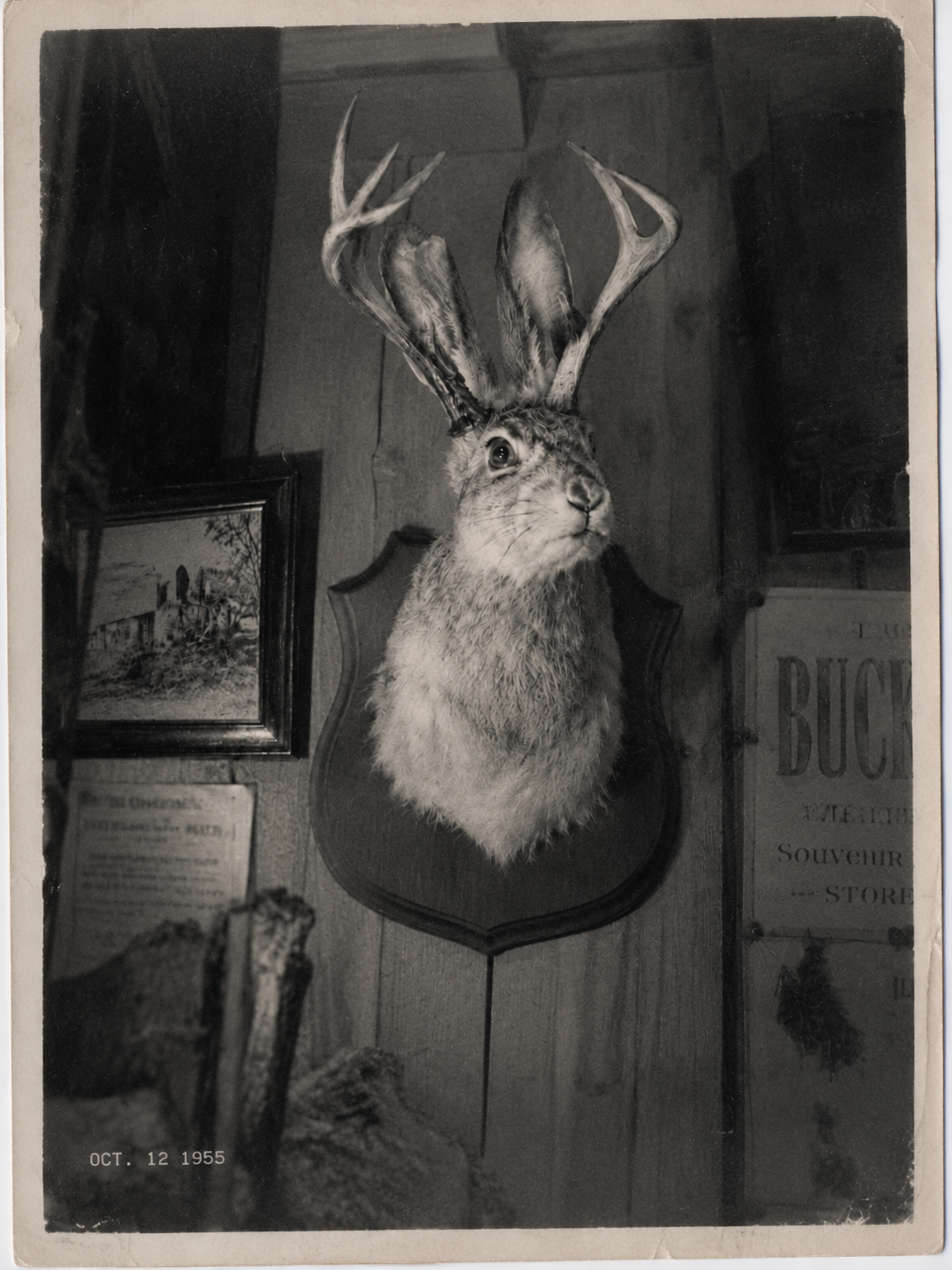
Case Identification
Jackalope Quick Facts
- Archive status
- Manufactured creature; origin story disputed
- Classification
- Cryptid, tall-tale creature, taxidermy hoax, roadside folklore
- Supposed appearance
- A jackrabbit or rabbit with deerlike antlers
- Modern heartland
- Douglas, Wyoming
- Earliest print use found
- The word “jackalope” appears in newspaper publicity around 1950
- Earlier American motif
- “Horned jack rabbit” appears in newspapers decades earlier
- Real biological referent
- Rabbit papillomavirus can cause hornlike keratin growths
Also filed under: American Urban Legends Cryptids Fearsome Critters Taxidermy Hoaxes
01
Is a Jackalope Real?
That direct answer is accurate, but it is not the whole case.
The jackalope is physically real as a taxidermy object, culturally real as American folklore, and biologically suggestive because actual rabbits can develop hard, hornlike growths. What has not been established is the existence of a naturally antlered rabbit species.
The history is more complicated than the standard debunking, too. The familiar story says the Herrick brothers invented the jackalope in Douglas, Wyoming, during the 1930s. But horned jackrabbits had appeared in American newspapers for decades. Mounted antlered rabbits were displayed before the Herrick story was documented. And the word jackalope does not become visible in the newspaper record we examined until around 1950.
The horned jackrabbit existed before Douglas. The jackalope, as a named and promoted Wyoming creature, appears later.
02
What Is a Jackalope?
A jackalope is a legendary animal of the American West, usually described as a jackrabbit with the antlers of a deer or pronghorn. The name combines jackrabbit and antelope, although the taxidermy version is often made from a cottontail rabbit and fitted with deer antlers rather than pronghorn horns.
It belongs to several overlapping categories. It is a cryptid because stories describe it as a rare animal that might still be found. It is a taxidermy hoax because the familiar mounted heads are deliberately constructed. It is a tall-tale creature because storytellers gave it impossible speed, dangerous habits, humanlike vocal abilities, and elaborate rules for hunting it.
Unlike legends that depend on sustained fear, the jackalope usually depends on play. The teller knows. The listener probably knows. The fun lies in seeing how long both sides can protect the possibility.
03
The Jackalope Origin Story Everyone Repeats
The standard story begins in Douglas, Wyoming, with two brothers: Douglas and Ralph Herrick. They hunted rabbits, practiced taxidermy, and supposedly created the first jackalope mount sometime in the 1930s.
In the best-known version, the brothers returned from hunting and left a dead jackrabbit on the floor of their shop. A pair of deer antlers happened to be nearby. When they came back, the rabbit had slid or been placed against the antlers in a way that made the combination suddenly obvious.
Ralph later recalled Doug saying:
Let’s mount it the way it is.
[1]
The brothers allegedly sold the first mount for $10 to Roy Ball, who displayed it at the Hotel LaBonte in Douglas. The mount became a curiosity. The family made more. Douglas eventually embraced the animal as its own.
It is a perfect origin story. It has named creators, a precise setting, a visual accident, a memorable quotation, an early buyer, and a modest first sale that later becomes culturally valuable.
The trouble begins when we ask when the story was documented.
04
The Story Changes When It Is Retold
In 1977, Ralph Herrick described the jackalope as an accident. He and his brother Doug
were late for dinner, leaving a rabbit beside a pair of antlers on the floor of their
taxidermy shop. When they returned, Doug supposedly looked at the two together and said,
Let’s mount it the way it is.
[1]
By 1998, the story had changed. In that version, the idea came from an unnamed friend during a rabbit hunt. The friend suggested putting deer antlers on a rabbit’s head, and Herrick—then taking a taxidermy course—followed through. The name arrived later, when an unidentified little boy reportedly called the creature a “jackalope.”[2]
Those accounts can be made to fit together, but the sources do not fit them together for us. One presents a spontaneous discovery between two brothers. The other gives the initial idea to a friend and the name to a child.
Even the fate of the first mount shifts. The 1977 account says the mount remained at the Hotel LaBonte for roughly 43 years before being stolen in September 1977. The 1998 account says it disappeared only six months after it was sold.
| Question | 1977 account | 1998 account |
|---|---|---|
| How did the idea arise? | A rabbit happened to lie beside antlers on the shop floor. | An unnamed hunting friend suggested adding antlers to a rabbit. |
| Who proposed mounting it? | Doug reportedly said, “Let’s mount it the way it is.” | Herrick acted on the friend’s suggestion while learning taxidermy. |
| Who named it? | Not explained. | An unidentified little boy reportedly said “jackalope.” |
| When was it made? | 1934 in the 1977 article. | No stable date; other accounts give 1932, 1939, and additional years. |
| When was it stolen? | September 1977, about 43 years after the sale. | Six months after it was sold. |
The broad story may still be true. The Herricks made antlered rabbit mounts in Douglas and helped turn them into a Wyoming tradition. But the closer we get to the supposed moment of invention, the more the story begins to behave like folklore.
05
Horned Jackrabbits Before the Jackalope
Once I stopped searching only for the word jackalope and began searching for horned jack rabbit, the earlier record opened.
An 1885 Kansas newspaper used a horned jackrabbit as part of a joke about local civic boasting. In 1892, another Kansas paper reported that Bill Spencer had killed two: one allegedly had four horns, while the other had a single horn emerging near its nose. In 1900, a South Dakota report described a cottontail with uneven, pronged growths near the bases of its ears. The scalp was reportedly preserved as a curiosity.
In 1907, a seventy-year-old veteran named Calvin Young reportedly sent a three-horned jackrabbit scalp to The National Tribune. The newspaper said it displayed the specimen in its office for doubters. The growths were described as one horn between the eyes and two on the nostrils—an irregular arrangement very different from a clean pair of mounted deer antlers.
Some reports read like possible encounters with diseased animals. Others were already jokes. A 1908 Arizona column claimed Cave Creek jackrabbits had evolved their “rudimentary horns” to goring length. A 1911 Texas wire story proposed that horned jackrabbits had crossed with white-tailed deer. A 1927 report claimed one attacked and gored a dog.
These are not nine independent proofs of a hidden species. Newspaper fillers were copied, exaggerated, and syndicated. But they establish something historically important: Americans already knew what a “horned jackrabbit” was supposed to be before the Herrick story begins.
1885
Horned jackrabbit as regional joke
A Kansas newspaper uses the creature in comic civic boasting, showing that the phrase was already intelligible to readers.
1892
One horn, four horns
A report describes two animals with very different, asymmetrical horn arrangements— anatomy more suggestive of growths than antlers.
1900
A preserved scalp
Herbert Cook reportedly saves the scalp of a cottontail with pronged, uneven growths near its ears.
1907
A specimen sent to a newspaper
The National Tribune says a three-horned scalp was placed on exhibition in its office.
1911
The hybrid explanation
Texas reports claim giant jackrabbits had crossed with white-tailed deer—decades before the portmanteau “jackalope” appears in print.
1923–1927
Public exhibitions and dangerous horns
Horned heads are displayed for crowds, while stories increasingly turn the strange rabbit into an armed tall-tale animal.
06
The Mounted Rabbit Before Douglas
The most important pre-Herrick image appeared in newspapers in late 1912 and 1913. One surviving reprint appeared in The Gordon Journal of Gordon, Nebraska, on February 28, 1913. It shows a mounted rabbit with branching deerlike antlers, reportedly taken near San Benito, Texas. [17]
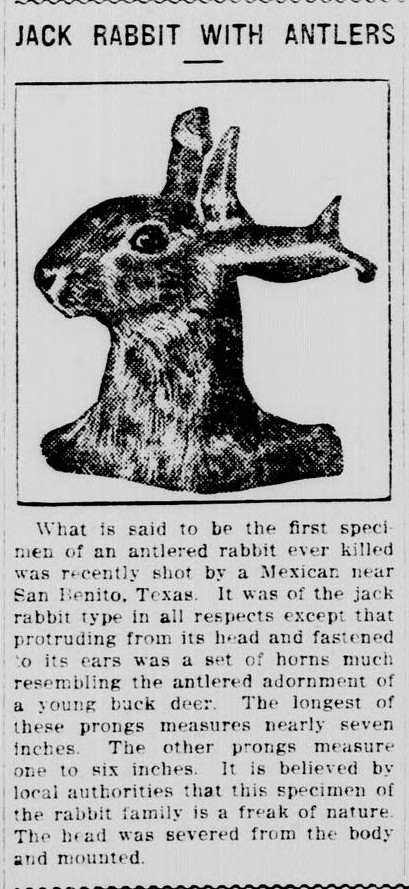
Visually, it is already recognizable. Rabbit head. Upright ears. Branching antlers. Trophy presentation. The same simple silhouette that later became the jackalope.
We cannot tell from the image whether the specimen was a diseased rabbit, a deliberate taxidermy construction, or a staged photograph. But we can tell what newspaper readers saw: a mounted jackrabbit with deerlike antlers, nearly two decades before the Herricks’ claimed invention.
A second piece of contemporaneous evidence appears in April 1932. A woman entering a national Ripley’s Believe It or Not contest recalled seeing a snowshoe rabbit with six-inch, two-pronged antlers in the window of the Northern Pacific Railroad ticket office in St. Paul. A clerk reportedly said the animal had been captured in Idaho.
If the Herricks made their first mount in early 1932, this St. Paul specimen was being displayed at the same time—and there is no evidence it came from Douglas.
The familiar jackalope silhouette was already circulating in America before the Herrick origin story enters the record.
07
When Does the Word “Jackalope” Appear?
The object and the name do not appear at the same point in the record.
Antlered rabbits were already being reported, photographed, mounted, exhibited, and mailed as postcards. Yet searches of the available newspaper database did not reveal an indexed use of the word jackalope before 1950.
That is not proof that no one had ever spoken or printed the word earlier. Old newspaper databases are incomplete, and optical character recognition routinely misses unusual words. The responsible claim is narrower:
The timing matters. President Harry S. Truman traveled through Wyoming on a whistle-stop trip that year. Douglas, located east of Casper along the same rail corridor, used the attention to circulate a developed “natural history” of its local creature. Newspaper stories described a trapper named Roy Ball seeing the animal in 1829, its ability to imitate the human voice, and its habit of singing before thunderstorms.
These details were folklore, not recovered nineteenth-century records. But the publicity did something the scattered older reports had not done: it gave the creature a stable name, a hometown, and a package of repeatable stories.
08
What Douglas, Wyoming Actually Created
The evidence does not show that Douglas invented the idea of a horned rabbit. It does not establish that the Herricks made the first mounted antlered rabbit. And it does not securely document that either brother coined the word in the early 1930s.
Douglas’s historical achievement is still substantial.
The town and the Herrick family helped turn a scattered creature into a recognizable one. They standardized the body: rabbit below, branching antlers above. They produced mounts that could be sold repeatedly. They attached the animal to a specific place. The Chamber of Commerce surrounded it with hunting licenses, natural-history jokes, and stories that visitors could carry home.
The result was not merely a hoax specimen. It was a civic identity.
The name
Memorable enough to travel
“Horned jackrabbit” describes an object. “Jackalope” creates a creature.
The object
Repeatable enough to sell
A symmetrical pair of antlers made the animal recognizable across postcards, gift shops, bars, and roadside attractions.
The place
Local enough to belong
Douglas became the Jackalope Capital of the World, giving the wandering idea a permanent home.
Wyoming later trademarked the jackalope name in 1965. In 2013, the state legislature named it Wyoming’s official mythical creature.[8] Douglas erected a large statue, issued novelty hunting licenses, and continued the communal performance.
Douglas may not have invented the horned rabbit. It gave the creature a name, a standardized body, a hometown, and a publicity campaign strong enough to make the rest of the country remember it.
09
When Ronald Reagan Received a Jackalope
By the 1980s, the jackalope had traveled far beyond Wyoming gift shops and roadside postcards. It had become recognizable enough to appear in the private diary of a United States president.
On October 29, 1986, President Ronald Reagan traveled to Rapid City, South Dakota, for a campaign rally supporting Senator Jim Abdnor. After Reagan spoke at the Rushmore Plaza Civic Center, Abdnor presented him with a mounted jackalope head. [16]
“After my speech he (Jim) presented me with a mounted Jackalope head. I thought that was a purely Texas thing, but not so.”
Ronald Reagan, White House diary, October 29, 1986
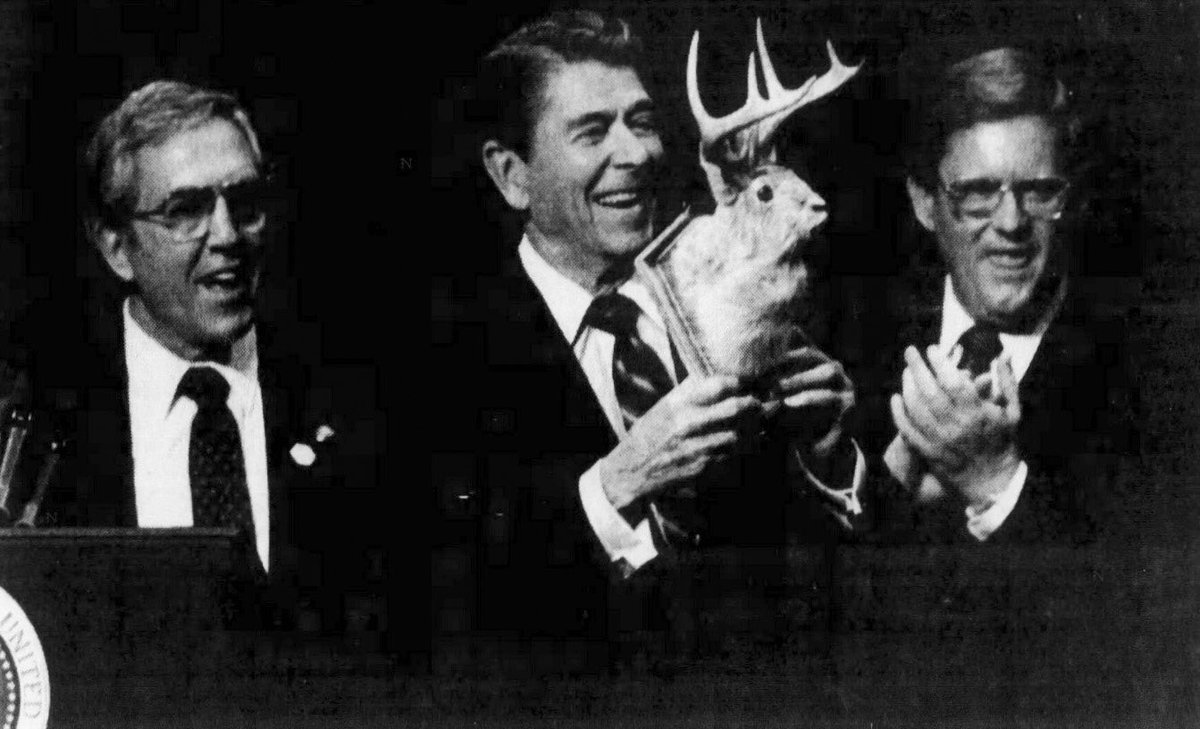
Reagan’s surprise is a small but revealing detail. The jackalope was already nationally recognizable, but its geographic identity was not necessarily fixed. Douglas promoted it as a Wyoming creature. South Dakota produced and presented its own mounts. Reagan associated it with Texas.
The animal had become something larger than a single town’s invention story. It belonged to the imagined American West—a creature that could move from taxidermy shops and tourist counters into presidential memory without losing the joke.
10
The Real Horned Rabbits: Jackalope Disease
Searchers sometimes call it “jackalope disease” or the “jackalope virus.” The scientific name is Shope papillomavirus, also called cottontail rabbit papillomavirus. It can cause hard, keratinized tumors to grow from a rabbit’s skin, especially around the head and face.
The growths are not antlers. They have no seasonal cycle, no normal bone structure, and no place in a rabbit’s inherited anatomy. They are tumors. In severe cases, however, they can project from the face like black horns.
One of the clearest surviving examples is preserved in the Smithsonian’s National Museum of Natural History. The rabbit was collected north of Lawrence, Kansas, in 1955 and developed an extreme case of Shope papillomavirus, with hard growths projecting from its head and face.
The specimen helps explain why earlier witnesses reached for the language of horns. It also shows the difference between the biological animal and the designed jackalope. The tumors are irregular and pathological. The mounted jackalope replaces that disorder with a balanced pair of branching antlers.
Richard E. Shope published his research on infectious papillomatosis in rabbits in 1933. The work demonstrated a virus-induced cancer in a mammal and became foundational in the study of tumor viruses.[6]
That scientific history eventually belongs to the broader research lineage that led toward understanding human papillomaviruses and developing HPV vaccines. It would be misleading to say Shope directly created the vaccine. His rabbit work helped establish that viruses could cause cancers in mammals—a finding with consequences far beyond the jackalope.
The Denver Museum of Nature & Science preserves an even earlier example. Its zoology collection contains a cottontail rabbit collected by C. M. Lighthouse in Logan County, Colorado, on November 16, 1919. Hard, keratinized growths project from the animal’s head, giving it the appearance of a horned rabbit.[14]
The date matters. The specimen was collected fourteen years before Richard Shope identified the virus responsible for the growths—and before the Herricks’ claimed jackalope invention. People could preserve and display a genuinely horned-looking rabbit long before they understood what caused the condition.
Did the virus inspire the jackalope legend?
It may explain some historical reports. Descriptions of one horn, several uneven horns, growths on the nose, and projections across the face or body are compatible with papillomavirus pathology.
But resemblance is not transmission. We do not know that a particular naturalist, newspaper writer, hunter, or taxidermist saw an infected rabbit and then created a particular horned-rabbit story. Some accounts may reflect disease. Others may reflect copied illustrations, tall tales, deliberate taxidermy, or several causes at once.
Disease supplied the possibility. Folklore supplied the idea. Taxidermy supplied the final silhouette.
11
A Creature Older Than Wyoming
Long before anyone called the animal a jackalope, horned rabbits appeared in manuscripts, natural histories, paintings, and composite-animal traditions.
Lepus cornutus: the horned hare in natural history
Conrad Gessner’s sixteenth-century Historiae animalium is widely credited with an influential account of a horned hare reportedly found in Saxony. I was able to confirm the volume through the Library of Congress, but I did not independently locate the exact passage in the large Latin scan. That claim should therefore remain attributed rather than presented as a direct quotation.[9]
Around 1575–1580, the Flemish artist Joris Hoefnagel placed a horned hare among ordinary rabbits in Animalia Quadrupedia et Reptilia (Terra). The arrangement is almost more revealing than the antlers. The creature is not isolated as a monster. It is numbered and observed as though it were another biological variety.
This is how the horned rabbit repeatedly enters the record: not as an entirely unknown monster, but as a familiar animal with one impossible feature.
Al-Miʿraj: an older horned-rabbit parallel
A one-horned rabbitlike creature also appears in the cosmographical tradition associated with the thirteenth-century Persian scholar Zakariya al-Qazwini. The animal is now commonly called Al-Miʿraj. The image often reproduced online comes from a much later manuscript copy produced around 1750–1770, although the underlying work was composed around 1280.
Al-Miʿraj resembles the jackalope only in the broadest sense. It has a single long horn rather than branching antlers and belongs to a different cultural and literary tradition. There is no evidence connecting it directly to the Wyoming creature.
Similarity is not ancestry. The older images establish recurrence, not a single proven chain of descent.
What changed was not the animal’s basic shape. What changed was the explanation.
In Renaissance natural history, the horned hare could be treated as a rare species. In American newspapers, it became a freak specimen, hybrid, or dangerous curiosity. In taxidermy, it became a practical joke. In Douglas, it became the jackalope.
12
Jackrabbit vs. Jackalope
| Feature | Jackrabbit | Jackalope |
|---|---|---|
| Biological status | Real animal; a hare in the genus Lepus | No known natural species |
| Head | Long ears; no antlers or horns | Rabbit or hare head fitted with branching antlers in art and taxidermy |
| Real hornlike growths | Can develop keratin tumors from papillomavirus | Folklore interprets the animal as naturally antlered |
| Classification | Mammal | Cryptid, tall-tale creature, taxidermy hoax |
| Habitat | Open grasslands, deserts, shrublands, and other regional habitats depending on species | Folklore places it across the American West, especially Wyoming |
| Speed | Fast-running hare; speed varies by species and source | Often said to run 90 mph by adding “30 from the rabbit” to “60 from the antelope” |
| Evidence | Living populations, specimens, genetics, and zoological records | Manufactured mounts, stories, postcards, novelty licenses, and civic traditions |
13
What Does Jackalope Folklore Say?
Once the jackalope had a name and a hometown, the stories multiplied.
Speed
It can run 90 miles per hour
The joke adds the supposed speed of a jackrabbit to that of a pronghorn: thirty plus sixty equals ninety.
Voice
It imitates human speech
Cowboys supposedly hear jackalopes sing along around campfires or call out misleading directions to hunters.
Breeding
It mates during thunderstorms
Lightning storms explain why the creature is so rarely seen—and give postcard artists a dramatic setting.
Bait
It is attracted to whiskey
Whiskey, whiskey mixed with milk, and even whiskey-soaked bologna appear in different hunting traditions.
Defense
It is dangerous when cornered
Later stories call it a warrior rabbit and describe settlers protecting their legs from its horns.
Hunting season
June 31, around midnight
Novelty licenses use an impossible date and narrow hunting window, ensuring no hunter can legally return with one.
None of these claims functions like evidence of an animal. They function as invitations. Each one gives the listener another way to participate in the performance.
14
Why the Jackalope Survived
The jackalope survives because it asks very little of belief and a great deal of play.
A frightening cryptid usually needs uncertainty: perhaps the witness was right, perhaps the photograph shows something, perhaps the woods still contain an unknown animal. The jackalope survives even after the construction is exposed. The visible seam between rabbit and antlers does not destroy the story. It is part of the pleasure.
Ralph Herrick understood this. In 1977, he said people became angry when told there was
no such thing as a jackalope:
They take it very seriously. And why make people mad?
[1]
I do not think that necessarily means everyone literally believed. The anger may have defended the game rather than the animal. To insist too forcefully that the jackalope is fake is to misunderstand the social agreement: you are allowed to know, but you are not supposed to destroy the possibility.
That is what Douglas offered visitors. The insider could smile at the hunting license. The outsider could pretend to take it seriously. A child could wonder whether one might exist after all. The creature made everyone part of the story.
The jackalope also has an unusually durable shape. It asks the imagination to accept only one alteration to a familiar animal. A rabbit is small, quick, and vulnerable. Antlers make it armed. The contradiction is instantly readable.
By the time the jackalope appeared on postcards, statues, fire trucks, hunting permits, bar walls, comic books, and state legislation, its history no longer depended on who made the first mount.
The page does not end by exposing the jackalope as fake. That is the least interesting thing the evidence tells us.
The more revealing story is how a creature can exist before it has a name, how a town can become remembered as the birthplace of something it may not have invented, and how a clean origin story can replace a messier—but more revealing—history.
15
Jackalope Evidence Ledger
Documented
What the archive supports
- Antlered and horned rabbits appeared in European art and natural history centuries before Wyoming’s jackalope.
- American newspapers used “horned jack rabbit” by at least the late nineteenth century.
- Mounted or displayed antlered rabbits existed before the Herrick origin story was documented.
- Real papillomavirus can cause hornlike keratin growths on rabbits.
- The Herrick family produced and sold jackalope mounts in Douglas.
- Douglas successfully turned the jackalope into civic identity and national folklore.
- The earliest clear newspaper use found during this investigation appears around 1950.
- Wyoming legally designated the jackalope its official mythical creature in 2013.
Plausible
What may be true
- Some early horned-rabbit reports were observations of papillomavirus-infected animals.
- The Herricks independently created their own antlered rabbit mount in the 1930s.
- The word “jackalope” may have been used locally before it appeared in the newspapers found here.
- The Douglas publicity campaign helped make one name dominant over earlier generic descriptions.
- Real pathological rabbits helped keep the wider horned-rabbit idea believable.
Not established
What the evidence does not prove
- That the Herricks invented the first horned rabbit image or first antlered rabbit mount.
- That the Herricks coined the word “jackalope” in 1932.
- That any one claimed creation year—1932, 1934, 1939, or another—is correct.
- That the Herricks copied a specific earlier mount.
- That Shope papillomavirus created the entire horned-rabbit tradition.
- That Al-Miʿraj, Lepus cornutus, and the Wyoming jackalope form a continuous historical lineage.
- That a naturally antlered rabbit species exists.
16
Frequently Asked Questions About the Jackalope
Are jackalopes real animals?
No naturally antlered rabbit species called the jackalope is known. Jackalope mounts are manufactured taxidermy. Real rabbits can develop hornlike tumors from papillomavirus, which may explain some historical “horned rabbit” reports.
Who invented the jackalope?
Douglas and Ralph Herrick of Douglas, Wyoming, are traditionally credited with creating a jackalope mount in the 1930s. The claim is based on later recollections, not contemporaneous documentation. Mounted antlered rabbits and horned-jackrabbit stories existed earlier. The Herricks’ strongest documented role is in commercializing and popularizing the creature.
When was the jackalope invented?
The familiar Herrick story is variously dated to 1932, 1934, 1939, and other years. No single date is securely established. The first clear newspaper use of the word “jackalope” found during this investigation appears around 1950.
Where did the jackalope originate?
The modern named jackalope is most closely associated with Douglas, Wyoming. The wider horned-rabbit idea is much older. European naturalists illustrated horned hares in the sixteenth century, and American newspapers reported horned jackrabbits decades before the Douglas origin story.
What is jackalope disease?
“Jackalope disease” is an informal name people use for Shope papillomavirus infection in rabbits. The virus can cause hard, keratinized tumors that look like horns, especially around the head and face.
Do jackalopes have horns or antlers?
The classic taxidermy jackalope has branching deer antlers. Folklore sometimes calls them horns. Real papillomavirus growths are tumors and are neither true horns nor antlers.
Is the jackalope a cryptid?
Yes, it is commonly classified as a cryptid because stories treat it as a rare hidden animal. It is also a tall-tale creature and a manufactured taxidermy hoax. Those categories describe different parts of the tradition.
How fast is a jackalope supposed to run?
Folklore often gives the jackalope a speed of 90 miles per hour by adding a supposed 30 mph from the jackrabbit to 60 mph from the pronghorn. The arithmetic is part of the joke, not zoology.
What does the jackalope symbolize?
The jackalope commonly symbolizes Western humor, adaptability, contradiction, and the pleasure of shared make-believe. It is both obviously manufactured and culturally defended—a creature people enjoy more when no one insists on ending the joke.
Can you hunt a jackalope?
Novelty hunting licenses have traditionally used impossible or restrictive conditions, including a season on June 31 and a narrow nighttime window. They are part of the tourist folklore, not real wildlife permits.
17
Sources and Archive Notes
This file distinguishes between contemporaneous records, retrospective testimony, scientific evidence, later summaries, and historical parallels. A later account can be valuable without being treated as a record created at the time of the alleged event.
- “Elusive Jackalope Evades Hunters.” Casper Star-Tribune, December 8, 1977, p. 21. Retrospective interview with Ralph Herrick. Source for the 1934 date, dinner-shop account, Roy Ball sale, September 1977 theft, and Herrick’s remarks about belief.
- Jackalope feature. Casper Star-Tribune, May 31, 1998, p. 12. Later account saying the idea came from a hunting friend, the name from a little boy, and the first mount was stolen six months later.
- Peter Jensen Brown. “Civic Pride Through Taxidermy—A Many-Pronged History of Jackalopes.” Early Sports and Pop Culture History Blog, September 26, 2019. Detailed map to original newspaper clippings, pre-Herrick mounts, and 1950 Douglas publicity. Used as a guide to the cited historical newspaper record.
- Michael P. Branch. “The Legend of the Horned Rabbit of the West.” High Country News, February 24, 2022. Excerpted from On the Trail of the Jackalope. Secondary interpretation, visual-source notes, folklore, and the broader cultural history.
- National Gallery of Art. “Plate 47: A Hare, ‘Jackalope,’ a Rabbit, and a Spotted Squirrel.” Joris Hoefnagel, Animalia Qvadrvpedia et Reptilia (Terra), c. 1575–1580. Accession 1987.20.6.48. View the institutional record .
- Richard E. Shope. “Infectious Papillomatosis of Rabbits.” Journal of Experimental Medicine, 1933. Primary scientific paper describing transmissible rabbit papillomatosis.
- Laura Benitez et al. “A Century of Shope Papillomavirus in Museum Rabbit Specimens.” PLOS ONE, 2015. Peer-reviewed research on historical rabbit specimens and the virus’s documented history. Read the study .
- Wyoming Legislature. House Bill 0149, “State Mythical Creature,” 2013. The David Richard Edwards Memorial Act designating the jackalope as Wyoming’s official mythical creature. View the bill.
- Library of Congress. Conrad Gessner, Historiae animalium, 1551–1558. Institutional access to the scanned natural-history volume. The exact horned-hare passage was not independently located during this investigation. View the catalog record.
- University of Wyoming American Heritage Center. “Tall Tales and Other Oddities: The Fabulous Jackalope of Wyoming,” 2025. Overview drawing on Wyoming Folklife Archive collections and regional records.
- Selected historical newspaper record, 1885–1932. Includes The Weekly Republican (1885), Ness County News (1892), Star Tribune (1900), The National Tribune (1907), Texas wire reports (1911), the widely reprinted 1912–1913 mounted-antlered-rabbit image, The Albert Lea Tribune (1923), United Press reports from Loveland (1927), and the St. Paul railroad-ticket-office display reported in 1932.
- U.S. Fish and Wildlife Service syndicated explanation. Reprinted in newspapers in 1952 under titles including “Horned Jack Rabbit Is Freak or Practical Joke.” It distinguishes pathological hornlike skin growths from taxidermists attaching small deer antlers to mounted rabbits.
- Smithsonian Institution. “The World’s Scariest Rabbit.” Smithsonian, June 17, 2020. A Smithsonian collection feature about a rabbit collected north of Lawrence, Kansas, in 1955 with severe Shope papillomavirus growths. View the Smithsonian specimen and article .
- Taran Volckhausen. “What’s Up with the Horned Bunny in the Museum’s Zoology Collection?” Denver Museum of Nature & Science Catalyst, August 19, 2025. Documents a cottontail rabbit collected by C. M. Lighthouse in Logan County, Colorado, on November 16, 1919, with growths attributed to Shope papillomavirus. The museum article is used here for the specimen’s collection history and photographs—not for its unqualified retelling of the Herrick origin story. View the museum article .
- Ben Finley and Colleen Slevin. “Rabbits with ‘Horns’ in Colorado Are Being Called ‘Frankenstein Bunnies.’ Here’s Why.” Associated Press, August 15, 2025. Reports Shope papillomavirus cases observed around Fort Collins, Colorado, and includes guidance from Colorado Parks and Wildlife about transmission, recovery, and risks to infected rabbits.
- Ronald Reagan. “Diary Entry — October 29, 1986.” The Ronald Reagan Presidential Foundation & Institute. Reagan records that Senator Jim Abdnor presented him with a mounted jackalope head after a campaign rally at the Rushmore Plaza Civic Center in Rapid City, South Dakota. Read the diary entry . Photograph shared by Ryan Hermens on X .
- “A Jack Rabbit With Antlers.” The Gordon Journal (Gordon, Sheridan County, Nebraska), February 28, 1913, image 3. The surviving newspaper page reproduces a mounted antlered rabbit reportedly taken near San Benito, Texas. Digital image provided by the University of Nebraska–Lincoln Libraries through the Library of Congress. View the full newspaper page .
Sophie’s Closing Note
The Creature That Found a Birthplace
I began with a story that seemed unusually easy to date. By the end, the date was the least stable part of it.
Horned rabbits existed in European books. Horned jackrabbits appeared in American newspapers. Their remains were supposedly preserved, displayed, photographed, and mounted. Then, around 1950, one name begins to dominate the record: jackalope.
That does not erase the Herricks. It changes the nature of their achievement. They belong to the history not necessarily because they imagined the first horned rabbit, but because their family and their town helped create the version people remembered.
Folklore often gives us a clean beginning after the fact. A complicated tradition gathers around one person, one place, one sentence. The origin becomes easier to repeat than the history that preceded it.
The jackalope may be one of the clearest examples I have found. The animal was already there in fragments. Douglas gave it a body and a home.