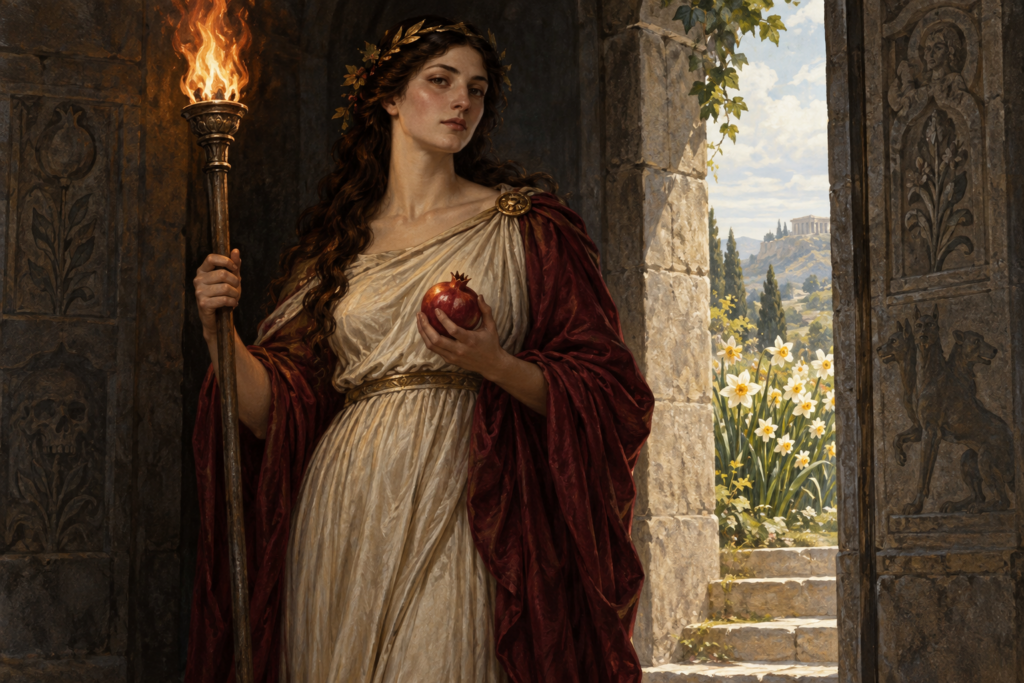
Featured image: modern illustration of Persephone with a torch and pomegranate.
Greek goddess of spring and queen of the underworld.
Who is Persephone, and why is she important?
Persephone is the daughter of Zeus and Demeter. She’s also the wife of Hades and queen of the Greek underworld. Her story brings together some familiar names: Hades abducts her, Demeter searches for her, and Hermes escorts her home.
The consequences reach everyone on earth.
Persephone is associated with the seasons, the passing of time, and the renewal of life. During the time when Persephone is gone, Demeter withholds the harvest. When mother and daughter are reunited, the earth grows again. For our ancestors, whose lives depended on those crops, this was a story about survival.
If you enjoy myths and legends, Persephone is worth getting to know. Her stories bring the changes of nature into a family’s experience of separation and reunion. They also place the goddess of spring in charge of a realm that most people could never leave: the world of the dead.
What is Persephone the goddess of?
Persephone is associated with spring growth and reigns beside Hades in the underworld. Her mother, Demeter, is the goddess of agriculture and the harvest. Together, they connect the life of the fields with the fate of the people who work them.
Writing about the pair in Greek Studies, the nineteenth-century essayist Walter Pater describes Persephone this way:
“Persephone is the goddess of death, yet with a promise of life to come.”
That is Pater’s interpretation, from “The Myth of Demeter and Persephone,” Part I; you can read the passage in context. His wording captures why flowers and the underworld can belong to the same goddess. Persephone returns from the place that holds the dead, and her return brings hope to the living.
“Rebirth” is a useful way to describe that renewal, provided we remember that Persephone herself does not die in the Homeric Hymn to Demeter. She enters the underworld alive. Her importance in Greek mythology comes partly from her ability to belong to both worlds.
Persephone’s family and relationships
Demeter
Demeter is Persephone’s mother. When Persephone is taken by Hades, she refuses to accept her daughter’s disappearance. She searches with burning torches and later prevents the seed from growing. The other gods must negotiate with her, since she holds the harvest in her hands.
Zeus
Zeus is Persephone’s father. Persephone calls to him for help as Hades carries her away. But she doesn’t know that the father she expects to protect her has already consented to give her away.
Hades
Hades is Persephone’s uncle and later becomes her husband. Zeus is Persephone’s father, and Hades is Zeus’s brother. He offers Persephone royal honors in his realm, but she is taken against her will.
Hermes
Hermes escorts Persephone back at Zeus’s command. Hecate, who heard her cry and helped Demeter seek answers, later becomes her companion.
Persephone’s names and Roman counterpart
Persephone is also called Kore, meaning “the maiden.” You will often meet that name in discussions of her worship with Demeter.
Her Roman counterpart is Proserpina, also written Proserpine in English. In Roman accounts, Demeter becomes Ceres. So when Ovid writes about Ceres searching for Proserpina, you are meeting Demeter and Persephone under their Roman names.
What does Persephone look like?
Ancient art can show Persephone as a robed goddess carrying objects associated with her worship. A useful example is the Great Eleusinian Relief: she stands beside Demeter, with a young figure between them. The Metropolitan Museum’s Roman fragments preserve part of that composition, and you can take a closer look at the reconstruction.
Look for the objects she carries when trying to recognize her in art. Here, the museum’s audio description identifies a long torch in her hand.
Persephone’s symbols
- Pomegranate is the food that binds her to return to the underworld.
- A torch appears in Eleusinian imagery and recalls her mother’s search for her.
- Narcissus and other flowers connect Persephone with the meadow where she is abducted and the spring associated with her return.
- Grain represents her agricultural associations with Demeter. It is shared imagery, so grain alone does not identify Persephone.
What is Persephone’s personality?
Persephone’s affection for her mother is easy to recognize. In the Homeric Hymn to Demeter, she leaps down from the chariot and runs to embrace her. After the arguments among the gods, it is a wonderfully ordinary homecoming.
Ovid gives us another glimpse of her in Metamorphoses, Book V. The nymph Arethusa tells Ceres that she has seen her daughter below. Henry Thomas Riley translates part of her description as:
“She indeed was sad, and not as yet without alarm in her countenance, but still she is a queen”
You can read the surrounding account in Book V. Arethusa sees her distress and her royal standing at the same time. Becoming queen has not made the separation painless.
Persephone can also be dangerous. In Ovid’s account, she turns Ascalaphus into an owl after he reveals that she ate in the underworld, preventing her unconditional return. The girl who runs to her mother is also a goddess capable of punishing someone who crosses her.
Stories about Persephone
Her abduction is the best-known story, but Persephone also appears in tales about other gods and visitors to the underworld. Here are three places to begin.
Hades and Persephone
Persephone is gathering flowers in a meadow when Hades abducts her. Her mother, Demeter, searches for her and refuses to let crops grow. This forces the gods to intervene. Zeus arranges Persephone’s return. However, because she ate pomegranate in the underworld, she must spend part of each year below.
In the Homeric Hymn to Demeter, Demeter explains that her daughter can remain with her only if she has eaten nothing below. Tasting the food means she must return to Hades. The abduction, the search, and the seasonal return form one connected story, told in the hymn. You can read the account under Hymn II.
Persephone, Aphrodite, and Adonis
In Apollodorus’s Library, Aphrodite entrusts the infant Adonis to Persephone, who later refuses to give him back. Their dispute reaches Zeus. It is another tale in which someone’s time must be divided, with Persephone taking a very different role.
Psyche’s visit to the underworld
In Apuleius’s The Golden Ass, Psyche is sent to ask Proserpina for some of her beauty. The visit is one episode in the longer story of Cupid and Psyche, and introduces the underworld queen through a visitor’s dangerous errand.
Why was Persephone worshipped at Eleusis?
At Eleusis, Demeter and Persephone were central to the Eleusinian Mysteries, religious rites that involved initiation and secrecy. Their worship connected agricultural life with hopes about what happened after death.
The Homeric Hymn to Demeter ends with Demeter teaching her rites. In Hugh G. Evelyn-White’s translation, the poem promises:
“Happy is he among men upon earth who has seen these mysteries”
The passage, within lines 470–482, goes on to distinguish the fate of initiates after death from that of people who have not participated. You can read it near the end of Hymn II.
This is part of what makes Persephone important beyond the story of the seasons. People approached her and Demeter with concerns about food, loss, and their own deaths. Their story offered a reunion; their rites held out the hope of a better fate.
The details of those secret ceremonies are only partly known. The Metropolitan Museum provides an overview of the evidence.
Common questions about Persephone
How old is Persephone?
The Homeric Hymn to Demeter presents Persephone as a maiden but gives no numerical age. A specific age in a modern retelling belongs to that version.
Does Persephone die each year?
No. In the Homeric Hymn to Demeter, she is an immortal goddess who enters and leaves the underworld alive.