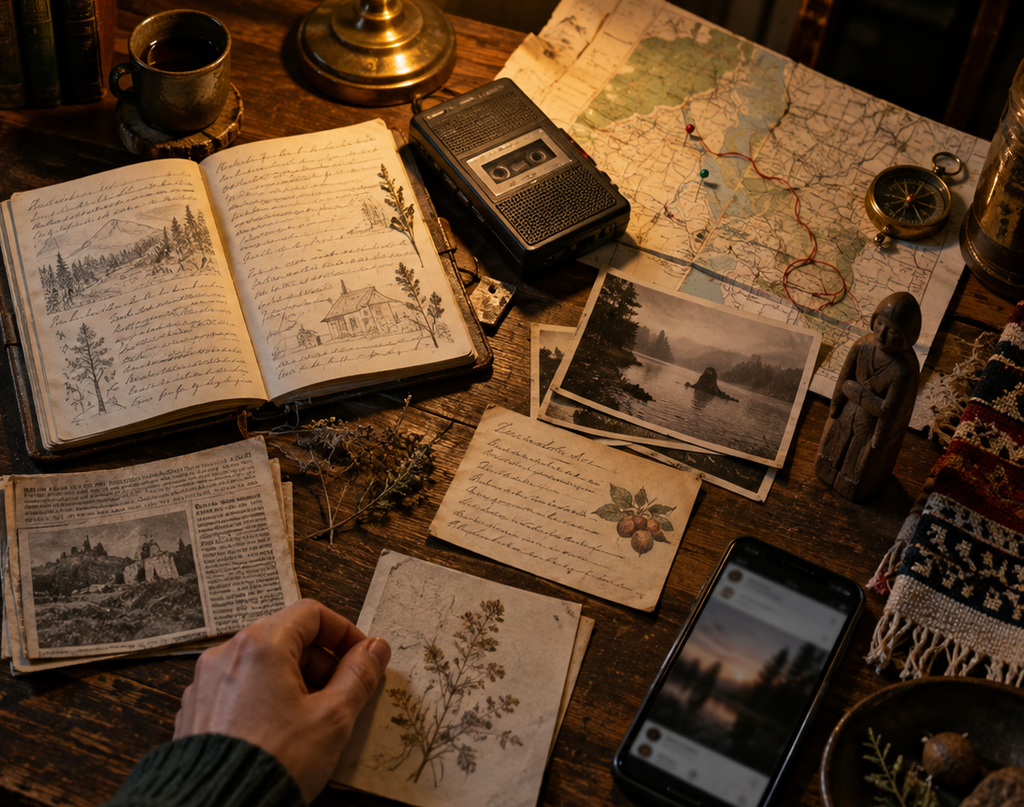
Folklore is the shared stories, beliefs, customs, knowledge, art, and practices passed among members of a group.
People learn it from one another through conversation, imitation, performance, tradition, and the internet. Folklore can include:
- Myths
- Legends
- Fairy tales
- Jokes
- Songs
- Dances
- Festivals
- Family recipes
- Healing practices
- Supernatural beliefs
- Rumors
- Memes
- Traditions
In this field guide
- What does folklore mean?
- Where did the word come from?
- Types of folklore
- Examples of folklore
- Folklore, mythology, legends, and fairy tales
- How folklore spreads and changes
- Is folklore true?
- Why folklore matters
- How folklorists study folklore
Meaning
The word folklore can refer to both the traditions people share and the field that studies those traditions.
The American Folklore Society describes folklore as the art, stories, knowledge, and practices of a people. That definition reaches far beyond folktales.
Folklore can be something people:
- Say — legends, jokes, riddles, proverbs, rumors, and personal stories
- Do — rituals, dances, games, celebrations, and workplace traditions
- Make — quilts, carvings, costumes, food, shrines, and traditional crafts
- Believe — supernatural explanations, omens, healing traditions, and ideas about luck
- Know — local weather signs, family recipes, occupational skills, and community knowledge
A tradition does not need to be ancient to become folklore.
A joke shared among nurses, a ritual performed before a baseball game, or a meme repeatedly altered online can all function as folklore.
“The folk should be put back into folklore.” It “represents a people’s image of themselves.”
—Alan Dundes, Interpreting Folklore (1980), p. viii
Where did the word folklore come from?
English writer and antiquarian William J. Thoms introduced the term folk-lore in 1846.
Before that, scholars used phrases such as “popular antiquities” to describe traditional tales, customs, and beliefs. They recorded ballads, rural customs, supernatural beliefs, and stories carried through oral tradition.
Then the field changed.
The American Folklore Society was founded in 1888. Over time, folklorists increasingly studied living communities rather than treating tradition as a relic from the past.
Today, folklore may be found in a village, a classroom, a church, a factory, a family group chat, a gaming community, or a social-media feed.
Sophie’s field note: Folklore does not disappear when people get smartphones. It follows them there.
Types of folklore
Folklore is often divided into several overlapping forms.
| Type | What it includes | Examples |
|---|---|---|
| Oral folklore | Traditions primarily shared through speech or performance | Legends, folktales, jokes, riddles, proverbs, songs |
| Customary folklore | Repeated social practices and rituals | Holiday customs, initiations, games, wedding traditions |
| Material folklore | Objects and skills created within a tradition | Quilts, foodways, architecture, carvings, costumes |
| Belief folklore | Shared ideas about unseen forces, luck, danger, and protection | Ghost beliefs, omens, charms, taboos, supernatural creatures |
| Occupational folklore | Traditions shared within a profession or workplace | Jargon, cautionary stories, pranks, rituals, insider knowledge |
| Digital folklore | Traditions circulated and transformed through technology | Memes, creepypasta, chain messages, viral challenges |
These categories are useful, but folklore rarely stays inside one box.
A ghost story may be told aloud, attached to a real location, reenacted during a local festival, and turned into a viral video. It remains one tradition moving through several forms.
Examples of folklore
Folklore appears wherever a group shares something informally and gives it meaning.
Examples include:
- Stingy Jack and the stories used to explain the jack-o’-lantern
- La Llorona, whose story changes across regions and generations
- Baba Yaga, the ancient Russian witch
- Bigfoot
- Wedding customs passed through families
- Games children play on the playground
- Home remedies
- Ghost stories
- Internet memes
The subject does not need to be supernatural.
A recipe can be folklore. So can a nickname, an office prank, a graduation ritual, or the “correct” way a family decorates for a holiday.
Folklore, mythology, legends, and fairy tales
These terms overlap, but they do not mean the same thing.
| Term | Basic meaning | Relationship to belief |
|---|---|---|
| Folklore | The broad field of shared traditions, stories, beliefs, knowledge, and practices | May be believed, doubted, performed, joked about, or simply repeated |
| Myth | A traditional sacred or foundational narrative about gods, origins, or the structure of the world | Often connected to a religious or cultural worldview |
| Legend | A story presented as connected to real people, places, or historical events | Usually told as possibly true |
| Urban legend | A modern legend circulated as a true or plausible event | Often supported by alleged witnesses or “a friend of a friend” |
| Fairy tale | A traditional wonder tale involving magical events, transformations, or impossible beings | Usually told as fiction rather than recent history |
| Folktale | A traditional narrative passed through a community | Often told for entertainment, instruction, or cultural memory |
Folklore is the umbrella. Myths, legends, urban legends, fairy tales, and folktales can all exist under that umbrella.
The categories are not perfect. A story may be sacred in one community, entertainment in another, and a tourist attraction somewhere else.
Stories that spread and change
Folklore survives through repetition. But that repetition often changes the story.
People shorten stories, add local names, change the setting, remove details, and emphasize the parts that matter to their audience.
Folklorists call these different tellings variants.
A variant is not necessarily a corrupted version of an original. It’s just one of the ways folklore lives on as the story spreads and changes.
Folklore is “always changing, and yet ever the same.”
—Simon J. Bronner, introduction to The Meaning of Folklore (2007), p. viii
A story changes because:
- A teller forgets part of it.
- A new location makes the story feel closer.
- The audience needs a different warning.
- New technology changes how the event could happen.
- A frightening story becomes a joke—or a joke becomes frightening.
The internet accelerates this process. It does not replace folklore’s older mechanisms.
Is folklore true?
Sometimes.
Folklore may preserve memories of real events, practical knowledge, historical conditions, or places that can still be identified.
It may also contain exaggeration, supernatural interpretation, mistaken memory, or details added long after the event.
The better question is often not simply, “Did this happen?”
We can also ask:
- Who tells the story?
- Where’d they hear it?
- Which details remain the same?
- What changes in different versions?
- Why does the story continue to matter?
A legend does not need to be factually accurate to reveal a real fear, conflict, memory, or value.
That does not mean every claim should be accepted as evidence. It means the existence of the story is evidence of something—even when the monster is not.
Why folklore matters
Folklore helps groups remember who they are. It can
- Preserve local knowledge
- Teach acceptable behavior
- Warn against danger
- Challenge authority
- Explain the unknown
- Express shared experience
Folklore is “one of the principal means by which an individual and a group discovers or establishes his or its identity.”
—Alan Dundes, Folklore Matters (1989), p. 51
Folklore is not automatically wise because it is traditional. All too often, folklore spreads prejudice, panic, and misinformation.
Studying it requires attention to who benefits from a story, who is harmed by it, and whose version has been preserved.
That tension is part of what makes folklore worth investigating.
How folklorists study folklore
Folklorists study traditions in context.
They may record interviews, compare story variants, observe rituals, examine archives, study objects, or spend time with the communities whose traditions they are documenting.
The goal is not merely to collect a story.
Folklorists also ask how the story is performed, what it means to the people telling it, and what changes when it moves into a new setting.
Filed by Sophie Vale: The oldest version is not always the origin. It is the oldest trace we have found so far.
Frequently asked questions
What is a simple definition of folklore?
Folklore is the traditional stories, beliefs, customs, knowledge, art, and practices shared by a group of people.
What are the main types of folklore?
Common categories include oral folklore, customary folklore, material folklore, belief traditions, occupational folklore, and digital folklore.
Is folklore the same as mythology?
No. Mythology is one part of folklore. Folklore also includes legends, fairy tales, jokes, crafts, customs, foodways, music, rituals, and everyday traditions.
Are urban legends folklore?
Yes. Urban legends are modern legends shared as true or plausible accounts. They are one of folklore’s most active contemporary forms.
Does folklore have to be old?
No. New folklore develops whenever a group begins sharing and repeating stories, customs, jokes, beliefs, or creative practices.
Explore the Archive
- What Is an Urban Legend?
- Types of Urban Legends
- List of Urban Legends
- Folklore, Mythology, and Legend Glossary
- Folklorists
- Mythologists
Last reviewed: September 2026.
Sources and further reading
- American Folklore Society, “What Is Folklore?”
- The Ohio State University Center for Folklore Studies, “About Folklore”
- Dan Ben-Amos, “Toward a Definition of Folklore in Context,” Journal of American Folklore 84, no. 331 (1971): 3–15.
- Alan Dundes, ed., The Study of Folklore (Prentice-Hall, 1965).
- Alan Dundes, Interpreting Folklore (Indiana University Press, 1980).
- Alan Dundes, Folklore Matters (University of Tennessee Press, 1989).
- Alan Dundes, The Meaning of Folklore: The Analytical Essays of Alan Dundes, edited and introduced by Simon J. Bronner (Utah State University Press, 2007).
- Jan Harold Brunvand, The Study of American Folklore: An Introduction, 4th ed. (W. W. Norton, 1998).