Monster File · Werewolf
Werewolf
History Behind the Legend
Most of the rules people associate with werewolves came together relatively recently. The oldest accounts do not mention an infectious bite or a silver bullet, and their transformations were not controlled by the full moon. What they describe is often much stranger.


Case Identification
Quick Facts
01
What is a werewolf?
A werewolf is a human being who becomes a wolf—or something caught between human and wolf. That definition is about as far as the stories agree. The change may be chosen, inherited, inflicted, or imposed as punishment. It may require a wolf skin, a salve, a belt, a forbidden meal, or nothing more than belonging to the wrong family. The bite belongs mostly to modern fiction. So does the hulking, half-human body we now recognize on sight. Many older werewolves looked like wolves. The troubling part was what might still be thinking behind the animal’s eyes.
02
The earliest accounts of werewolves
Long before the word werewolf appeared in English, Greek and Roman writers were collecting stories about people who became wolves. They did not always believe them. Fortunately for us, disbelief did not stop them from writing the stories down.
The Neuri in Herodotus
In the fifth century BCE, Herodotus wrote about a people called the Neuri. Their Scythian neighbors—and Greeks living in Scythia—said that every Neurian became a wolf for several days each year, then changed back. Herodotus was not persuaded. He included the claim, then told his readers he did not believe it. This is evidence that a story was circulating in the fifth century BCE, not a record of what the Neuri said about themselves.
Lycaon and the name lycanthropy
The change comes quickly in Ovid’s Metamorphoses. King Lycaon tries to deceive Jupiter with a meal containing human flesh. He flees into the countryside, attempts to speak, and howls instead. His clothes become hair. His arms become legs. The savagery already visible in his face remains there. Ovid completed the poem around 8 CE, but the story he used was older. Lycaon is not bitten, and moonlight does not force the change. His wolf shape reveals the nature Jupiter believes was there all along. His name, built from the Greek word for wolf, also gave us lycanthropy.
Pliny’s lake-crossing werewolf
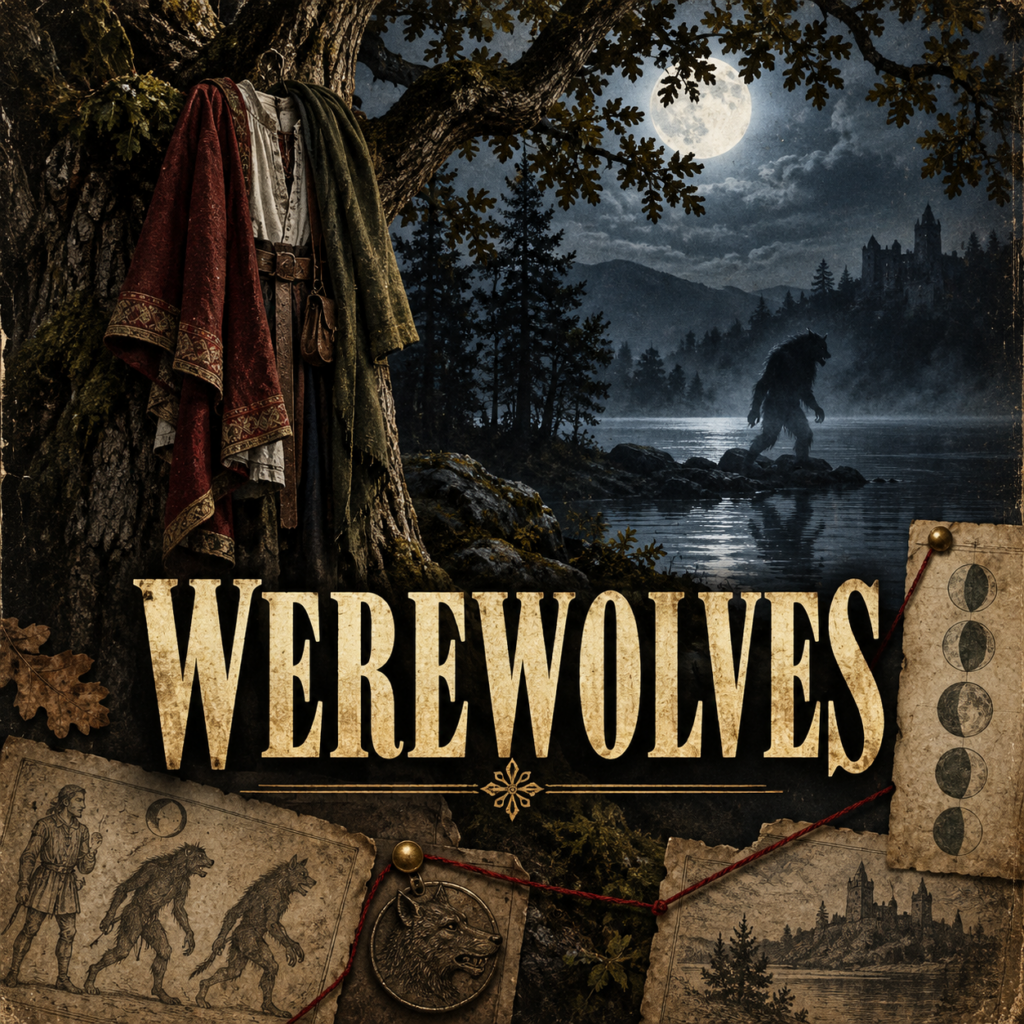
Pliny the Elder opens his werewolf discussion by saying, plainly, that people turning into wolves and back again is a lie. Then he devotes a chapter of Natural History to the subject. The best story he preserves comes from the Greek writer Euanthes. The family of Anthus selected one of its members by lot. The chosen person went to an Arcadian lake, stripped, hung his clothes on an oak, and swam across. On the other side he became a wolf and joined a pack. If he went nine years without tasting human flesh, he could return to the lake, swim back, and dress again. He would be human—although nine years older. Pliny adds another Arcadian tale.
Pliny records another story about an Arcadian named Demaenetus. After eating the entrails of a boy sacrificed to Lycaean Jupiter, Demaenetus was said to have become a wolf. Ten years later, he changed back into a man and went on to win a boxing contest at the Olympic Games.
Pliny didn’t believe the story. In fact, he introduced the subject by saying that tales of people becoming wolves should be considered false. He recorded this one anyway, apparently because it was already well known by the time he encountered it.
The soldier in Petronius The werewolf in Petronius’s Satyricon appears in a story told over dinner. The narrator, Niceros, insists that he is not joking. He once set out at night with a soldier. Among the tombstones beside the road, the soldier stopped to undress. He urinated in a circle around his clothes—and turned into a wolf. Niceros ran to a friend’s farm, where he learned that a wolf had just attacked the animals and been stabbed through the neck. When he later found the soldier in bed, a doctor was treating the same wound. Petronius calls the man a versipellis: a turnskin, or skin-changer. The shared wound became one of folklore’s most durable pieces of evidence. Wound the animal. Then see which neighbor begins to limp.
03
Medieval werewolves were sometimes heroes
Most information about werewolves focuses on dangerous ones, but medieval literature was more nuanced.
Bisclavret
In Marie de France’s twelfth-century Bisclavret, a Breton nobleman becomes a wolf for three days every week. He must remove his clothes before transforming, and he cannot become human again without recovering them. His wife discovers the secret, has his clothing stolen, and marries another man.
The werewolf eventually reaches the king’s court. He behaves so intelligently and gently toward the king that he is treated as a favored animal. His aggression is directed specifically toward the wife and knight who betrayed him. Once the truth is discovered and his clothes are returned, he regains his human form.
William of Palerne
There’s also the medieval romance William of Palerne. Its werewolf, Alphonsus, was enchanted by his stepmother. He rescues an infant prince, feeds him, protects two lovers, and helps restore the rightful political order.
These works show that the tragic or sympathetic werewolf existed in medieval fiction long before modern horror movies. Medieval storytellers had already imagined the werewolf as:
- Betrayed
- Enchanted against his will
- Morally intelligent while transformed
- Protective of human beings
- More honorable than the people around him
The Priest and the Werewolves of Ossory
Gerald of Wales included this story in his Topographia Hibernica, written around 1188. Unlike Bisclavret and William of Palerne, Gerald presented it as an account that had been reported to him.
A priest traveling from Ulster toward Meath spends the night in a forest. A wolf approaches the fire and speaks to him.
The wolf explains that he and his wife are people from Ossory. Because of a curse, two members of their community must live as wolves for seven years. If they survive, they become human again and another pair takes their place.
The female wolf is dying and wants Communion. To convince the priest that she is human, the male wolf uses his claw to peel her wolf skin away from her head and upper body. Beneath it, the priest sees an old woman. He administers the sacrament, and the wolf carefully replaces the skin.
The account was apparently considered serious enough that a gathering of bishops and abbots discussed it and sent the priest to Rome. Summers reproduces Gerald’s discussion of whether killing such a creature would count as killing a human.
This story is more than a simple monster story. It gives the reader:
- A medieval werewolf who can speak and reason
- Transformation as communal punishment
- A seven-year cycle rather than a monthly one
- Wolf skin behaving almost like clothing
- A theological problem
Frank’s dissertation describes a transition from the courtly werewolves of medieval literature to the peasant werewolves of early-modern trials.
This gives us a compelling progression:
- The medieval werewolf could be noble, rational, and protective.
- The early-modern accused werewolf was increasingly connected with peasants, witchcraft, criminality, and the Devil.
- The cinematic werewolf became a tragic middle-class victim infected by another creature.
That is more than a collection of stories. It shows the monster changing social identities. A literal transformation over time.
Franck also notes that applying the English word “werewolf” to Guillaume de Palerne can conceal its original context. The title William and the Werewolf belongs to later English presentation; it is not a literal title of the French romance.
04
When werewolves entered the courtroom
By the sixteenth century, the werewolf was no longer confined to stories. It had entered the courtroom. Gilles Garnier was convicted in Franche-Comté in the 1570s, accused of killing children while in the shape of a wolf. Peter Stumpp—the Werewolf of Bedburg—was executed near Cologne in 1589 after accusations of murder, cannibalism, incest, and sorcery. Much of what English readers know about Stumpp comes from a pamphlet published in London in 1590. The title page identifies it as a translation of a German account printed in Cologne and brought to England by a messenger named George Bores. No copy of the German publication is known to survive. The English pamphlet was written after Stumpp’s execution and appears to have been intended as a warning to its readers rather than as a complete record of his trial. Its werewolf is spectacular. The Devil gives Stumpp a girdle that transforms him into a wolf with fiery eyes, a huge mouth, and paws armed with claws. Yet the same pamphlet admits that Stumpp was placed on the rack and confessed out of fear of torture. The marvelous girdle conveniently vanished before anyone could find it. The pamphlet is still a valuable record of how Stumpp’s execution was presented to the public. It shows that readers were expected to accept the Devil’s involvement and the story of the missing girdle. But it was written to describe Stumpp as a monster, not to investigate the accusations against him. There is no surviving trial transcript with which to compare it, and the pamphlet cannot confirm that he committed all the crimes it describes. Jean Grenier’s case ended differently. He was thirteen years old when he went on trial in France in 1603, claiming that he had become a wolf and attacked children. The Parlement of Bordeaux overturned his death sentence. Grenier was confined to a religious house instead, with the court taking his age and mental condition into account. This was not modern psychiatry arriving three centuries early. Belief in werewolves survived the decision. But, for once, a court looked at the person inside the accusation and hesitated.
05
Transformation methods were even stranger than you might think
There is a remarkable assortment of reported methods for becoming a werewolf.
This is far richer than the generic reference to “magic” we get so often these days, especially in movies.
The strangest examples here—and my personal favorites—are the wolf’s footprint, rolling naked in sand, and returning to human form by rolling in dew.
A person might become a wolf by:
- Drinking enchanted ale while words were spoken over it
- Wearing a belt made from wolf skin
- Wearing a three-finger-wide belt made from the skin of an executed criminal
- Putting on an entire wolf pelt
- Rubbing the body with ointment before donning the skin
- Rolling naked in sand for an extended time
- Drinking water collected from a wolf’s footprint
- Eating a wolf’s brain or flesh
- Drinking from a haunted stream or pool
- Wearing or smelling a “lycanthropic flower”
- Chewing a particular herb
Returning to human form could require:
- Removing the belt or skin
- Rolling in morning dew
- Washing in running water
- Diving back into the same pool
- Being wounded while in wolf form
- Having part of the wolf body cut off
The way a person becomes the wolf changes with the circumstances. In a story about sacrilege, the wolf was punishment. In a witch trial, the belt or ointment became evidence of sorcery. Modern horror preferred the bite. It lets the victim escape one monster while carrying the next one home.
06
Not every werewolf was violent
Portuguese folklore included the lobis-homem. Summers describes one southern tradition in which the afflicted person went to a place where four roads met, spun around five times, fell to the ground howling, and rose as a wolf.
The werewolf here was described as frightened and secretive. Glimpsing a lantern might send it running into the darkness. It might howl or sob until the residents extinguished their light.
One small physical detail is wonderful: the Portuguese werewolf was sometimes said to have a short tail covered with yellow fur.
This gives us a striking counterexample to the “ravenous monster.” Some traditions treated the werewolf as a cursed and miserable person trying to avoid discovery.
07
The werewolf was connected with outlawry
Summers traces an old linguistic and legal relationship between wolves and people expelled from society.
He cites the expression wargus esto—essentially “become a wolf”—as language applied to an outlaw who could be hunted and killed like a wild animal. English literature also used “wolf’s-head” for someone declared outside the protection of the law.
This is potentially excellent for the “Why the legend survives” material. The werewolf was not only a transformed body. It could represent a person who had crossed the boundary separating human society from the wilderness.
However, I should verify Summers’s legal sources before using this as a firm historical claim.
08
The moon existed before Hollywood
Summers’s book added useful nuance to my full-moon theory.
My first belief was that the moon is absent from the earliest accounts, and that seems to remain correct. Lycaon, the Neuri, Petronius’s soldier, and Pliny’s Arcadians do not follow the modern monthly schedule.
However, lunar transformation does appear before cinema:
- Gervase of Tilbury wrote around 1212 that people in England changed into wolves “during lunations.”
- Summers describes Greek traditions involving moonlit nights.
- A nineteenth-century Périgord tradition had young men transforming at each full moon.
- Some Portuguese traditions made moonlight an important part of the transformation.
- Jean Grenier claimed that his group hunted during the waning moon rather than exclusively under a full moon.
These claims come from Summers’s survey and still need to be checked against the sources he cites.
De Blécourt says writers commonly cite Petronius and Gervase of Tilbury as evidence for an old full-moon rule, but neither source establishes one:
- Petronius says the moon was shining brightly. He does not identify its phase or say it caused the transformation.
- Gervase refers to people transforming during “lunations”—plural phases or lunar periods—not specifically at the full moon.
The modern werewolf rules have a more precise film history
The film Werewolf of London appeared in 1935. Universal released The Wolf Man in 1941 from a screenplay by Curt Siodmak. Between those films and their successors, audiences learned a new vocabulary: the reluctant victim, the transmitted curse, the pentagram, wolfsbane, silver, and eventually the inescapable moon.
Film didn’t invent every piece. It did something more effective. It gathered scattered pieces, fitted them together, and showed an entire culture the result, and we began remembering it as folklore.
Franck gives us a valuable refinement:
- Werewolf of London already used a bite, a curse, and full-moon transformations in 1935.
- It allowed an herbal cure and did not require silver to kill the werewolf.
- The Wolf Man consolidated the curse, infectious bite, full moon, silver vulnerability, and fatal ending in 1941.
- The famous “Even a man who is pure in heart…” verse was invented for the film. It’s faux folklore, not an old traditional rhyme.
That last detail perfectly illustrates how cinema created something that now feels inherited.
09
Silver is conspicuously absent
Herodotus gives us wolves but no silver. Ovid, Petronius, and Pliny are silent on it too. Summers discusses werewolf protections, spells, wolf skins, enchanted belts, wounds, holy water, charms, herbs, and magical ointments. He does not establish a traditional silver-bullet rule for killing werewolves.
Silver does appear elsewhere in the book:
- Wolf teeth were mounted in silver as protective amulets.
- Scottish traditions required silver shot when firing at witches transformed into hares or birds.
That is interesting because it suggests a possible neighboring tradition from which silver could migrate, but it does not prove that connection.
Another trail leads to the Beast of Gévaudan, the animal—or animals—that killed people in eighteenth-century France. Later versions claim that Jean Chastel killed the beast with a silver bullet cast from religious medals. The surviving examination of the animal’s body says no such thing. Henri Pourrat included the silver in a twentieth-century retelling, by which time storytellers were already assembling the werewolf rules familiar today.
This source, therefore, strengthens my cautious conclusion: silver was not a consistent part of older werewolf lore. Its exact path into the legend is murkier than the confident rule suggests.
10
Are werewolves real?
No verified evidence shows that a human body can physically become a wolf. But people have feared werewolves, accused their neighbors of being werewolves, confessed to becoming werewolves, and died because a court believed—or found it useful to believe—that the transformation was possible. Real wolves lived at the edges of many communities that told these stories. They took livestock. On rarer occasions, they attacked people. Add a missing child, an unexplained killing, and a suspect the community already distrusted, and the werewolf offered an answer that could walk on four legs by night and stand trial on two by day.
11
Clinical lycanthropy has a much older medical history
Clinical lycanthropy is the name given to a rare psychiatric syndrome in which someone believes they are turning into a wolf, have already done so, or sometimes can do so at will. When the animal is something other than a wolf, the broader term is zoanthropy.
Summers reproduces a description attributed to the seventh-century physician Paul of Aegina, itself based on earlier medical writing. People suffering from lycanthropia were said to:
- Wander at night
- Imitate wolves
- Remain near tombs until morning
- Appear pale and thirsty
- Have dry or sunken eyes
- Develop leg injuries from repeated falls
The condition was classified as a form of melancholy, not as physical transformation. The proposed treatments included food, bathing, purging, bloodletting, opium and, in some versions, considerably harsher measures.
This is valuable because it demonstrates that supernatural and medical interpretations existed alongside one another long before modern psychiatry.
A 2021 systematic review found 43 published cases involving transformation into a wolf or dog. Many occurred alongside psychotic or mood disorders. That number should be read cautiously: the medical literature consists largely of individual case reports, not a broad body of controlled research. These are accounts of real patients, not evidence for supernatural transformation.
The term “werewolf syndrome” creates a second source of confusion. It is sometimes used informally for hypertrichosis, a group of conditions involving excessive hair growth. Hypertrichosis affects the body. Clinical lycanthropy affects a person’s belief about the body. Neither condition produces a werewolf.
No disease explains the werewolf
The werewolf is too variable to be diagnosed retrospectively as one medical condition. Different authors have proposed porphyria, hypertrichosis, rabies, ergot poisoning, and psychiatric illness. The historical evidence does not support any of them as the origin of the legend.
De Blécourt examines attempts to explain werewolf traditions through:
- Porphyria
- Hypertrichosis
- Rabies
- Ergot poisoning
- Hallucinogenic ointments
- Feral children
- Psychiatric illness
He shows that their advocates often started with a modern diagnosis and assembled historical details to fit it.
The porphyria theory is an especially good example. One influential author constructed a composite “werewolf” from unrelated descriptions—including material from Indonesia that did not concern transformation into a wolf at all.
12
Summers requires more caution than I thought
Both de Blécourt and Franck confirm that Summers believed in supernatural transformation and interpreted the material through that belief.
Franck puts it plainly: his work is colored by his supernatural convictions.
De Blécourt also mentions later writers appearing to cite early sources when they were actually taking quotations from Summers. This is exactly the type of contamination chain I am always most worried about when researching…
13
Frequently asked questions
What is a werewolf?
A werewolf is a human believed to become a wolf or a creature with both wolf and human traits. Stories blame gods, magic, enchanted clothing, family curses, forbidden acts, and—in modern fiction—the bite of another werewolf.
What does werewolf mean?
It comes from Old English wer, “man,” and wulf, “wolf”: literally, a man-wolf.
What is lycanthropy?
In folklore, it means transformation into a wolf. In medicine, clinical lycanthropy describes the rare belief that this transformation has happened or is happening.
Do werewolves transform during a full moon?
No, the full moon is not a requirement according to historic texts. The full-moon transformation became standard largely through twentieth-century film.
Can a werewolf be killed with silver?
That is the famous rule in modern fiction. It is absent from the principal ancient accounts and became standard much later.
Who was the first werewolf?
There is no single first werewolf. Herodotus’s report about the Neuri is among the earliest surviving written references. Lycaon, Demaenetus, and Petronius’s unnamed soldier followed in Greek and Roman literature.
Is a werewolf the same as a lycanthrope?
Yes. The word Lycanthrope is Greek while the word werewolf is Germanic.
14
The case is still open
Franck’s bibliography gave me the specialist works I’ll pursue next:
- Leslie Sconduto, Metamorphoses of the Werewolf — probably the best next source for the ancient and medieval literary material.
- Curtis Runstedler, “The Benevolent Medieval Werewolf in William of Palerne.”
- Richard Buxton, “Wolves and Werewolves in Greek Thought.”
- Chantal Bourgault du Coudray, The Curse of the Werewolf — especially useful for the film-created rules.
- Caroline Oates, “The Trial of a Teenage Werewolf” — described by de Blécourt as the most accurate account of Jean Grenier.
- Willem de Blécourt’s own historical work.
- Charlotte Otten, A Lycanthropy Reader — useful as a source collection, though individual selections still need contextualization.
15
Sources and further reading
- Willem de Blécourt, “Monstrous Theories: Werewolves and the Abuse of History,” Preternature 2, no. 2 (2013): 188–212.
- Kaja Franck, The Development of the Literary Werewolf: Language, Subjectivity and Animal/Human Boundaries (doctoral thesis, University of Hertfordshire, 2017).
- Robert Spadoni, “Old Times in Werewolf of London,” Journal of Film and Video 63, no. 4 (2011): 3–20.
- Marie de France, Bisclavret — a twelfth-century literary werewolf betrayed when his clothing is stolen.
- The Romance of William of Palerne — a medieval romance featuring Alphonsus, a protective werewolf.
- Gerald of Wales, Topographia Hibernica — the account of the priest and the werewolves of Ossory.
- Montague Summers, The Werewolf (1933) — the survey behind several transformation, moon, Portuguese, medical, and outlawry leads identified here; its underlying citations require independent checking.
- Herodotus, Histories 4.105 — the report about the Neuri and the author’s skepticism.
- Ovid, Metamorphoses, Book I — Lycaon’s punishment and transformation.
- Pliny the Elder, Natural History 8.34 — the Anthus-family and Demaenetus accounts.
- Petronius, Satyricon 61–62 — public-domain editions of the soldier’s transformation story.
- A True Discourse Declaring the Damnable Life and Death of One Stubbe Peeter — a proofread, scan-backed transcription of the 1590 English pamphlet.
- Jan Machielsen, “The Making of a Teen Wolf: Pierre de Lancre’s Confrontation with Jean Grenier” — a scholarly study of Grenier’s 1603 trial and later accounts.
- Aleksandra Loewenau, “Battling Demons with Medical Authority” — research on medicine, rationalization, and early modern werewolf proceedings.
- Guessoum et al., “Clinical Lycanthropy, Neurobiology, Culture: A Systematic Review” — medical review of reported clinical cases.
- American Film Institute, The Wolf Man — credits, release information, and synopsis for the 1941 film.
The archive is open. Keep investigating