Cryptid File 001
Bigfoot
The Urban Legend That Refuses to Disappear
The history of Bigfoot begins long before the famous film frame. Inside the archive are Indigenous traditions, newspaper stories, enormous footprints, admitted hoaxes, failed laboratory tests—and witnesses who remain certain they saw something in the trees.
“The creature in the earliest records is not quite the creature we recognize now.”
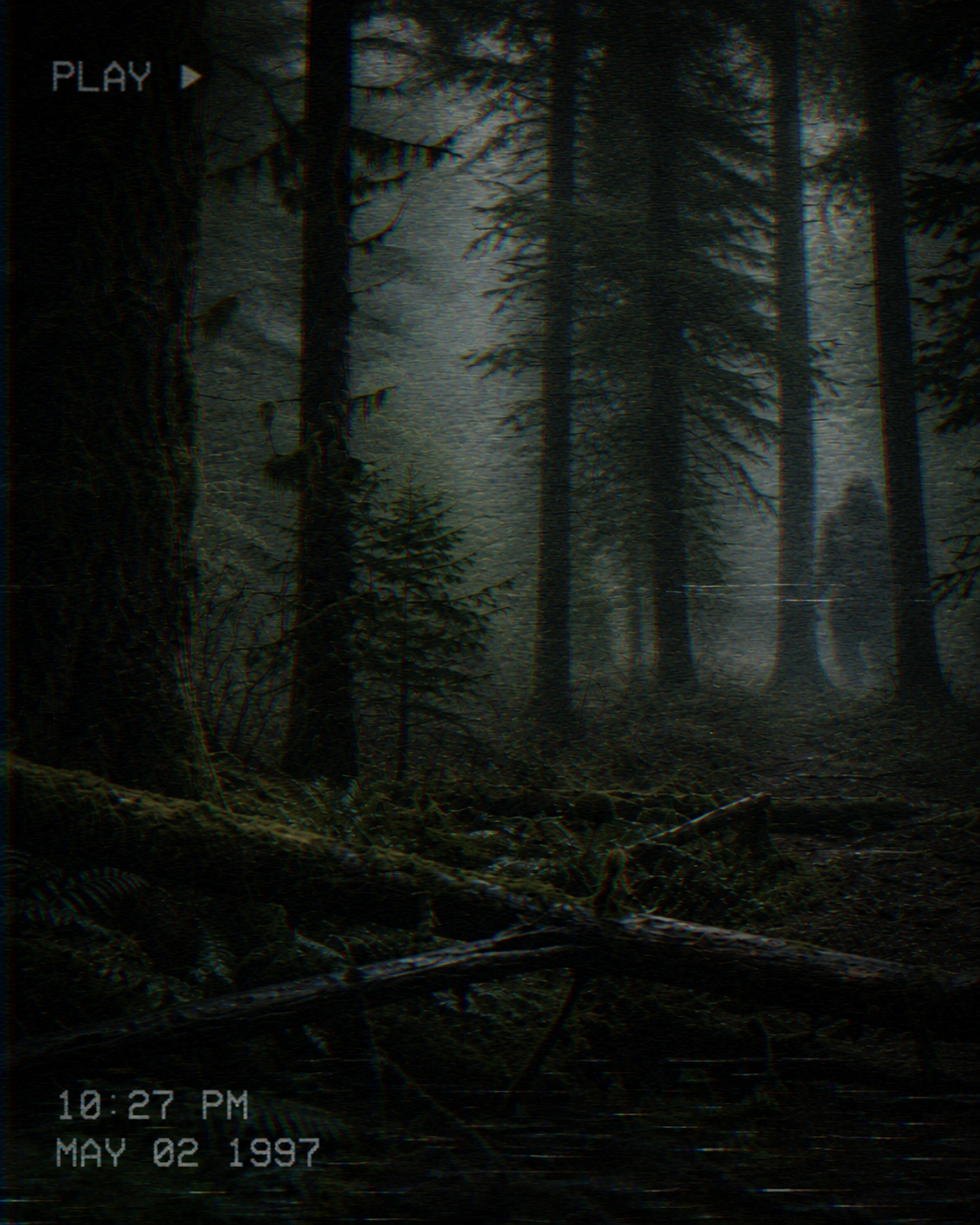
Case Identification
Bigfoot Quick Facts
- Archive status
- Unresolved
- Also called
- Sasquatch
- Classification
- Cryptid, belief legend, regional folklore
- Core region
- Pacific Northwest of the United States and Canada
- Modern name
- Popularized in northern California in 1958
- Reported appearance
- Large, upright, hair-covered, humanlike figure
- Confirmed physical evidence
- None accepted by established science
Also filed under: American Urban Legends Forest Legends Famous Sightings
01
What Is Bigfoot?
Bigfoot is the name commonly given to an alleged large, hair-covered, upright creature said to live in the forests and mountains of North America. Reports concentrate most heavily in the Pacific Northwest, especially British Columbia, Washington, Oregon and northern California, although alleged sightings have been recorded across the continent.
Witness descriptions vary, but the modern portrait is remarkably recognizable: a powerful biped standing roughly seven to eight feet tall, covered in dark or reddish-brown hair, with long arms, broad shoulders and a head that seems to sit low on the body. Other reports add enormous humanlike footprints, a strong odor, piercing screams, whistles, wood knocks or a sudden silence in the surrounding forest.[4]
None of those traits has been verified as belonging to an unknown species. No authenticated body, skeleton, tissue sample or genetic sequence has established the existence of a previously undocumented North American primate. The biological case remains unconfirmed. The cultural case does not.
02
Is Bigfoot an Urban Legend?
Yes, in the broad folkloric sense, Bigfoot can be described as an urban legend—or more precisely, a contemporary belief legend. “Urban legend” does not mean the story must happen in a city. It describes a modern story passed as something that may have happened, often to a named witness, a friend, a relative or someone in the teller’s community.
Bigfoot is also a cryptid: a creature whose existence is alleged but not scientifically established. The two labels describe different parts of the same phenomenon. “Cryptid” identifies the disputed creature. “Legend” describes the stories, evidence and arguments that keep moving through culture.
Folklorist Linda Milligan treated the disagreement itself as central to the Bigfoot legend. Believers and skeptics examine the same unstable collection—testimony, tracks, photographs, casts, hair, sounds and missing bodies—and reach incompatible conclusions. The uncertainty is not incidental. It is the condition that allows the legend to continue.[5]
If the evidence became clear and indisputable, Bigfoot would stop being a legend. It would become either a documented animal or a solved deception.
03
Before Sasquatch: Sa:sq’ets and Distinct Indigenous Traditions
Bigfoot histories often begin with a sentence like “Native Americans have always believed in Bigfoot.” It sounds respectful. It is also too broad to be accurate.
Indigenous nations across North America hold distinct traditions involving wild people, giants, forest beings, protectors, dangerous beings and entities that cross spiritual and physical boundaries. Similarities exist, but the traditions are not interchangeable, and they should not all be treated as early sightings of a single modern cryptid.
The clearest linguistic line behind the word Sasquatch leads to the Sts’ailes people of the Harrison and Chehalis watersheds in British Columbia. Sts’ailes sources describe Sa:sq’ets as an important part of cultural identity and spiritual belief: a primary caretaker who watches over the land, not simply a monster hiding in it.[1]
That understanding is not identical to the commercial Bigfoot image. It belongs to a particular people, place and living tradition. I think the respectful approach is to let that distinction remain visible rather than using Sa:sq’ets as a historical stamp of approval for every later Bigfoot claim.
04
1929: Sasquatch Enters the English-Language Archive
On April 1, 1929, Maclean’s published J. W. Burns’s “Introducing B.C.’s Hairy Giants.” The article gathered accounts Burns said he had heard while making inquiries among Indigenous people in British Columbia. Its opening question is revealing. Were the mountains inhabited by giant men—“not ape-like men”?[2]
One account attributed to Peter Williams describes a hair-covered giant that chased him across the landscape, followed him home and pressed against the wall hard enough to shake the house. Williams reportedly found tracks measuring twenty-two inches the next morning. Yet his description did not end with an ape. Looking through a crack in the wall, he said there was “nothing to distinguish him from the rest of us” except the hair and enormous size.[2]
Another narrator, Charley Victor, spoke of “Sasquatch” as rare mountain people. In the article, they appear male and female, use caves, show intelligence and sometimes speak or understand human languages. Some encounters are frightening. Others are almost quiet: a large, hairy man looks at Victor with kind eyes and walks back into the forest.
This is one of the archive’s most important complications. The early published Sasquatch was not a single stable creature. Historian Joshua Blu Buhs argues that Burns compressed a much wider diversity of traditions into a more uniform race of mountain giants for an English-speaking audience.[3] Burns’s article is invaluable as a historical document, but it is not transparent glass. We are reading Indigenous testimony selected, translated and arranged by a non-Indigenous writer for a national magazine.
“Introducing B.C.’s Hairy Giants”
J. W. Burns, Maclean’s. One of the foundational English-language texts in the modern history of Sasquatch.
Read the archived article05
1958: “Big Foot” Reaches the Newspapers
The modern American Bigfoot story took shape almost thirty years later and more than seven hundred miles south of the Sts’ailes territory.
In August 1958, road worker Jerry Crew found large, humanlike tracks around his bulldozer near Bluff Creek in northern California. More tracks appeared. Workers talked about the unseen visitor as Big Foot, two words, and blamed it for disturbances, missing equipment and other strange events around the logging road.
The setting matters. Lumber camps already had a lively tradition of practical jokes, impossible animals and stories used to test newcomers or make the wilderness feel manageable. Some workers were frightened; others added details for entertainment. The earliest Big Foot stories occupied the same uncertain ground they still occupy now: part report, part workplace folklore, part joke that may have stopped feeling like a joke.[3]
Crew made a plaster cast of one sixteen-inch print and brought it to the Humboldt Times. On October 6, the paper ran a front-page photograph of Crew holding the cast. Journalist Andrew Genzoli printed the name as one word—Bigfoot— because it worked better in a headline. The story traveled over national newswires, and a local track-maker became a North American celebrity.[3]
Were the 1958 Bigfoot tracks a hoax?
There is strong reason to distrust at least some of the Bluff Creek evidence. Ray Wallace, whose family’s company was involved in the road project, had a reputation for elaborate stories and admitted making other fake tracks. After his death in 2002, members of his family displayed carved wooden feet and said he had created the famous prints.
That may explain the tracks that launched the name. It does not automatically explain every report before or after them. Evidence that one file was manipulated is evidence against that file—not a universal solution to thousands of unrelated experiences. The distinction is easy to lose because the 1958 tracks were so influential.
06
The Patterson–Gimlin Film: Fifty-Nine Seconds That Changed Bigfoot
On October 20, 1967, Roger Patterson and Bob Gimlin filmed a large, hair-covered figure walking across a creek bed near Bluff Creek. The figure turns its upper body toward the camera, continues walking and disappears into the trees. It is usually called Patty, based on the reported female anatomy visible in the film.
For believers, the footage remains the strongest visual evidence in the file. They point to the figure’s proportions, gait, apparent muscle movement and the difficulty of producing a convincing suit in 1967. Skeptics point to Patterson’s financial interests, his prior plans for a Bigfoot film, conflicting testimony and claims by Bob Heironimus that he wore the costume.
The film is clearer than most Bigfoot images and still not clear enough to resolve what it shows. That has made it almost perfectly durable. Every improvement in image processing reveals more detail, but interpretation still enters before certainty does.
07
What Is Bigfoot Supposed to Look and Sound Like?
There is no verified specimen from which to create a biological description. What follows is a composite assembled from recurring witness claims—not a list of confirmed traits.
Height and build
Usually described as seven to eight feet tall, sometimes taller, with a broad torso, heavy musculature and long arms. Estimates made during frightening, brief encounters are difficult to verify.
Hair and face
Dark brown, black, gray or reddish hair is commonly reported. The face is often described as flatter and more humanlike than a bear’s, with little visible neck and a pronounced brow.
Movement
Witnesses often describe an upright, purposeful walk with a long stride. Some reports emphasize surprising speed or an unusually smooth gait over rough ground.
Footprints
Claimed prints are generally humanlike, five-toed and much larger than an adult human foot. Their credibility ranges from detailed trackways to known carvings and obvious pranks.
Sounds
Reports include screams, whoops, whistles, chatter, howls and repeated knocks against wood. No recording has been established as a unique Bigfoot vocalization.
Odor
A powerful smell—often compared with wet animal hair, decay or a skunk—appears in many encounter stories. It is common enough to be part of the modern legend, but not present in every report.
Philosopher H. Peter Steeves noticed why this composite is so unsettling. At a distance, the outline and movement can look human. The fur, size or roar can read as animal. Bigfoot forces the observer to make a category judgment at the exact moment when the available information is least reliable.[6]
That may be the creature’s most consistent feature: it appears close enough to human to create hesitation, but different enough to create fear.
08
The Bigfoot Evidence File
Bigfoot evidence is abundant in one sense and absent in another. There are thousands of stories and many objects presented as traces. There is no accepted specimen linking those traces to an unknown species.
Eyewitness accounts
Numerous · difficult to testWitnesses include hunters, loggers, police officers, families and experienced outdoors people. Some accounts are detailed and apparently sincere. Sincerity matters when evaluating a witness, but it cannot by itself identify what the witness encountered. Distance, darkness, expectation, fear, memory and ordinary animals can all change an observation without requiring dishonesty.
Footprints and casts
Physical · frequently disputedTracks can be measured, photographed and cast, which makes them feel more objective than testimony. They are also comparatively easy to fabricate. Some alleged prints show details proponents regard as anatomical; others have been linked to carved feet, altered footwear, overlapping animal tracks or pranks. Without a verified track-maker, even an impressive print remains an unidentified impression.
Photographs, film and audio
Compelling · rarely conclusiveMost photographs are distant, dark or blurred. Clear images tend to invite questions about costumes and staging; unclear images preserve possibility by withholding detail. Audio recordings present the same problem. A strange call can be genuine while its source remains a known animal, a person or something unresolved.
Hair and DNA
Testable · no confirmed unknown primateLaboratory analysis has repeatedly identified alleged Bigfoot material as known species. In the 1970s, the FBI examined hairs submitted by researcher Peter Byrne. The Bureau did not open a hunt for Bigfoot; it made a laboratory exception and identified the hairs as belonging to the deer family.[7]
A 2014 peer-reviewed study genetically analyzed thirty hair samples attributed to Bigfoot, Yeti and other alleged anomalous primates. The tested material came from known mammals rather than an unknown primate.[8] That result does not logically prove that no undiscovered animal exists. It does mean those samples did not provide the evidence claimed for them.
Bodies, bones and fossils
AbsentNo authenticated Bigfoot body, skeleton or fossil has been entered into an established scientific collection. Believers propose explanations: small populations, acidic forests, scavengers, deliberate burial or extreme remoteness. Skeptics answer that a breeding population spread across North America should leave recoverable biological remains. At present, the missing specimen is the central weakness in the biological case.
09
What Could Explain Bigfoot Reports?
The Bigfoot file does not require one explanation for every report. A cultural phenomenon this large can absorb several causes at once.
Misidentified animals
Bears can stand upright and black bears can walk on the soles of their feet. Under brief or obstructed viewing conditions, a standing bear, other animals, trees, shadows and people in bulky clothing can become humanlike figures.[11]
Hoaxes and folklore play
Fake feet, costumes, staged photographs and invented reports are documented throughout Bigfoot history. Some hoaxes are commercial; others are practical jokes or forms of communal storytelling.
Perception and memory
A witness may report an experience honestly and still be mistaken. Human perception completes incomplete scenes, while memory reorganizes details each time an event is recalled and retold.
An unknown animal
The possibility cannot be disproved by definition. New species are still documented. The difficulty is scale: a large, widespread, breeding primate should leave consistent genetic material, remains and high-quality observations. So far, that evidence has not appeared.
A cultural figure with many sources
Bigfoot may be less like a single mistaken object and more like a category into which unusual forest experiences are placed. Older wild-person traditions, local histories, popular media and personal encounters influence how an ambiguous event is recognized and described.
10
Why the Bigfoot Legend Endures
Bigfoot has survived confessed hoaxes, failed searches, negative laboratory results and decades of cameras becoming smaller, sharper and more common. It survives partly because no single debunking can reach the entire legend. Disprove one footprint and another witness remains. Challenge one film and a century of stories still waits behind it.
There is also something unusually generous about the idea. Bigfoot allows the forest to keep one secret. It suggests that maps are not the same as complete knowledge, and that a place can remain inhabited by something beyond our categories even after the roads, satellites and trail cameras arrive.
In the Pacific Northwest, the figure has become part of regional identity: found in local art, roadside attractions, festivals, mascots and stories shared by people who may not agree on whether the creature exists. The Oregon Encyclopedia describes Bigfoot as a symbol through which Northwesterners consider their relationship to wilderness and the boundary between human and animal.[4]
Bigfoot remains just beyond the tree line: close enough to recognize, too far away to identify.
Sophie’s assessment
- Biological status
- Unconfirmed
- Historical status
- Well documented as a modern legend
- Evidence quality
- Mixed, frequently disputed, no accepted specimen
- Archive status
- Open
Sophie’s Closing Note
The more time I spent with this file, the less interested I became in issuing a verdict on every witness.
The better question was how the stories acquired the shape they now share.
Sa:sq’ets, Burns’s mountain people, the Bluff Creek track-maker and the figure in the 1967 film are not one clean historical line. They are separate records that culture has layered until the seams became difficult to see.
I cannot tell you what every person saw.
I can tell you that the creature in the oldest folders is not quite the creature we recognize now.
Somewhere between the mountain people, the footprints, the film and the stories told afterward, Bigfoot became familiar to almost everyone—and identifiable to no one.
That is where I’m leaving the file tonight.
Status: Open.
— Sophie Vale
11
Frequently Asked Questions About Bigfoot
Is Bigfoot real or a myth?
Bigfoot is unquestionably real as a modern legend and cultural figure. Its existence as an undiscovered biological species has not been established. Witness reports and alleged traces continue, but no authenticated body, DNA sample or other specimen has been accepted by established science.
Is Bigfoot an urban legend?
Bigfoot is often classified as a contemporary belief legend and a cryptid. The word “urban” describes the modern circulation of the story, not its forest setting. Bigfoot stories are commonly told as potentially true events involving witnesses, evidence and unresolved encounters.
Are Bigfoot and Sasquatch the same?
In modern popular culture, the names are used interchangeably. Their histories differ. “Sasquatch” developed from Sa:sq’ets, a Sts’ailes word tied to a specific cultural tradition in British Columbia. “Big Foot” emerged as the nickname for a track-maker at a northern California road project in 1958. The traditions were later blended.
Where did the Bigfoot legend originate?
There is no single origin. North American Indigenous nations hold varied traditions involving wild, giant or forest-dwelling beings. J. W. Burns introduced “Sasquatch” to a broad English-language readership in 1929. The modern name “Bigfoot” was popularized after large tracks were reported near Bluff Creek, California, in 1958.
Where is Bigfoot said to live?
The legend is most strongly associated with the dense forests of the Pacific Northwest, including British Columbia, Washington, Oregon and northern California. Alleged sightings have been reported throughout North America.
How tall is Bigfoot supposed to be?
Most modern descriptions place Bigfoot around seven to eight feet tall, though some estimates are higher. These measurements usually come from brief eyewitness observations or footprint interpretations and have not been confirmed from a specimen.
Has a Bigfoot skeleton ever been found?
No authenticated Bigfoot skeleton, body or fossil has been documented in an established scientific collection. Claims have circulated, but none has produced a specimen that independent specialists could verify as an unknown primate.
Did the FBI investigate Bigfoot?
The FBI did not conduct a broad search for Bigfoot. In the 1970s, it agreed to examine hairs submitted by researcher Peter Byrne. The laboratory identified them as belonging to a member of the deer family.
Is Bigfoot good or evil?
There is no consistent answer across the traditions. Modern reports usually portray Bigfoot as shy, elusive or defensive rather than evil, although aggressive encounters also appear. Sts’ailes tradition describes Sa:sq’ets as a caretaker connected to the land, which should not be reduced to the morality of the commercial monster character.
What powers does Bigfoot have?
Standard Bigfoot lore emphasizes physical size, strength, speed and an ability to avoid detection, not verified supernatural powers. Some later paranormal accounts attribute invisibility, telepathy or connections to UFOs. Certain Indigenous traditions include spiritual or transformative qualities, but those beliefs are culturally specific and are not generic “Bigfoot powers.”
What is the best evidence for Bigfoot?
The Patterson–Gimlin film, long trackways and detailed eyewitness reports are most often cited by proponents. Each remains disputed. As of this review, no evidence has produced an independently verified specimen or genetic identification of an unknown North American primate.
Research record
Sources and Further Reading
This dossier separates documented history from reported encounters and later interpretation. Sources are listed so the record can be checked directly.
- Sts’ailes / Sasquatch Crossing Eco Lodge. “Story of the Sasquatch.” A community-grounded explanation of Sa:sq’ets and its place in Sts’ailes cultural identity. Read source.
- J. W. Burns. “Introducing B.C.’s Hairy Giants.” Maclean’s, April 1, 1929. Read archived article.
- Joshua Blu Buhs. Bigfoot: The Life and Times of a Legend. University of Chicago Press, 2009. Read the 1958 chapter excerpt.
- Robert Walls. “Bigfoot (Sasquatch) Legend.” The Oregon Encyclopedia, Oregon Historical Society. Read source.
- Linda Milligan. “The ‘Truth’ About the Bigfoot Legend.” Western Folklore 49, no. 1 (1990): 83–98. View record.
- H. Peter Steeves. “The Phenomenology of Bigfoot.” Between the Species, Issue VII, August 2007. Read source.
- Federal Bureau of Investigation. “Bigfoot Part 01 (Final).” Correspondence and laboratory analysis concerning alleged Bigfoot hairs. View FBI file.
- Bryan C. Sykes et al. “Genetic Analysis of Hair Samples Attributed to Yeti, Bigfoot and Other Anomalous Primates.” Proceedings of the Royal Society B 281 (2014): 20140161. View study record.
- The Canadian Encyclopedia. “Sasquatch.” Read source.
- South by Southwest. Capturing Bigfoot, 2026 Film & TV Festival listing. Contemporary reporting documents both the documentary’s rehearsal-footage claim and the dispute it produced. View festival record; read the SXSW review.
- U.S. National Park Service. “Black Bear Biology” and bear-identification guidance. The NPS notes that black bears can stand upright and walk on the soles of their feet. Read source.
Additional context consulted: BBC Travel’s “The True Origin of Sasquatch” and the Washington State Military Department’s overview of the Bigfoot legend. Indigenous names and traditions vary by nation; they have not been treated here as interchangeable.