Arizona Legend File 001
The Red Ghost of Arizona
The story of the Red Ghost of Arizona begins with something enormous crashing through a desert camp in the dark.
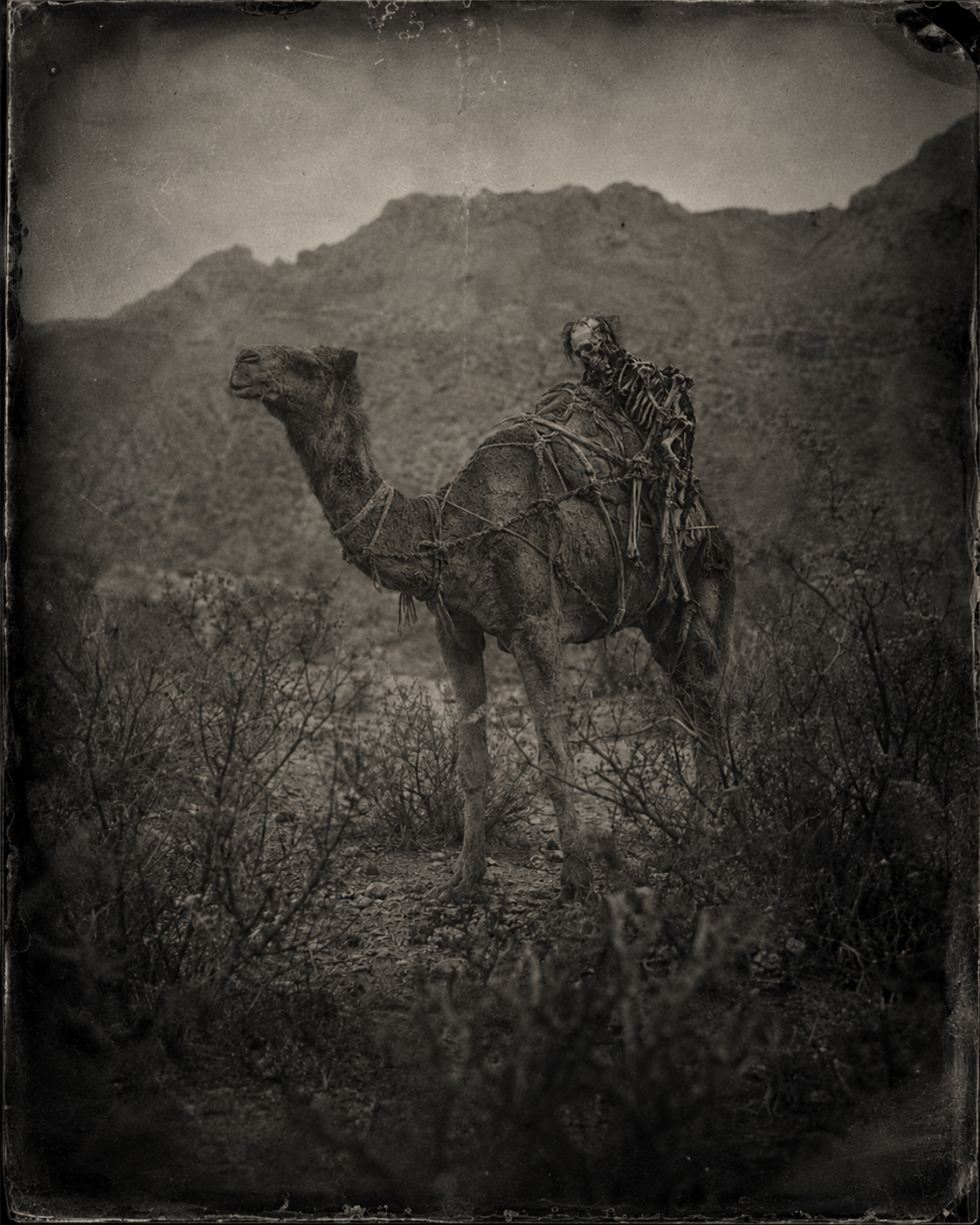
Witnesses said it was red and taller than two horses. At an isolated ranch, one woman claimed she saw the devil riding on its back. Two prospectors later fired at it as it fed on a mesa. Something fell as it fled. When the men reached the spot, the 1893 newspaper account says, they found a human head in the dust—“dry and withered,” with flesh and hair still attached.
Then it vanished into the Arizona hills.
When witnesses finally put a name to what they had seen, the story became even harder to believe.
A camel. In the Arizona wilderness.
Surely that was impossible. Before we can decide what the Red Ghost was, we have to understand how camels reached the Southwest—and what became of them after they arrived.
Was the Red Ghost a surviving camel carrying human remains? Was it a frontier murder story? Or did one newspaper turn a frightened rumor into Arizona’s most disturbing legend?
Archive Film · Case File #001
Watch: The Red Ghost of Arizona
Subscribe to the Urban Legends Archive
New legends, investigations, and archive films.
Runtime: 9 Minutes
Location: Arizona Territory
Filed By: Urban Legends Archive
Case Identification
The Red Ghost of Arizona: Quick Facts
- Earliest complete account found
- San Francisco Examiner, February 19, 1893
- Reported creature
- A large reddish camel carrying human remains
- Documented context
- The U.S. military imported and tested camels in the Southwest
- Unresolved
- The alleged death, rider, human remains, and final killing
- Legend region
- Eastern and central Arizona Territory
- Evidence warning
- Several newspapers carried the same source story
01
What Was the Red Ghost of Arizona?
The Red Ghost of Arizona is a nineteenth-century legend about a large red camel that wandered Arizona Territory with human remains tied to its back.
No one in the earliest newspaper account sees the whole Red Ghost.
Two gold washers glimpse something taller than two horses. At Eagle Creek, a woman sees a towering red shape with the devil on its back. A hunter named Si Hamlin spots a camel carrying a burden that might be a man. Two prospectors find a dried human head. A cowboy later sees rawhide—and what remains of a pack.
The newspaper gathers those scenes under one name. Read separately, they are fragments. Joined together, they become the Red Ghost.
Before we follow the creature any farther, we need to answer the question that once sounded ridiculous: How did camels reach the Southwest in the first place?
02
Before the Ghost: The U.S. Army Camel Experiment
Camels in Arizona sound like the detail that gives the whole story away.
Then I found the paperwork.
In 1855, Congress set aside $30,000 for what became known as the U.S. Army camel experiment. Secretary of War Jefferson Davis had been pressing the idea. The Army needed a way to carry supplies across the dry, punishing routes of the Southwest. Horses and mules were struggling. Camels, Davis believed, might not.[1]
Major Henry C. Wayne was sent overseas to buy them. The first shipment reached Indianola, Texas, in May 1856. A second voyage followed. By the time the buying was finished, the government had acquired roughly seventy camels and dromedaries.[1]
The plan sounds ridiculous now because we already know it disappeared. On the trail, it made considerably more sense.
In 1857, Lieutenant Edward Fitzgerald Beale took twenty-five camels on a wagon-road survey from New Mexico toward California. They carried heavy loads. They ate desert plants that horses and mules refused. They crossed rivers and climbed difficult ground. When water and food ran short, the camels sometimes carried supplies for the other animals.[2]
Beale became convinced they belonged in the Southwest.
Then I found a notice from 1859.
On April 14, The Weekly Arizonian reported that more than twenty government camels had strayed from Beale’s ranch on the Colorado. They had not been recovered. The paper feared they had fallen into the hands of the Mohave Indians.[14]
This is the part that changed the file for me. Loose camels were not merely a later explanation for the legend. A territorial newspaper was reporting an unrecovered government herd thirty-four years before the Red Ghost story appeared.
That does not make one of those animals the Red Ghost. It does give wandering camels a contemporary paper trail.
So why aren’t camels wandering Arizona today?
The Civil War broke the experiment apart before the Army settled that question. The government’s herds in Texas and California were eventually sold. Some animals passed into private hands. Other camels had already reached the West through commercial owners, and reports of loose animals continued for years.
That gives us a route by which a camel could have reached Arizona. The trail becomes harder to follow after that.
I looked for a military brand, an auction record, an owner, or a handler who could connect the Red Ghost to Beale’s expedition. Nothing surfaced. The Army records bring camels into the West. They never introduce us to one called the Red Ghost.
If the military file ends there, where does the ghost story begin?
On page 15 of a San Francisco newspaper.
03
The 1893 Newspaper Story That Created the Case
Page 15 of the San Francisco Examiner did not look like the birthplace of an Arizona legend.[3]
On February 19, 1893, the paper published “Mystery of the Red Ghost.” The opening announced that the phantom had finally been killed. Everything that came before—the crushed tent, the dead woman, the human head, the cowboy with his rope—was presented as a story that had already reached its ending.
Six days later, the Mohave County Miner printed the tale in Kingman, Arizona. On March 22, it appeared in the Indiana State Sentinel.[4][5]
For a moment, I thought I had three sources.
Then I reached the final line of the Miner version:
—Examiner.
The Indiana paper followed the same text. These were not three reporters chasing the same creature. One newspaper story was traveling.
It kept traveling.
On March 31, the Waupun Leader in Wisconsin published a shorter version called “The Red Ghost.” This one acknowledged its source inside the story: “His next appearance, says the San Francisco Examiner.”[6]
By late April, the story had changed clothes.
A new illustrated version appeared beneath the headline “Many Were Slain by the Terrible Ghost of the Deserts.” It ran in newspapers in Illinois, Iowa, Michigan, and Wisconsin. The drawings showed moments from the story as if someone had been there to sketch them. Nothing in the article suggests that the artist had.[7]
The new headline also promised more death than the story could provide. The article claimed that the Red Ghost had killed several people, yet described only one alleged death in detail. No additional victims were named.
Other things had been added. Oro became an ancient Aztec city built over buried ruins. Treasure hunters abandoned their work because they feared the Red Ghost. The Chicago World’s Fair entered the story. At the end, readers were offered the possibility that Arizona’s wild camels were survivors of some much older animal.
This all happened within weeks of the Examiner article.
I had expected the Red Ghost to gather its exaggerations slowly, as one generation handed the story to the next. Instead, I could watch the changes arrive before the ink on the first version had time to fade.
By May 1893, one newspaper feature had become a mystery, a massacre, an illustrated spectacle, and a piece of prehistoric speculation.
A growing stack of newspapers had given me more copies of the story.
It had not given me another witness.
So I went back to the first account and read it again—this time, line by line.
04
What the Earliest Red Ghost Account Actually Says
The first witnesses have no names.
The Examiner reaches back about ten years, to roughly 1883. Two Mexican gold washers are sleeping beside a creek that feeds the San Francisco River when their tent collapses on top of them.[3]
They crawl out to the sound of galloping hooves and what the article calls “a terrible shriek.” In the darkness, they see something taller than two horses disappear into the brush.
The next morning, people from Oro search the creek. They find strange tracks in the mud and brush flattened by something large.
Then the trail disappears into the rocks.
The next scene has a body.
At a sheep ranch on Eagle Creek, two women are left with the children while the herders tend the flocks. One of the women walks to a spring for water. The other hears the ranch dogs and reaches the door in time to see something red tear through the fence.
She hears the woman at the spring cry out.
She stays inside with the children and barricades the door.
When the men return that night, they find the missing woman beside the spring, “trampled and crushed as though a troop of cavalry had run over her.”
A coroner arrives from Solomonville. The surviving witness can offer only a few details. The thing was red. It was very tall. A devil was riding on its back.
The jury returns a verdict of “death in some manner unknown.”
Then the article adds something I wasn’t expecting: the jurors reportedly wondered whether the surviving woman had committed the murder herself and invented the apparition.
Neither woman is named. Neither is the coroner. The ranch is not identified, and the article gives no date for the death.
I looked for an inquest, a death notice, or a local report that might pull one of those people out of the story and into the historical record.
I found nothing.
After Eagle Creek, the sightings become harder to trust.
One man claims he watched the Red Ghost gallop across half a mile of open air between two cliffs. The Examiner points out that this same man had previously reported a flying bear and a mountain made of solid gold.
Even the newspaper knew when the story had gone too far.
The first person to call the thing a camel was a hunter named Si Hamlin. From the top of a ridge, he reportedly saw something large moving through the chaparral. When it crossed a burned patch of ground, he recognized the shape.
There was something on its back.
Hamlin thought it looked like a man, although he could not be certain.
The camel appeared again on the Verde. Two prospectors crept within shooting distance and fired. It bolted into the hills. As it ran, something dropped from its back.
The men followed and found a human head, “dry and withered,” with flesh and hair still attached.
Not a bare skull.
A head.
Weeks later, a cowboy from the Anchor-J outfit found the camel inside an abandoned branding corral. He threw his rope out of habit. The camel charged, caught his horse by the throat, and escaped with sixty feet of rawhide trailing behind it.
The cowboy returned to camp convinced that the ruined pack on the camel’s back had once held a man.
He is never named.
The final encounter supposedly happened only a few months before the article appeared.
Mizoo Hastings, a rancher living above a mining camp on the San Francisco River, woke to find a large red camel eating turnips outside his cabin. He rested his rifle on the windowsill and fired.
When Hastings examined the body, the newspaper says he found its hide crossed with knotted rawhide. The straps had been there long enough to cut into the flesh. The camel was scarred all over.
Whatever it had carried was gone.
The Examiner offered three possible explanations. Someone had tied a man to the camel for revenge. The rider had arranged his own death. Or someone had possessed “a camel and a corpse for which he had no use.”
The article chose none of them.
One phrase remained in my notes. The paper claimed that Mexican residents called the creature “Fantasia Colorado.” That is not straightforward Spanish for “Red Ghost,” and I have not found the name in an independent Spanish-language source.
Maybe the writer heard it incorrectly. Maybe the printer changed it. Maybe nobody outside the newspaper ever called the creature that.
By the end of the earliest complete account, I had a camel, a dead woman, a human head, a length of rawhide, and several people who could not be identified.
I also had three explanations supplied by the newspaper.
What I did not have was an answer.
Once I knew exactly what the 1893 story said, I began noticing how often later writers changed it.
05
How the Red Ghost Story Changed
The first major changes did not take decades.
They took weeks.
By late April 1893, the Red Ghost had acquired a new headline: “Many Were Slain by the Terrible Ghost of the Deserts.”[7]
The story beneath it still described only one alleged death in detail.
The new version also gave Oro an ancient Aztec past. It added buried ruins, frightened treasure hunters, and a connection to the Chicago World’s Fair. At the end, it suggested that Arizona’s camels might be remnants of some prehistoric animal.
None of that appeared in the February Examiner article.
The story had started changing before it was four months old.
Later alterations were smaller. They were also harder to notice.
The two prospectors became five.
The dried human head became a skull. In some retellings, the men carried it to Kingman. Modern illustrations went farther and left an entire skeleton strapped to the camel until the day it was shot.
The earliest account describes none of that. The head fell from the camel years before the final encounter. By the time Hastings supposedly killed it, the rider was gone.
Even the camel’s last meal changed.
In 1893, Hastings found it eating turnips. Later, the turnips became tomatoes.
Names began drifting too. Si Hamlin became Hamblin and eventually Cy Hamblin. Oro became Ore. The Anchor-J outfit grew into the more imposing Anchor-JOT Ranch.
I began treating those changes like fingerprints.
If two retellings used the same altered name, the same five prospectors, or the same tomato patch, there was a good chance they came through the same source. They might look like separate accounts. The shared mistake gave them away.
Many of the details people now associate with the Red Ghost settled into place in Robert Froman’s 1961 retelling.[8]
Froman gave the first sighting a season: spring 1883. The sheep ranch acquired an adobe house. Geronimo’s raid moved closer to the action. The witness found red hairs. Si Hamlin became Cyrus Hamblin. Five prospectors found a skull and carried it to Kingman.
The Anchor-J became the Anchor-JOT.
The story now had a clearer calendar, fuller names, and more physical evidence than it had possessed in 1893.
That made it feel better documented.
It wasn’t.
In 1976, the Arizona Republic printed another detailed version of the Red Ghost story. I initially treated it as a new newspaper investigation.[9]
Then I read the introduction.
The piece was an excerpt from a book by historian Odie B. Faulk, and the newspaper warned readers that the author had allowed himself some “creative reporting.” Faulk was retelling the legend. He was not reopening the case.
The same thing happened when I reached a 2015 article from Smithsonian Magazine. It was useful for understanding the camel experiment, but its Red Ghost section repeated the tomato patch and included a dramatic quotation attributed to the New York Sun.[10]
I went looking for the original quotation.
I could not find an issue date, a page number, or a copy of the article that supposedly contained it.
The name Smithsonian made the quotation feel settled. Once I followed it backward, it disappeared.
That kept happening.
The longer my source list became, the more convincing the Red Ghost appeared. Then I traced the citations and watched the list collapse into a much smaller family of retellings.
The additions had done something important to the legend. Five prospectors sounded stronger than two. A skull sounded more durable than a decaying head. A named ranch felt easier to locate. A specific spring day in 1883 looked like history.
Each new detail closed a gap in the story.
None closed a gap in the evidence.
The newspaper trail had shown me how the Red Ghost grew. It had not yet answered the simplest question in the case.
Was there really a camel?
06
Was the Red Ghost a Real Camel?
Probably.
Camels had crossed Arizona before any newspaper called one a ghost.
Beale’s expedition brought them through the territory in 1857. Government auctions later scattered the herds, and private owners had imported camels of their own. By the 1880s, a loose camel in Arizona would have been unusual.[1][2]
It would not have been impossible.
To someone who had never seen one, a camel could look badly assembled. Its neck was too long. Its legs bent strangely. It made unfamiliar sounds. Horses that knew how to face cattle could panic when they smelled one.
A red camel appearing at night might not need anything supernatural to frighten a ranch.
The problem is identifying this camel.
The Examiner says Si Hamlin recognized it. The same article says Mizoo Hastings later shot it in his turnip patch and found its hide scarred by rawhide.[3]
That is the only ending I could find.
I tried to follow the body out of the garden.
There is no hide in a museum. No bones. No photograph. No surviving rawhide. I found no ranch record describing the shooting and no second named witness who examined the carcass.
Even the camel’s connection to the Army remains uncertain.
A military brand or auction record might have led back to Beale’s herd. None has surfaced. The camel could have descended from government stock. It could have escaped from a private owner. The newspaper does not tell us.
Calling it an “Army camel” gives the Red Ghost a wonderfully neat origin.
The historical record is not that neat.
So the most careful answer is that a loose camel could have wandered Arizona during the period described. The Examiner reported that one did. Whether that camel was the Red Ghost—and whether Mizoo Hastings really killed it—remains unconfirmed.
I could get a camel into Arizona.
I still could not put a man on its back.
07
Was a Dead Man Really Tied to Its Back?
The 1893 newspaper says there was.
The rest of the historical record says nothing.
The rider enters the story in pieces.
Si Hamlin sees a burden that looks like a man. Two prospectors find a dried human head after firing at the camel. The Anchor-J cowboy believes the remains of its pack had once been human. Finally, Mizoo Hastings supposedly finds knotted rawhide crossing the camel’s scarred body.[3]
The newspaper joins those details together.
None of them comes from a witness we can question.
The rawhide is the hardest detail to dismiss. According to the Examiner, some of the straps had cut so deeply into the camel that they were embedded in its flesh. Something had been fastened there for a long time.[3]
The article never proves what that something was.
Rawhide could secure a person. It could also secure cargo, a saddle, or an abandoned pack. The scars become evidence of a corpse only after we connect them to the head and Hamlin’s distant sighting.
That connection may be correct.
It may also be the work of the story.
I went looking for the rider next.
There is no name. No missing-person report has surfaced. The article mentions no clothing, jewelry, weapon, uniform, or personal object that might identify him. It does not tell us what happened to the head after the prospectors found it.
We do not even know who the prospectors were.
The Examiner offered three explanations for the body. The man had been tied to the camel as an act of revenge. He had arranged his own death. Or someone had played a grotesque joke with an unwanted camel and an unwanted corpse.
Those are not three competing theories supported by evidence.
They are three guesses printed in the same article.
Later writers supplied more. The rider became a dying prospector who strapped himself down so the camel could carry him to water. In other versions, he was a soldier tied there as punishment. Sometimes he was already dead when someone placed him on the camel.
I could not trace those explanations to the earliest account.
The complete skeleton seen in modern artwork is another later addition. In the 1893 version, the head falls from the camel years before Hastings shoots it. By the final scene, the body and most of the pack have disappeared.
Only the scars remain.
That leaves us with a very narrow answer.
Could a person have been tied to the Red Ghost? Yes.
Do we have evidence outside one newspaper story that it happened? No.
The camel is historically possible. The rider exists only in the tale.
To keep those two kinds of evidence from blending together, I had to sort the entire case.
08
The Evidence: Supported, Plausible, Speculative, and Unknown
By this point, I had two different cases sharing the same folder.
One was documented in government records. Congress bought camels. Beale led them across the Southwest. The herds were sold and scattered.
The other case had a dead woman, a human head, a scarred camel, and witnesses who were mostly unnamed.
If I allowed those two cases to blur together, the government records made the ghost story look proven.
So I separated them.
Well supported
- Congress appropriated $30,000 for the camel experiment in 1855.
- The government imported roughly seventy camels and dromedaries in 1856 and 1857.
- Beale used twenty-five camels during his wagon-road survey across the Southwest.
- In 1859, The Weekly Arizonian reported that more than twenty government camels had strayed from Beale’s ranch on the Colorado and had not been recovered.[14]
- The government herds were eventually sold, and privately owned camels were also present in the West.
- Hadji Ali, later remembered as Hi Jolly, worked with the camels and remained in Arizona.
- The San Francisco Examiner published “Mystery of the Red Ghost” on February 19, 1893.[3]
- Newspapers across the country reprinted and expanded that story between February and May.[4][5][6][7]
- The earliest article contains the claims about Eagle Creek, Si Hamlin, the human head, the Anchor-J cowboy, Mizoo Hastings, and the embedded rawhide.
That last point needs to be read carefully.
The claims are documented as newspaper text.
The events are not independently confirmed.
Plausible
- A government or privately owned camel could have escaped and wandered through Arizona.
- People unfamiliar with camels could have mistaken one for something monstrous, especially at night.
- Several frightening camel encounters may have been combined into one Red Ghost story.
- The Examiner may have collected tales already circulating in Arizona rather than inventing the entire legend.
- Neglected harness or rawhide could have remained on a camel long enough to leave scars.
These ideas fit the known history.
I still cannot prove that any of them happened to the Red Ghost.
Speculative
- One camel was responsible for every encounter in the story.
- The Red Ghost descended from the Army’s herd.
- A corpse was tied to the camel.
- The Eagle Creek woman was killed by the camel.
- Mizoo Hastings shot the famous animal and found rawhide embedded in its flesh.
- Spanish-speaking residents called it “Fantasia Colorado.”
- The camel crossed a canyon through the air, stood thirty feet tall, ate a grizzly, or possessed anything resembling supernatural power.
Some of these claims are reasonable guesses. Others belong comfortably in a tall tale.
They share the same problem: no surviving evidence allows us to test them.
Unknown
- Who was the woman found dead at Eagle Creek?
- Did the coroner’s inquest occur?
- Who were the two prospectors?
- Can Si Hamlin or the Anchor-J cowboy be identified?
- Was Mizoo Hastings a real rancher?
- Where was Oro?
- What happened to the human head?
- Did anyone besides the newspaper see the camel after it was shot?
- Who wrote the original Examiner feature?
- What sources did that writer use?
- Does the quotation later attributed to the New York Sun appear in a verifiable issue?
Those are not minor missing details.
They are the details that would allow us to move from a published legend to a historical event.
Here is where the case stands:
A camel in nineteenth-century Arizona is plausible.
The Red Ghost is documented as a developed legend by 1893.
The historical setting is strong. The evidence for one scarred camel carrying a dead man is not.
The file remains open.
There is, however, one person in Arizona’s camel story whose name did survive.
Hadji Ali.
Most people remember him as Hi Jolly.
09
Hi Jolly, Quartzsite, and Arizona’s Camel Memory
Hadji Ali is a real person in this case file.
His name appears in the history of the Army’s camel experiment. He was hired to help manage animals brought from the eastern Mediterranean, and he remained in the Southwest after the military project ended.[11]
Americans found his name difficult to pronounce.
Hadji Ali became Hi Jolly.
He worked around Arizona for years and was eventually buried in Quartzsite. A pyramid-shaped monument now stands over his grave, topped by a metal camel.[11]
It is one of the few places where the old camel experiment becomes something you can see and touch.
That is probably why Hi Jolly appears so often beside the Red Ghost.
When I began searching, I expected the legend’s trail to lead toward Quartzsite.
The map refused.
The 1893 story moves through the San Francisco River country, Eagle Creek, the Salt River region, the Verde, and an Anchor-J corral. Most of that trail lies in eastern and central Arizona.
Quartzsite is in western Arizona.
The original account never takes the Red Ghost there.
The connection between Hi Jolly and the Red Ghost is not a shared location. It is a shared animal.
Legends like having somewhere to stand. The Red Ghost has no known grave, no preserved hide, and no ranch we can identify with confidence.
Hi Jolly has a grave.
His monument gives Arizona’s camel history a physical address. Visitors see the metal camel, learn that the Army experiment really happened, and encounter stories of animals wandering the desert after it ended.
From there, the Red Ghost no longer sounds quite so impossible.
The monument documents Hadji Ali and the camel experiment. It does not document the Red Ghost.
Still, it helps explain why the legend remained at home in Arizona.
The state had real camels. It had a real cameleer. Eventually, it had a monument preserving both.
The Red Ghost could borrow credibility from all three.
And that may be the most important reason the story survived.
10
Why the Red Ghost Became an Urban Legend
Most monsters become less frightening once someone identifies them.
The Red Ghost became more believable.
Calling it a camel removed the supernatural explanation, but it did not make the story disappear. The Army records gave that camel a way into Arizona. Hi Jolly and the Quartzsite monument gave the state’s camel history a face and a place.
The explanation solved the wrong mystery.
It told us what the creature might have been.
It did not tell us who was on its back.
The 1893 article was built to keep readers balanced between belief and disbelief. It gave them tracks in the mud, a coroner’s verdict, a human head, rawhide scars, and a rancher with a name.
Then it reminded them that one witness also claimed to have seen a flying bear.
The newspaper never asked readers to choose between a report and a tall tale. It let the Red Ghost be both.
That uncertainty traveled well.
When the story appeared in more newspapers, each copy made it feel more widely confirmed. The illustrated versions gave readers scenes to remember: the creature breaking through a fence, a hunter seeing it at dawn, something human on its back.
Those drawings were not evidence.
They gave the story a visual history anyway.
Later writers made the legend easier to follow. They added a season, expanded the witness list, corrected names into new names, and turned a decaying head into a cleaner skull.
The story became more specific as its source trail became less visible.
That is part of what makes the Red Ghost an urban legend.
It is told as something that really happened. It is attached to recognizable places and fragments of genuine history. The details change as it passes from one source to another, while the disturbing center remains intact.
A camel crossed the desert.
Something human was tied to it.
Nobody knew why.
The oldest complete account understood what was happening. Before the feature ended, the writer said the Red Ghost had “degenerated into a story and then into a tradition.”[3]
That sentence appeared in 1893.
The legend was not created a century later by websites or ghost hunters. It was already becoming folklore while the newspapers were still printing it as news.
The real camel history kept the story from floating away.
The missing rider kept it from ending.
That is why the Red Ghost survived.
Questions About the Red Ghost of Arizona
Is the Red Ghost of Arizona a true story?
Parts of the story rest on documented history.
The United States government really imported camels for military use during the 1850s. Those animals crossed the Southwest, and the remaining herds were later sold. Privately owned camels were also present in the West.
A newspaper really did publish the Red Ghost story in 1893.
What we cannot confirm is whether one camel caused all the reported encounters, killed a woman, carried human remains, or was shot by Mizoo Hastings. Those events come from one central newspaper account and the retellings that followed it.
What was the Red Ghost?
According to the legend, the Red Ghost was a large reddish camel that wandered Arizona Territory with human remains tied to its back.
The earliest complete account does not give us one witness who sees all of that. Different people see a tall red shape, a camel carrying a burden, a human head, and the remains of a rawhide pack.
The newspaper connects those scenes and calls the result the Red Ghost.
Was a dead man really tied to the camel?
The 1893 San Francisco Examiner article says the camel carried something that looked human. It also says two prospectors found a dried head after shooting at the creature.
When the camel was supposedly killed, its body was covered with knotted rawhide that had cut into its flesh.
No independent record confirms the rider. We have no name, body, missing-person report, clothing, or personal object belonging to him.
The familiar image of a complete skeleton riding the camel came later.
Who killed the Red Ghost?
The Examiner names a rancher called Mizoo Hastings.
According to the article, Hastings found the camel eating turnips outside his cabin. He rested his rifle on the windowsill and shot it.
I have not found an independent account from Hastings, a second witness to the shooting, or a record of what happened to the carcass.
So Mizoo Hastings is the answer given by the legend. Whether the shooting occurred as described remains unknown.
Where was the Red Ghost seen?
The 1893 account places the story around Eagle Creek, the San Francisco River, the Salt River country, the Verde, and an Anchor-J corral.
Those locations point toward eastern and central Arizona.
Quartzsite is often associated with the Red Ghost today because Hi Jolly is buried there beneath a camel monument. The original newspaper story never places the Red Ghost in Quartzsite.
How did camels get to Arizona?
Congress funded an Army camel experiment in 1855. The government imported roughly seventy camels and dromedaries during two purchasing expeditions.
In 1857, Edward Fitzgerald Beale used twenty-five camels during a wagon-road survey that crossed northern Arizona on its way toward California.
Two years later, The Weekly Arizonian reported that more than twenty government camels had strayed from Beale’s ranch on the Colorado and had not been recovered.
The government later sold its herds. Some animals entered private ownership, and other camels had been imported commercially.
That history gives a loose camel a believable route into Arizona. It does not identify the Red Ghost as one of Beale’s animals.
What does “Fantasia Colorado” mean?
The Examiner claimed that Mexican residents called the creature “Fantasia Colorado” and that the translated name remained with it.
The phrase is not straightforward Spanish for “Red Ghost.” I have not found it in an independent Spanish-language newspaper or document.
It may have been misunderstood, misspelled, or added by the writer. Until an earlier source appears, all we can say with confidence is that the phrase was printed in 1893.
Why is the Red Ghost considered an urban legend?
The Red Ghost is presented as a true event, attached to real places and genuine history. Its details change as the story moves from one source to another.
The Army camels provide a believable foundation. The corpse, the scars, and the unnamed witnesses supply the mystery. Newspaper reprints make one account look like many.
That combination allowed the story to survive as history, horror, and folklore at the same time.
Research record
Sources and Case Notes
A newspaper proves that a story was printed.
It does not prove that everything inside the story happened.
That distinction matters throughout this file. Several newspapers carried the Red Ghost account, but most belong to the same source family. They show us how far the legend traveled and how its language changed.
They do not give us additional witnesses.
-
The Army Historical Foundation
“The U.S. Army’s Camel Corps Experiment.”
This history provides the foundation for the military portion of the file: the 1855 appropriation, the imported animals, Army use, and the eventual dispersal of the herds.
-
Fort Tejon Historical Association
“Camels at Fort Tejon.”
Useful for following Beale’s expedition into California and understanding what happened to the western herd.
-
San Francisco Examiner
“Mystery of the Red Ghost,” February 19, 1893, page 15.
This is the earliest complete Red Ghost account located during the investigation. It contains the Eagle Creek death, Si Hamlin, the human head, the Anchor-J cowboy, Mizoo Hastings, and the knotted rawhide.
It also calls the creature a phantom and a desert bugaboo, mocks one of its witnesses, and admits that the Red Ghost had already become “a story and then a tradition.”
-
Mohave County Miner
“The Phantom that Terrified All Arizona for a Time,” February 25, 1893.
The Kingman newspaper printed the story six days after the Examiner. Its closing credit—“Examiner”—reveals the source.
This is an Arizona printing of the account, not a second Arizona investigation.
-
Indiana State Sentinel
“Mystery of the Red Ghost,” March 22, 1893.
This eastern reprint shows how quickly the story traveled. Its value is in tracing circulation rather than corroborating the encounters.
-
Waupun Leader
“The Red Ghost,” March 31, 1893.
The Wisconsin paper published a shortened version and explicitly introduced part of the narrative with the words “says the San Francisco Examiner.”
That attribution makes the relationship between the two texts unusually clear.
-
The illustrated “Many Were Slain” newspaper package
Versions appeared in the Streator Daily Free Press on April 22, the Freeport Daily Bulletin on April 25, the Webster County Argus on May 4, and the Kalamazoo Gazette on May 5, 1893.
The matching headline, illustrations, captions, and wording indicate that these newspapers were carrying the same feature package.
This version added the Aztec history of Oro, buried ruins, frightened treasure hunters, the Chicago World’s Fair, unnamed additional deaths, and the possibility of a prehistoric camel.
-
Robert Froman
Froman’s 1961 retelling is an important bridge between the original article and the version commonly told today.
Many familiar details become stable here: spring 1883, the adobe ranch house, Cyrus Hamblin, five prospectors, a skull taken to Kingman, and the Anchor-JOT Ranch.
These details should not be projected backward into the 1893 account.
-
Odie B. Faulk
Faulk’s Red Ghost account was excerpted in the Arizona Republic on April 18, 1976.
The newspaper introduced it as a book excerpt and allowed for “creative reporting.” It helps us trace the legend’s development. It is not a new investigation conducted in 1976.
-
Chris Heller, Smithsonian Magazine
“Whatever Happened to the Wild Camels of the American West?” August 2015.
This article offers useful modern history of the western camels and became an influential source for later Red Ghost retellings.
Its Red Ghost section repeats the tomato patch and includes a quotation attributed to the New York Sun. I have not yet located an issue date or original printing for that quotation.
-
Quartzsite and Hi Jolly public-history records
The Hi Jolly Monument preserves the history of Hadji Ali and the Army camel experiment.
It helps explain Arizona’s long memory of the animals. It does not place the Red Ghost in Quartzsite.
-
Marshall Trimble
Arizoniana: Stories from Old Arizona and later Red Ghost writing.
Trimble’s work is useful for tracing how Arizona historians and storytellers preserved the legend after it entered the state’s popular history.
-
Bob Hutton
“Camels Go West: A Forgotten Frontier Story,” HistoryNet, 2018.
A secondary account of the military camel experiment and the animals’ place in western history.
-
The Weekly Arizonian
“A lot of camels belonging to the United States Government,” April 14, 1859, page 2.
This contemporary notice reported that more than twenty government camels had strayed from Beale’s ranch on the Colorado and had not been recovered.
It documents an unaccounted-for herd in the region. It does not connect any individual camel to the later Red Ghost story.