Tucson has been telling ghost stories for a long time.
Some are attached to real buildings that still welcome guests every day.
Others belong to places that have been demolished, rebuilt or put to an entirely different use.
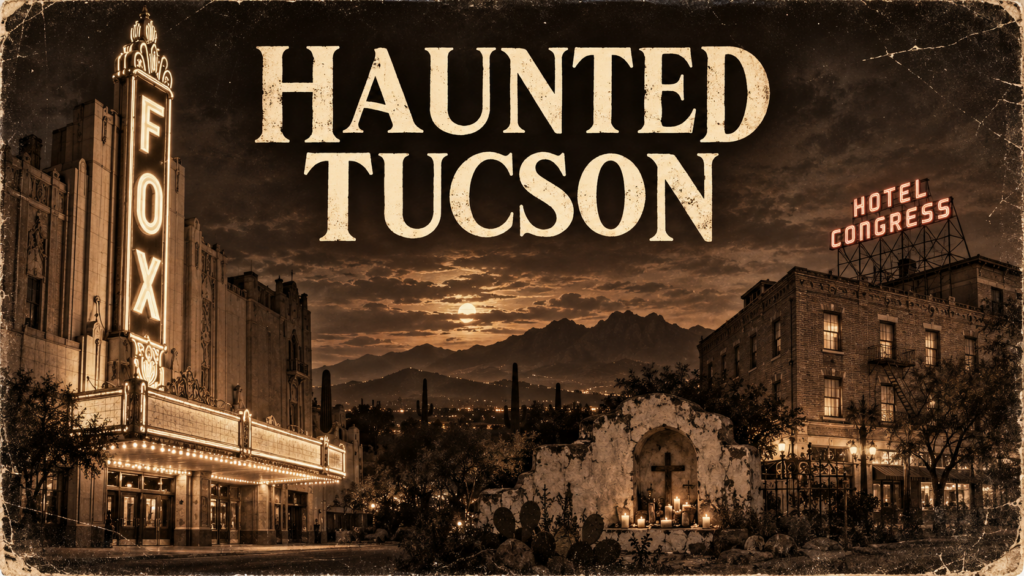
The stories vary. Hotel employees talk about odd encounters during quiet shifts. Theater workers have heard movement in rooms they thought were empty. A small adobe shrine in Barrio Viejo has collected wishes, candles and several competing versions of the same tragedy.
This guide covers the most haunted places in Tucson and explains what we can document about them. When the history is clear and the ghost story is harder to pin down, we’ll say so.
Hotel Congress
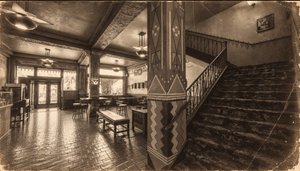
Hotel Congress opened in 1919 across from Tucson’s Southern Pacific depot. Its best-known historical episode came in 1934, when a fire helped authorities identify members of John Dillinger’s gang who were staying at the hotel.
The hotel also has one of Tucson’s longest-running collections of ghost stories. Guests and employees have described unexplained knocks, footsteps and a man seen in or near the lobby. A few rooms have developed reputations of their own. The hotel discusses these accounts on tours and during special events, so the stories haven’t been tucked away or treated as a secret.
There’s enough documented history here to make Haunted Hotel Congress interesting without embellishment. People have slept, worked, celebrated and argued inside the building for more than a century. The ghost stories are part of that history now, even when a particular account can’t be verified.
El Tiradito (The Wishing Shrine)
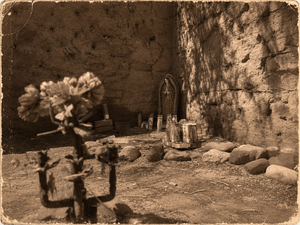
El Tiradito is a small adobe wishing shrine in Barrio Viejo. Visitors leave candles and written petitions there, usually with the hope that a wish will be granted.
The story behind the shrine depends on whom you ask. Most versions involve a man killed because of a love affair, although his name, his relationships and even the manner of his death change from one telling to another. That variation is important. El Tiradito is a good example of a place where the repeated telling has become as meaningful as the search for one definitive version.
The shrine also has a documented place in Tucson’s preservation history. Efforts to save El Tiradito helped draw attention to Barrio Viejo when urban-renewal projects threatened the neighborhood. It remains an active community site, so visitors should treat it as a shrine rather than a ghost-hunting prop.
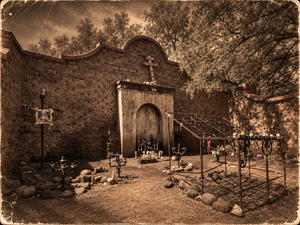
The plaque reads:
HISTORIC SITE EL TIRADITO (THE WISHING SHRINE) This is the only shrine in the United States dedicated to the soul of a sinner buried in unconsecrated ground. It is affectionately called “El Tiradito”—the castaway. The many legends about its origin all involve a tragic triangle love affair in the early 1870’s. The mysterious powers of “El Tiradito” are still an important part of local Mexican lore and culture. This site is on the National Register of Historic Places. BY TUCSON HISTORICAL COMMITTEE and ARIZONA HISTORICAL SOCIETY 1988.
Fox Tucson Theatre
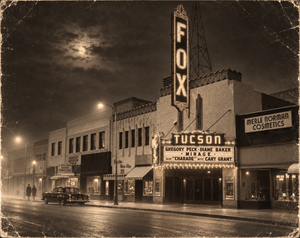
The Fox opened in 1930 with a striking Southwestern Art Deco interior. It closed in 1974, sat unused for years and eventually returned after an extensive restoration.
People who’ve worked in the theater have reported footsteps, moving objects and figures glimpsed backstage.
A large old theater gives sound plenty of ways to travel, and anyone who has worked backstage knows how easily a noise can be misjudged.
Even so, the reports have followed the Fox through its restoration and become part of the building’s modern reputation.
Rialto Theatre
The Rialto opened in 1920 near Hotel Congress and the railroad depot. It has hosted vaudeville, films and generations of live performers.
Its ghost stories tend to come from employees and performers who were in the building after the audience had gone. They’ve mentioned noises, a sense of being watched and occasional movement in empty parts of the theater. These accounts are less standardized than the stories at Hotel Congress, which makes it difficult to trace them to a single event or person.
Pioneer International Hotel
The Pioneer Hotel fire on December 20, 1970, killed 29 people. It remains one of the worst disasters in Tucson’s history. The building survived and was later converted to other uses, but the fire still shapes the way people talk about the property.
Stories about voices and apparitions circulated in later years. They deserve careful treatment because the victims were real people whose families and community lived with the loss. This is one place where the documented event should remain at the center of the story.
Santa Rita Hotel
The Santa Rita Hotel stood downtown for decades and hosted ballplayers, entertainers, businesspeople and visiting celebrities. Newspaper writers remembered it as a gathering place where people came to eat, drink and be seen.
The hotel was demolished in 1972, but Tucson writers were already talking about its “ghosts” in the broader sense: the famous guests, local characters and memories attached to the building. Later accounts gave the site a more conventional haunted reputation. Because the building is gone, the Santa Rita works best as part of Tucson’s ghost-story history rather than as a place readers can visit today.
St. Augustine Cathedral
St. Augustine Cathedral has served Tucson’s Catholic community in its present location since the nineteenth century, although the building has changed over time. Local haunted-Tucson collections include stories of unexplained movement and figures seen around the church.
Those reports are difficult to separate from the atmosphere people bring to an old religious building. The cathedral is an active place of worship, so anyone who visits should do so for its history and architecture and respect services, parishioners and private areas.
Tucson Railroad Depot
The historic depot is closely tied to downtown Tucson’s growth. It also sits near several places that appear again and again in local ghost stories, including Hotel Congress and the former Pioneer Hotel.
Stories connected to the depot include shadowy figures and the feeling that someone has crossed a platform or room when no one is there. Railroad stations naturally collect stories about departures, reunions and sudden deaths, and Tucson’s depot has had more than a century for those stories to accumulate.
Manning House
Manning House is an historic Tucson property built for Tucson mayor and businessman Levi Manning and later became a clubhouse and event venue. It appears in local haunted-place collections because visitors and employees have reported footsteps and other unexplained activity inside the house.
The property’s history is well documented, while the supernatural claims are mostly personal accounts. That makes it a good candidate for further newspaper and archival research before we treat any one story as established Tucson folklore.
Colossal Cave
Haunted Colossal Cave is just to the southeast of Tucson. It’s been associated with stories about bandits, hidden loot, and people losing their way underground.
Its passages also make it hard to judge where a sound began. Visitors may hear another group before they see them, or hear a guide’s voice carried through the cave.
That doesn’t make every strange experience meaningless. It does explain why the cave has produced stories about voices and footsteps for so long. The older tales about train robbers and hidden treasure give visitors a ready-made story for whatever they hear in the dark.
Ghost stories from Barrio Historico
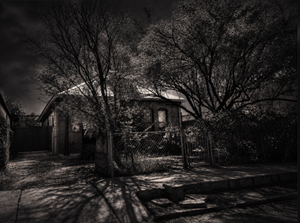
One of the most detailed newspaper accounts of a haunted Tucson house appeared in the Tucson Citizen in 2003.
Residents of a house on West Simpson Street described a little girl, a man in a kitchen and objects moving without an obvious cause. The people interviewed didn’t all agree about what they had seen, and some experiences were reported by only one resident.
That uncertainty is useful.
It shows how a house develops a haunted reputation through several people’s memories instead of through one polished legend.
The building was a private home, so the story belongs in Tucson’s folklore without turning the address into a tourist stop.
Tucson ghost tours
Walking tours have covered downtown, Barrio Viejo and Tucson’s historic theaters for years. The Tucson Citizen described tours that included Hotel Congress, the Rialto, the Pioneer Hotel and the former Santa Rita Hotel site.
Routes and operators change, so check current details before booking. A worthwhile tour should tell you which parts come from public records, which come from named witnesses and which have been passed along as local legend.
Visiting Tucson’s haunted places
Many of these locations are active hotels, theaters, churches, businesses or memorial sites. Visit during posted hours and stay out of employee-only or residential areas. El Tiradito is a living shrine, and the Pioneer Hotel story involves a real disaster. Both deserve more consideration than an ordinary sightseeing stop.
If you’re planning a longer trip, the Tucson page connects naturally with haunted places in Arizona, Tombstone’s historic buildings and the haunted hotels and mining stories of Bisbee.
Sources and Further Reading
- Pima County Public Library: Ghosts in Tucson
- Visit Tucson: Barrio Viejo and El Tiradito
- Hotel Congress
- Fox Tucson Theatre
- Tucson Citizen, October 31, 2003
- Tucson Citizen, October 24, 2008
- Southern Arizona’s Most Haunted