A couple parks in a remote area to make out. A broadcast interrupts the music. A dangerous patient has escaped nearby. He has a hook where one hand should be.
The young couple leaves the lovers’ lane in a hurry. They make it home safely—or so they think. Then they walk around the car and see it: a metal hook hanging from the passenger-side door.
The Hook is an urban legend about a couple who narrowly escapes an unseen attacker, only to discover how close he came after the danger has passed. That last image has kept the story alive since at least the 1950s. The Hookman barely appears. He doesn’t need to.[1][4]
| Conventional title | The Hook |
|---|---|
| Also called | The Hookman |
| Legend type | Automobile, adolescent horror, and cautionary legend |
| Typical setting | An isolated parking place or lovers’ lane |
| Defining image | A severed hook hanging from the car-door handle |
| Early circulation | American oral versions recalled from the 1950s; college collections published in 1965 and 1968 |
| Folklore index | BRUN 01400, Amputation Stories |
The Hook Urban Legend: The Short Version
A teenage boy and girl drive somewhere private and park. The radio is playing when a bulletin breaks in: an escaped killer is somewhere in the area. The warning includes one detail no one could forget. The man has a hook for a hand.
The girl wants to leave. The boy thinks she is overreacting. Then something scrapes against the car, or she becomes frightened enough that he finally starts the engine.
They race home. When the boy goes around to open her door, the killer’s hook is dangling from the handle.
That is the whole story. It can be told in under a minute, and almost everything depends on the pause before the final sentence.[2]
“The killer never enters the car. He barely enters the story. The hook does all the work.”
— Sophie Vale
Where Did The Hook Story Come From?
When I started following The Hook backward, I expected to find one famous crime, one newspaper story, or at least one town with a convincing claim to the original Hookman.
I found a trail of teenagers instead, and a some very old stories dating back to the thirteenth century.
Several people interviewed for folklorist Linda Dégh’s 1968 study remembered hearing versions of this urban legend in 1955. One informant thought she might have heard it at a girls’ camp as early as 1951, although her date was uncertain. The story moved through dormitories, fraternity houses, camps, slumber parties, schools, workplaces, and—appropriately enough—parked cars.[4]
The earliest substantial published collection I found came from Purdue University. JoAnn Stephens Parochetti began gathering scary stories from students in 1963 and published her results in 1965. The Hook was the story she encountered most often. Eleven Hook variants appeared in a collection of 50 stories.[6]
Three years later, Dégh examined 44 versions preserved in the Indiana University Folklore Archives.
The 1960 Dear Abby Column
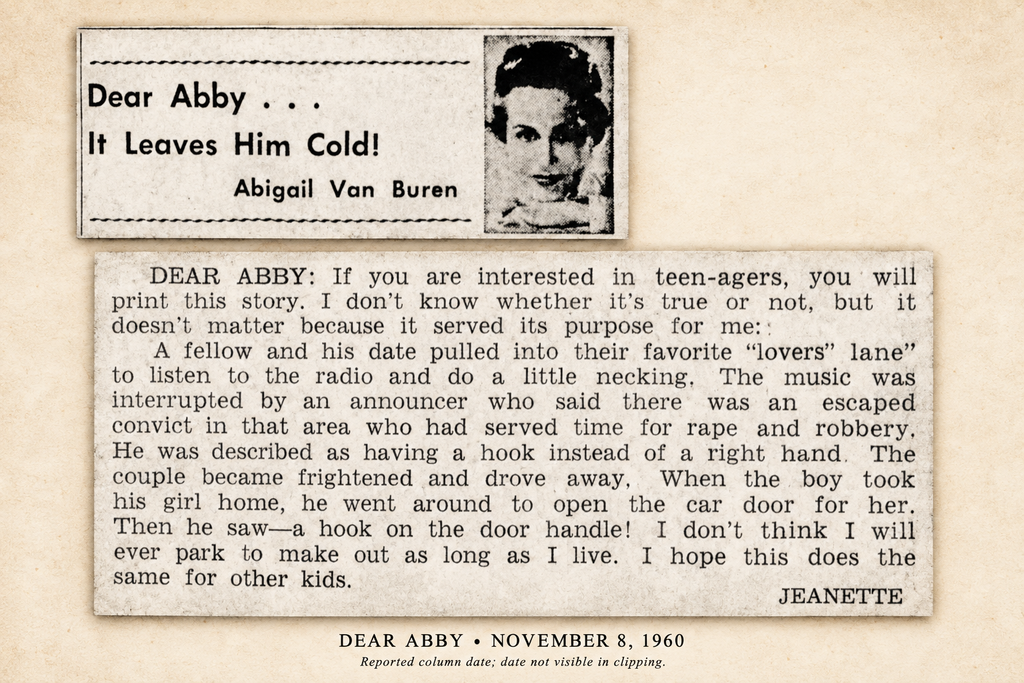
I also found this reference to the Hook Man in this Dear Abby column, published on November 9, 1960. A reader calling herself “Jeanette” admitted she didn’t know whether the story was true, but it had convinced her to stop parking to make out, and she hoped it would have the same effect on other teenagers. Her version describes the Hooko Man as an escaped convict. The letter shows the legend already circulating as a cautionary tale; it does not tell us where the legend began.
Connection to Older Legends
I also found references to a tale called “About a Thief Who Had His Hand Cut Off,” Tale 38 in Philippe d’Alcripe’s La Nouvelle Fabrique des excellents traits de vérité, published in France around 1579. This story appears to be a close predecessor to the Hook Urban Legend.
In the story:
- A robber grabs a traveler’s horse by the bridle.
- The traveler cuts off the robber’s hand with his sword.
- He rides home without realizing the hand is still gripping the bridle.
- His servant discovers it while unsaddling the horse.
- The traveler eventually nails the hand above his door as a trophy.
An English translation appears on page 151 of Gerald Thomas’s study of d’Alcripe. Read the translation through Memorial University. Folklorists classify the element as motif K912.0.2, “Robber’s hand cut off.”
An Older Story Inside a Modern Car
The lovers’ lane, the radio bulletin, and the car door make The Hook feel unmistakably modern. The machinery underneath it is older.
Jan Harold Brunvand pointed to earlier stories that use a similar ending: a rider escapes an attacker, then discovers the attacker’s weapon caught on the saddle. The Hook gives that delayed discovery a modern setting. The horse becomes a car. The lonely road becomes a lovers’ lane. The severed hand becomes the piece of evidence left behind.[1]
That combination also made the story easy to localize. Dégh found Indiana versions attached to Whiting Beach, Devil’s Hollow, Sand Pit Road, and Yellowwood Forest. Other storytellers supplied their own hospital, overlook, beach, or back road.
Like other migratory urban legends, the story travels while the place name changes.
Those nearby place names do more than set the scene. They help turn a portable plot into what folklorist Timothy R. Tangherlini calls a “historicized narrative”—a story that sounds as if it belongs to local history without becoming a verified historical report.[11]
How The Hook Urban Legend Changes
If someone tells you there is one official version of The Hook, the archive disagrees.
- The couple may hear the warning on the radio, or hear it before they park.
- The girl may panic because of a noise, a curfew, or a feeling that they are being watched.
- The scratching may come from the Hookman—or from a branch, until the ending changes its meaning.
- The hook may be clean, bloody, or still attached to part of an arm.
- The attacker may be called a killer, an escaped patient, or simply a dangerous man.
- The final discovery may happen at the girl’s house, a gas station, or somewhere else that first appears safe.
Some tellings borrow the scratching sound from The Boyfriend’s Death urban legend. Others absorb a local bridge ghost or a nearby institutional escape.
Urban legends do not respect the tidy borders we give them.[4]
Bill Ellis compared 70 complete narratives in the University of California, Berkeley folklore archive.
No single version contained every detail people tend to call essential. The Hook survives as a recognizable cluster of images, not a sacred text.[3]
Why Does the Story Work?
The Hook story serves as a warning. Adults are absent, sex is implied, and danger arrives the moment the couple moves beyond supervision.
That explains part of it. Not all of it.
A car is a great location for a horror story. It’s essentially a small metal room with dark windows and only one quick way out.
The radio brings news from the outside world inside, but the warning comes too late. Before the couple can decide whether to believe it, the threat may already be touching the door.
The story leaves room for the couple to escape. We feel the relief first. Then the hook takes it away.
Folklore Interpretations
Folklorists have read that ending in different ways.
In “On the Psychology of Legend,” first published in 1971, Alan Dundes emphasized sexual symbolism.[7]
In “Why Are There So Many Modern Legends about Revenge?” published in 1984, Bengt af Klintberg pointed to a conflict between rule-following society and the outsider who threatens it.[8]
In a 1987 study of a recorded performance, Bill Ellis described the Hookman as a possible “moral custodian” who interrupts the couple.[9] When he reconsidered the legend in 1994, Ellis warned that no single symbol unlocks every version.[3]
Older versions of the story may lean on stereotypes about psychiatric illness and limb difference. The escaped “lunatic” and the prosthetic hook are traditional parts of the story, but they are not evidence that people with mental illness or disabilities are unusually dangerous. They tell us more about the fears available to past storytellers than about the people those images stigmatized.
Is The Hook Based on a True Story?
No—not in the sense of one verified Hookman attack that inspired the story.
Real crimes, prison escapes, and attacks near parked cars can resemble pieces of the legend. None has been established as its single source. The story appears in too many places, with too many local names and contradictory details, to behave like a stable report of one event.
This urban legend is real in another way, however. People have told it in many settings. Some believed it, others doubted it. Storytellers changed it and warned one another with it for generations. As with many classic urban legends, proving the event false does not explain why the story felt true enough to repeat.
The Hook Story in Movies and Pop Culture
A hook hanging from a car door has become visual shorthand for the phrase “urban legend.”
The story moved easily from campfire scenes into horror films and television shows—even comic books and parodies.
Bill Murray tells it around a campfire in the 1979 comedy Meatballs.[1][10]
The telling is fun. The argument afterward is better.
The clean version of The Hook is only the plot. In performance, the pauses, objections, corrections, and jokes belong to the legend too.[11]
When one camper protests that it is “just a story,” another answers, “No … this is true.” Within seconds, the group relocates the event to a beach, then a park. One boy remembers the attacker missing a foot instead of a hand, and another asks how anyone could have a hook on his foot.
In less than twenty seconds, the movie shows a legend in motion: claimed as true, moved to a new place, contradicted, corrected, and already becoming somebody else’s version.
Jayne Anne Phillips reworked the story in “Blind Girls,” published in her 1979 collection Black Tickets.[5]
Brunvand also reprinted Ron Coulthard’s 1985 parody “Hooked,” which first appeared in Cold Mountain Review, Appalachian State University’s literary journal. It gives the Hookman the scare: he wakes to discover a sports car—with two terrified teenagers inside—caught on his hook.[5]
Those versions can change the setting, the couple, or even the joke. They keep returning to the same object on the door.
Sophie’s Closing Note
I went into this file expecting the hook to be the most interesting part.
It wasn’t.
What stayed with me was how carefully the story controls what we are allowed to see. There is no chase through the woods. No face at the window. No confrontation with the Hookman. The couple leaves before the horror story seems to begin.
Only later do they understand that it already happened.
The story of The Hook allows the listener’s imagination to build the missing scene: a man beside the car, a hand reaching for the door, a fraction of a second between escape and something worse.
That scene exists nowhere in the story.
We supply it ourselves.
That is where I’m leaving the file tonight.
Status: Open.
— Sophie Vale
Frequently Asked Questions About The Hook
What is The Hook urban legend?
The Hook is a lovers’ lane legend about a couple who flees after hearing that a hook-handed killer has escaped nearby. They later find his hook hanging from the car door.
When did The Hook story originate?
American oral versions were circulating by the mid-1950s, although one uncertain recollection places it at a girls’ camp in 1951. Purdue students supplied a large collection in 1963, published in 1965.
Was the Hookman a real killer?
No single real criminal has been verified as the Hookman. The story’s shifting locations and details are characteristic of folklore rather than one documented crime report.
Why is the hook hanging from the car door?
The hook reveals that the warning was true and that the couple escaped only moments before the attacker could open the door.
Related Urban Legends
- The Killer in the Backseat urban legend
- The Boyfriend’s Death urban legend
- The Slasher Under the Car urban legend
- The Severed Fingers urban legend
- The Vanishing Hitchhiker urban legend
- Explore the complete list of urban legends
Sources and Further Reading
- Jan Harold Brunvand. “The Hook,” Encyclopedia of Urban Legends, 2nd edition. ABC-CLIO, 2012.
- Robert Loren Fleming and Robert F. Boyd Jr., adapted from the works of Jan Harold Brunvand. The Big Book of Urban Legends. Paradox Press, 1994.
- Bill Ellis. “‘The Hook’ Reconsidered: Problems in Classifying and Interpreting Adolescent Horror Legends”. Folklore 105 (1994): 61–75.
- Linda Dégh. “The Hook”. Indiana Folklore 1, no. 1 (1968): 92–100.
- Jan Harold Brunvand. Be Afraid, Be Very Afraid: The Book of Scary Urban Legends. W. W. Norton, 2004.
- JoAnn Stephens Parochetti. “Scary Stories from Purdue”. Keystone Folklore Quarterly 10, no. 1 (Spring 1965): 49–57.
- Alan Dundes. “On the Psychology of Legend.” In American Folk Legend: A Symposium, edited by Wayland D. Hand, 21–36. University of California Press, 1971. Reprinted in Interpreting Folklore. Indiana University Press, 1980.
- Bengt af Klintberg. “Why Are There So Many Modern Legends about Revenge?” In Perspectives on Contemporary Legend, edited by Paul Smith, 141–146. University of Sheffield, 1984.
- Bill Ellis. “Why Are Verbatim Transcripts of Legends Necessary?” In Perspectives on Contemporary Legend II, edited by Gillian Bennett, Paul Smith, and J. D. A. Widdowson, 31–40. University of Sheffield, 1987.
- Meatballs. Directed by Ivan Reitman. Paramount Pictures, 1979.
- Timothy R. Tangherlini. “‘It Happened Not Too Far from Here…’: A Survey of Legend Theory and Characterization”. Western Folklore 49, no. 4 (October 1990): 371–390.
Last reviewed: September 2026.