Two girls heard drums carrying across the tundra. They had been told to remain inside. Instead, they stepped out—and the earth began to move beneath them.
Near Hooper Bay, Alaska, large depressions once marked a path across the tundra. People called them the Giant Footprints, or Giant Footsteps. But the story attached to them is not about a giant.
It is about two human girls whose final steps became impossibly large when they disappeared from the world of the living.
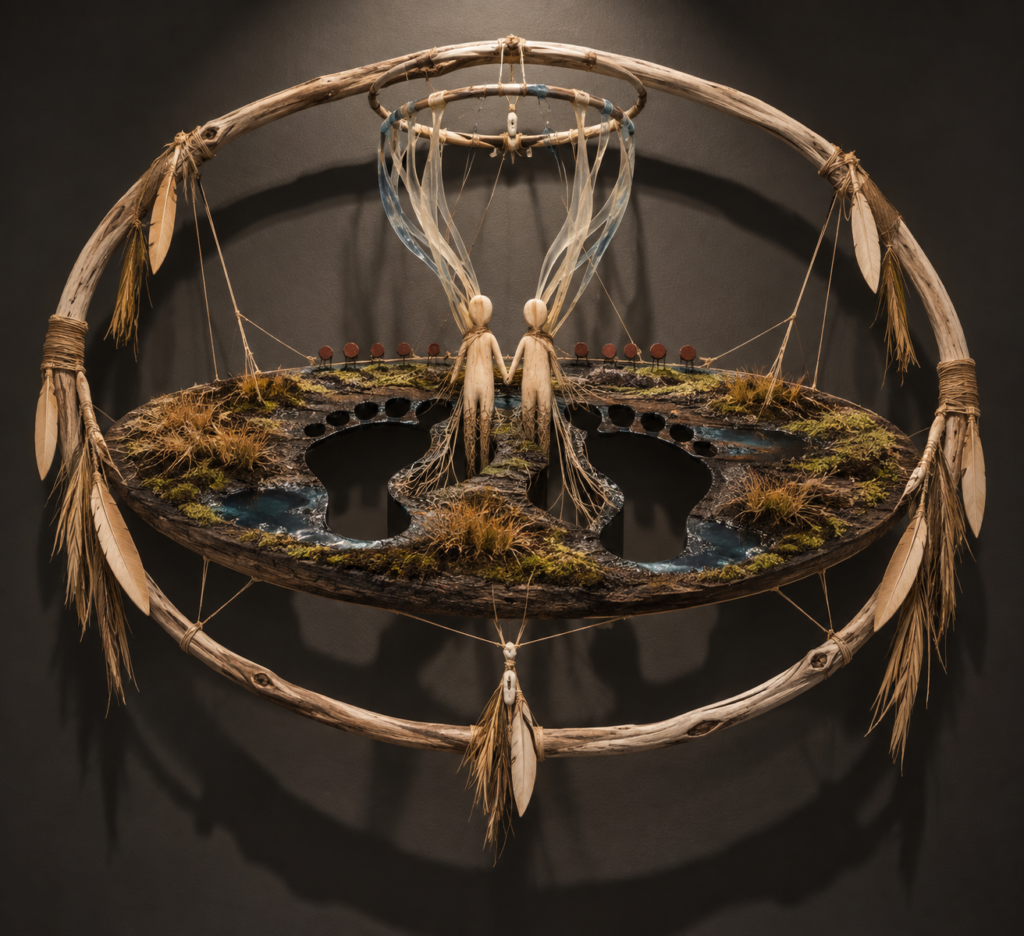
The story comes from the Yup’ik community of Hooper Bay on Alaska’s Bering Sea coast. It has been told in more than one form: in some versions, the girls sink beneath the tundra; in another, they rise into the sky while sinking into the ground. Across the tellings, one fact remains constant. The girls vanish, but their footprints stay behind.
Case File
| Name | The Giant Footprints; The Giant Footsteps |
|---|---|
| Tradition | Yup’ik oral tradition of Hooper Bay, Alaska |
| Location | Tundra near Hooper Bay and the old village site of Askinuk |
| Primary figures | Two girls who had recently begun menstruating |
| Earliest version identified in the principal study | Recorded by Helen Oswalt at Hooper Bay in 1950 |
| Classification | Sacred place narrative; cautionary tradition; disappearance legend; puberty narrative |
| Central themes | Respect for elders, menstrual observance, sentient landscape, reciprocity, and passage between worlds |
| Status of the footprints | Described by Hooper Bay residents and witnessed by researcher Holly Cusack-McVeigh; no published geological or archaeological investigation has been located |
Contents
The Story of the Giant Footprints
Long ago, the people were holding a feast and dance at Askinuk, the old village associated with Hooper Bay.
Two young girls were left behind. Both had recently begun menstruating. Under the rules they had been taught, they were to remain secluded rather than appear publicly or participate in the dance.
Then they heard the music.
The sound of singing and drums traveled across the tundra. The girls knew what their elders had told them, but the celebration drew them from their shelter. They slipped away and started toward the dance.
As they crossed the tundra, the ground began to roll and move.
One teller explained that the earth was thinner in those days. The boundary separating the human world from the other worlds was easier to cross—and easier to fall through.
The girls began to sink.
They struggled to free themselves, but the more they fought, the deeper they went. The tundra swallowed them until they were lost to the living world. They became part of another realm that was not entirely separate from this one, but they were never seen again.
Their footsteps remained on the land: a trail of deep depressions large enough to be seen from a distance.
Years later, when anthropologist Holly Cusack-McVeigh visited the site with young men from Hooper Bay, they warned her not to step inside the footprints. The warning was delivered teasingly, but she walked around them. At the time, she did not yet understand why the place required caution.
The Recorded Versions
LIke most oral traditions, there’s no single fixed text of the Giant Footprints. It’s an details emerge differently depending on the teller, audience, and occasion.
Cusack-McVeigh found that the central structure remained remarkably stable while several important details shifted.
| Version | Distinctive details |
|---|---|
| Common Hooper Bay telling | A feast and dance are held at old Askinuk. Two girls disregard the rules surrounding their first menstruation. The ground rolls beneath them, and they sink into the tundra. |
| Helen Oswalt’s 1950 field notes | The village has gone to a sealing camp. The girls leave a specially built puberty shelter. Because dancegoers carry offerings, they take the skin covering their doorway and carry it between them. They sink into the ground while also rising into the sky. |
| Elder’s telling, recorded around 2000 | The girls ignored the wisdom of their elders and are now “up in the sky.” The teller points toward the actual depressions while speaking. |
| Elder’s telling, recorded in 2002 | The teller remembers seeing the footsteps while hunting and says they were deeper when he was young. He believes the girls went beneath the ordinary path and underground. |
The most striking difference is the direction of the disappearance. Did the girls descend into the earth, ascend into the sky, or somehow do both?
Within the story’s worldview, those possibilities need not contradict one another. The land, sky, human community, and spirit world are overlapping parts of a larger reality. Passing out of the human world may be described as movement downward, upward, or through.
Were the Giant Footprints Real?
They were real in the most immediate sense: people at Hooper Bay identified visible depressions on the tundra as the girls’ footprints.
Cusack-McVeigh describes traveling to the location and seeing the large, deep marks from a distance. Elders recalled passing them while hunting. One said they had been deeper during his childhood. The story was therefore attached to a recognizable place—not simply to a vague landscape or imaginary country.
That does not tell us how the depressions formed geologically. Cusack-McVeigh’s chapter is a study of oral tradition and place, not a physical investigation of the ground. No measurements, excavations, soil analyses, coordinates, or photographs of the depressions are supplied in the published chapter. A natural explanation might involve thawing ground, collapsed tundra, erosion, old structures, or some other local process, but choosing one without examining the site would be speculation.
The more revealing question may be why these particular depressions became—and remained—the Giant Footprints.
For the people telling the story, the landform is not an incidental prop. The marks remember the event. They continue to warn, teach, and respond.
How Should the Giant Footprints Be Classified?
Calling the account an “urban legend” is convenient for a modern archive, but it is not the most precise classification. The tradition is older, more localized, and more closely connected to sacred geography than the rumors normally labeled urban legends.
A sacred-place narrative
The story explains the meaning of a specific feature in the landscape. Its continued power depends on the relationship between narrative and place: a person can hear the story and then be shown where it happened.
A cautionary tradition
The story is a cautionary tale. The girls knowingly disregard the instructions of their elders, and face consequences.
These lessons are normally delivered indirectly. In other words, instead of someone saying, “You’rere behaving incorrectly,” a teller recalls the footprints and allows the listener to discover the application.
A puberty or menarche narrative
The girls’ first menstruation is not a decorative detail. It places them at a moment of transition governed by rules intended to protect relationships among people, animals, hunting, the land, and the spirit world.
A disappearance and passage between worlds
Unlike some cautionary tales, the girls in this story don’t die. Instead, they pass from the human world into another—sinking beneath the earth, rising into the sky, or somehow doing both at once. Their story belongs to a larger family of traditions in which the boundary between worlds briefly opens, allowing people to cross without finding their way home.
An etiological legend
In folkloric terms, the narrative is also an etiological tale: it explains the origin of a visible feature. The giant footprints exist because the girls’ last journey impressed itself permanently upon the land.
Story Meaning
1. Respect for elders
The most direct lesson concerns the danger of dismissing inherited knowledge. The girls understand the rules but leave anyway. Every retelling makes the consequences visible beneath the listener’s feet.
This does not mean the tradition is reducible to “disobedient children are punished.” The elders’ instructions represent accumulated cultural knowledge about maintaining balance in a world filled with other forms of awareness.
2. Menstruation affects relationships beyond the individual
The Yup’ik have many behavioral rules associated with menstruation. These rules are recorded throughout the region. Edward William Nelson wrote that a menstruating girl was believed to affect a hunter’s relationship with animals. A twentieth-century missionary similarly recorded restrictions on leaving the house, seeing the surroundings, or touching the ground.
These accounts were written by outsiders and should not be mistaken for a complete Indigenous explanation. Cusack-McVeigh’s study is more useful because she examines how Hooper Bay residents themselves used the story. Within those tellings, the girls’ actions potentially disrupt relationships involving the entire community, hunting success, animals, spirits, and the land.
3. The land is a participant, not a backdrop
The tundra does not passively receive the girls’ tracks. It rolls, opens, accepts, rejects, remembers, and teaches.
Cusack-McVeigh describes this as a sentient landscape: the land operates as a social presence capable of responding to human thought and action.
This idea appears more than once. An elder collects healing water from the tundra and later offers a valued sewing needle in gratitude. She waits anxiously to see whether the water will accept it. When the needle sinks, she understands that the gift has been received.
The girls’ disappearance is the inverse of that exchange. The elder approaches the land with gratitude and reciprocity; the girls enter it after disregarding the instructions meant to govern their behavior.
4. The earth was once “thinner”
Several tellings of this story describe an earlier time when the earth was thinner and movement between worlds was easier. The statement works on more than one level. It explains how people could enter the land, but it also describes a past in which humans were more sensitive to spiritual realities.
One elder’s observation that the footprints were becoming shallower parallels descriptions of the earth becoming thicker. Cusack-McVeigh cautiously interprets both changes as possible signs of a world out of balance—a weakening awareness between the community, land, and spirit world.
5. A story can be addressed to one particular listener
Cusack-McVeigh first heard about the footprints after accompanying young men on an unsuccessful seal hunt. Years later she considered that the story might have been told partly for her benefit. Women did not ordinarily accompany men on such hunts, and traditional beliefs linked proper behavior with an animal’s willingness to present itself to a hunter.
No one directly accused or corrected her. Instead, the young men took her to the footprints and told the story. Its meaning was left to unfold as she learned more about Hooper Bay.
That indirectness is essential. The Giant Footprints story is not only a narrative about people receiving a lesson; its performance is itself a way of teaching.
How the Story Reached the Written Record
1950–1951: Helen Oswalt
The earliest written version identified by Cusack-McVeigh was recorded when University of Alaska graduate student Helen Oswalt visited Hooper Bay in 1950.
Her unpublished manuscript, Ethnological Notes from Hooper Bay, is dated 1951 and held by the Alaska and Polar Regions Collections at the University of Alaska Fairbanks.
Oswalt did not create the story. She wrote down a tradition shared with her in the community. The published excerpt does not name the original narrator.
The 1990s–2002: Holly Cusack-McVeigh
Cusack-McVeigh heard the story repeatedly during more than a decade of work with Hooper Bay residents. Instead of treating one version as the definitive text, she documented who told it, where it was told, what personal memories surrounded it, and what the teller appeared to be teaching.
Her chapter, “The Giant Footprints: A Lived Sense of Story and Place,” appeared in the 2008 collection Living with Stories: Telling, Re-telling, and Remembering. It remains the most detailed published study located for this story.
A Note on Language and Cultural Context
The 2008 chapter uses the phrase “Yup’ik Eskimo,” reflecting terminology used by its author and sources. This article generally uses Yup’ik and Yupiit. Hooper Bay has its own regional linguistic and cultural context, and terminology may vary among speakers.
The menstrual restrictions described here should not be pulled from the story and treated as universal rules shared by every Yup’ik community or every person today. The Giant Footprints belongs to Hooper Bay, and its recorded tellings reflect particular narrators, times, and relationships.
Nor should the story be reduced to an exotic taboo. Its deeper subject is relational responsibility: how individual behavior affects hunters, animals, elders, spirits, community life, and the living land.
Frequently Asked Questions
Were the Giant Footprints made by a giant?
No. In the recorded Hooper Bay story, the footprints belong to two human girls. Their extraordinary size or depth marks the supernatural circumstances of their disappearance.
Is this an Alaskan Bigfoot story?
No. Hooper Bay has other reports involving large, humanlike beings, but the Giant Footprints tradition described by Cusack-McVeigh is not a Bigfoot account.
Where are the footprints?
The published account places them on the tundra near Hooper Bay and the abandoned village site associated with Askinuk. It does not publish precise coordinates, and this article will not attempt to identify or direct visitors to a culturally significant location.
Do the footprints still exist?
Cusack-McVeigh saw the depressions during her work at Hooper Bay. Elders said they had become less deep over time. The available published study does not document their present condition.
Why did the girls disappear?
The tellers emphasize that the girls knowingly disregarded behavioral rules. Their disappearance demonstrates the consequences of ignoring elders and disturbing relationships among people, animals, spirits, and the land.
Did they sink into the earth or rise into the sky?
Both versions exist. Helen Oswalt’s 1950 account combines the two movements: the girls begin sinking in the thin ground while also going upward into the sky. The apparent contradiction reveals an overlapping cosmology rather than a simple geographical journey.
Is the story still told?
Cusack-McVeigh documented multiple tellings through 2002 and described it as widely known at Hooper Bay. This article has not independently established how often or in what settings it is told today.
What Remains
The strangest part of the Giant Footprints may not be that the earth opened.
It may be that the land remembered exactly where it happened.
The two girls disappeared from sight, yet the tundra continued telling their story. Hunters passed the marks and remembered warnings from their elders. Children learned that the ground beneath them was neither empty nor unaware. An outsider heard the story after a failed hunt and needed nearly ten years to understand that it might have been meant for her.
The depressions have reportedly grown shallower. The earth, some say, has grown thicker.
But every time the story is told, the boundary becomes thin again.
Sources and Further Reading
- Holly Cusack-McVeigh, “The Giant Footprints: A Lived Sense of Story and Place”, in William Schneider, ed., Living with Stories: Telling, Re-telling, and Remembering (Utah State University Press, 2008), pp. 18–35.
- Helen Oswalt, Ethnological Notes from Hooper Bay (1951), unpublished manuscript, Alaska and Polar Regions Collections, University of Alaska Fairbanks. Excerpted by Cusack-McVeigh.
- Edward William Nelson, The Eskimo About Bering Strait, Bureau of American Ethnology.
- Phyllis Morrow, “A Woman’s Vapor: Yup’ik Bodily Powers in Southwest Alaska,” Ethnology 41, no. 4 (2002), pp. 335–348, DOI: 10.2307/4153012.
- Alaska Native Knowledge Network, “A Brief Historical Sketch of Hooper Bay.”