Lake Monster File · Tahoe Tessie
Tahoe Tessie
The Lake Tahoe Monster
The history of Tahoe Tessie begins long before the friendly green monster appeared on children’s books and souvenirs. Inside the archive are nineteenth-century Lake Tahoe sea-serpent stories, a giant fish said to attack a steamer, unexplained sightings, real drownings, and a lake that newspapers claimed did not return its dead.
The monster didn’t necessarily create the missing bodies, but the missing bodies helped create a lake capable of holding a monster.
Case File Contents
In This Tahoe Tessie Case File
- What is Tahoe Tessie?
- Caxton and the 1865 Tahoe sea serpent
- The newspapers already knew it was a story
- The Lake That Did Not Return Its Dead
- The Terror of Tahoe
- Coggin’s six-hundred-foot serpent
- What the Washoe sources actually say
- Following Hernandez
- When the monster became Tahoe Tessie
- Tahoe Tessie sightings and evidence
- How the monster became a mascot
- The Lake Tahoe Monster Museum
- Is Tahoe Tessie real?
- Sophie’s closing note
- Frequently asked questions
- Sources and case notes
- The case is still open
Case Identification
Tahoe Tessie: Quick Facts
Also called
Tahoe Tessie; the Tahoe monster; the Lake Tahoe sea serpent; the big fish of Lake Tahoe
Location
Lake Tahoe, on the California–Nevada border
Earliest newspaper trail located
A comic Tahoe sea-serpent story published in 1865
Earliest newspaper use of “Tessie” located
A 1984 United Press International story
Reported appearance
Serpent, enormous fish, prehistoric creature, dark moving body, unexplained wake, or friendly green dinosaur-like mascot
Confirmed physical evidence
None establishing an unknown large animal in Lake Tahoe
Archive classification
Lake monster, newspaper legend, and regional mascot
01
What Is Tahoe Tessie?
Tahoe Tessie is the modern name for an unidentified creature said to inhabit Lake Tahoe. Depending on which account you open, Tessie may be a sea serpent, an immense fish, a surviving prehistoric animal, a misplaced sturgeon, something dark moving beneath the surface, or a wake with no visible boat attached to it.
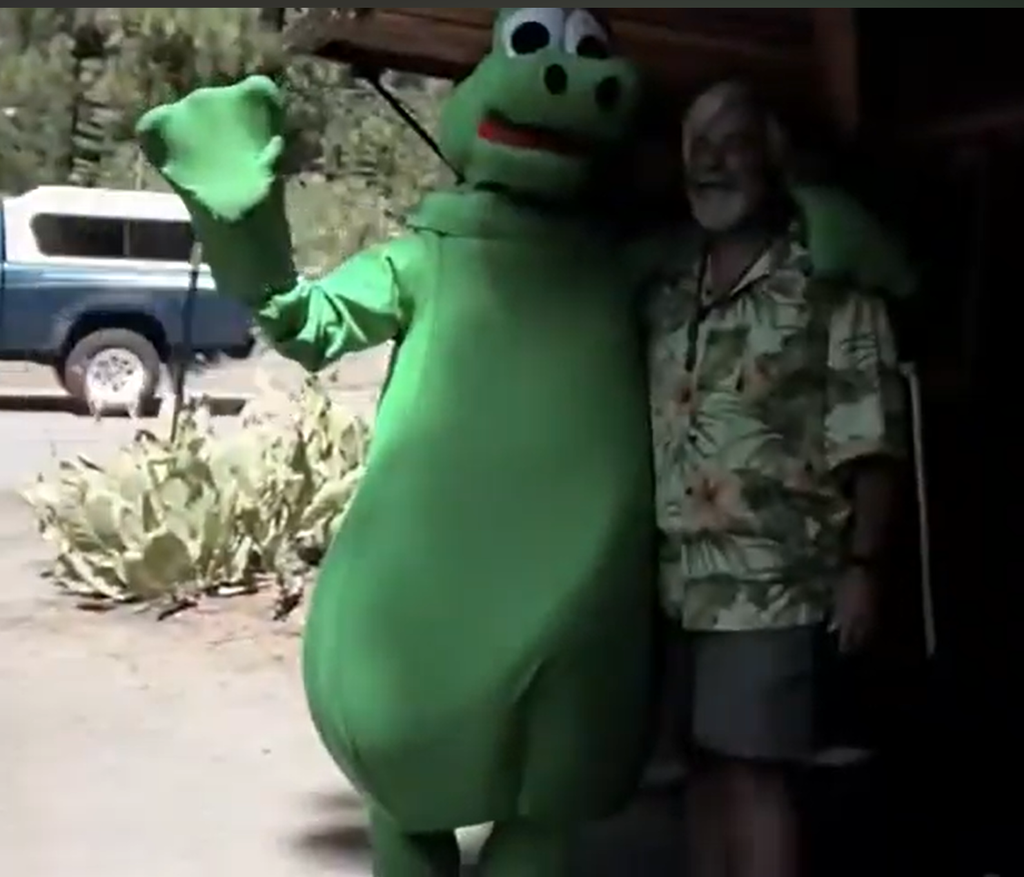
She is also a cheerful green character created by Bob McCormick and illustrator Eileen Gay. That Tessie appeared in a children’s book and then on shirts, postcards, mugs, patches, toys, and inside a costume large enough to visit schools and parades.
McCormick eventually called them the two Tessies: the real monster people thought they had seen and the one he had imagined.
That doesn’t untangle the file.
The name is modern. Some of the stories now placed beneath it are more than a century old. They probably don’t describe the same creature, and they weren’t always told seriously. Some were jokes from the beginning.
The quick answer
Tahoe Tessie is well documented as a Lake Tahoe legend. The existence of an unknown giant animal in the lake has not been established. The interesting record is not one creature remaining unchanged. It is what happened as newspaper serpents, giant fish, missing bodies, unexplained water, modern sightings, and a commercial character were drawn together.
02
Caxton and the 1865 Tahoe Sea Serpent
The earliest Tahoe serpent I found didn’t emerge from the water, but from a newspaper argument.
On August 28, 1865, the Gold Hill Daily News reported that William H. Rhodes, who wrote as Caxton, had recently traveled around Lake Tahoe with Barney Wolf. The “principal discovery of the voyage,” the paper announced, was a large creature of some kind.
The story gives us everything a respectable lake monster should have and then refuses to behave respectably. A man at the masthead shouts that a serpent is approaching. Everyone looks toward the water. The creature is more than one hundred feet long, as thick as a man’s body, deep blue, and carrying a head “as large as a hogshead.” It lifts thirty or forty feet out of the lake before vanishing in foam.
For a moment, it sounds like evidence.
“Bully for Caxton! Bully for the snake (a pine tree?)!!”
The paper punctures its own monster. The reader was supposed to recognize a tall tale, probably at Caxton’s expense.
Then came the detail that made this clipping more useful than I expected. On November 6, the same paper referred to the “Tahoe Sea Serpent” again while mocking Caxton in another editorial dispute. It did not retell the encounter or explain the name. Apparently, it no longer needed to.
By late 1865, the Tahoe serpent was already something a local newspaper could call back into the room with three words: Tahoe Sea Serpent.
03
The Newspapers Already Knew It Was a Story
When I first started gathering the clippings, I was treating each one as another possible sighting. Then a tiny item from 1880 corrected me.
The Sacramento Union said the Carson Daily Appeal was devoting itself to “sea-serpent narratives, the scene being laid at Lake Tahoe.”
Narratives.
That is not the language of a paper cautiously announcing an unknown species. It is the language of newspapers recognizing a recurring kind of story—and recognizing what another newspaper was doing with it.
By 1888, the Daily Territorial Enterprise could joke that the Sierra Tourist had “so far failed to discover any sea-serpents in Lake Tahoe.” The monster did not even need to appear. Its failure to appear was now material.
This changed my understanding of the legend. Newspaper skepticism did not sit outside the Tahoe legend, waiting to debunk it. The teasing, exaggeration, promotion, repetition, and disbelief were already inside the story while it was being made.
That does not tell us what every witness saw. It tells us what happened after a witness tried to describe something unusual. The newspapers already had a serpent-shaped space in which to place it.
04
The Lake That Did Not Return Its Dead
In 1883, a story attributed to the Virginia City Enterprise announced that the big fish of Lake Tahoe had returned.
It rose in front of the steamer Governor Stanford and “disputed her passage.” After a struggle lasting about ten minutes, the fish leaped upward, snapped off the bowsprit, and carried it away in its mouth. The steamer’s owners were supposedly preparing to lower a harpoon through the vessel and kill it.
Then the story supplied a history. The fish had appeared only two or three times in twenty-five years. In 1866, it said, the creature attacked a large boat and drowned four Canadians.
That sent me looking for the Canadians.
I found drownings, but not four Canadians or a serpent.
Four men disappear in 1869
On September 9, 1869, the Daily Miner-Transcript reported the disappearance of Isaac Steen, William Riddle, James Henley, and Charles Anderson. They left Tahoe City in a sailboat intending to travel to the Hot Springs. The account says the men had been drinking, the wind was blowing hard, and the lake was very rough. People tried to persuade them not to leave.
The report’s explanation was painfully ordinary. If the boat filled or overturned, its ballast would have taken it directly down.
No serpent. No attack. No Canadians.
Three more men drown that December
In December, Albert Woodcock, John Smith, and a Frenchman identified only as Frank drowned after a squall capsized their boat. The vessel was recovered. Their bodies were not.
The Carson Daily Appeal added that nine people had drowned in the lake since spring and none of the bodies had been found. The writer concluded that they apparently never rose to the surface.
The explanation becomes a property of the lake
By 1870, newspapers far from Tahoe were repeating a remarkable description. Skilled swimmers entered the lake and found themselves struggling because of its supposed lack of buoyancy. The bodies of drowned people were never seen again. Pine logs floated briefly, then sank and never returned. Looking through the clear water, a person could supposedly see slabs and lumber resting on the distant bottom.
A Reddit commenter offered the modern explanation many people now know: Tahoe’s cold water slows decomposition, preventing the gases that might bring a body back to the surface. That may help explain particular recoveries or failures to recover them, but the old newspaper story was doing something beyond explaining water temperature. It made disappearance one of Tahoe’s defining powers.
I do not think we can prove that the 1883 writer took the 1869 deaths, changed the year, changed the victims into Canadians, and placed a giant fish beside the boat. The details do not match closely enough.
What we can see is the sequence: real drownings, unrecovered bodies, repeated claims that the lake kept its dead, and then a monster story giving four lost men a monster.
The monster didn’t necessarily create the missing bodies, but the missing bodies helped create a lake capable of holding a monster.
05
The Terror of Tahoe
On December 9, 1884, The Morning Times gave the creature a magnificent headline: “The Terror of Tahoe: The Sea Serpent of the Sierras.”
The article says stories had circulated for years about an aquatic monster living in Tahoe’s deep caves. Its measurements ranged from twenty feet to twenty miles, depending upon the excitement—or early Sunday-school training—of the fishermen who saw it.
Then the paper names Captain Pomin and Mr. Robinson. Both reportedly saw a fish more than twenty feet long with a dorsal fin standing like a “mutton leg sail.” Their veracity, the paper assures us, was weakened only by the unfortunate fact that one owned an excursion steamer and the other a tourist hotel on the lake.
A fleet of fishing boats was watching for the monster. The newspaper advised them to leave it alone until the next visitor season.
This is not proof that tourism invented the serpent. Caxton’s pine tree was already swimming in 1865. It is evidence that people understood the commercial possibilities very early—and could make the tourism angle part of the joke.
06
Coggin’s Six-Hundred-Foot Serpent
If the early clippings had remained jokes about large fish, Tahoe Tessie might have inherited a much smaller ancestor.
Then I. C. Coggin’s serpent came down the canyon.
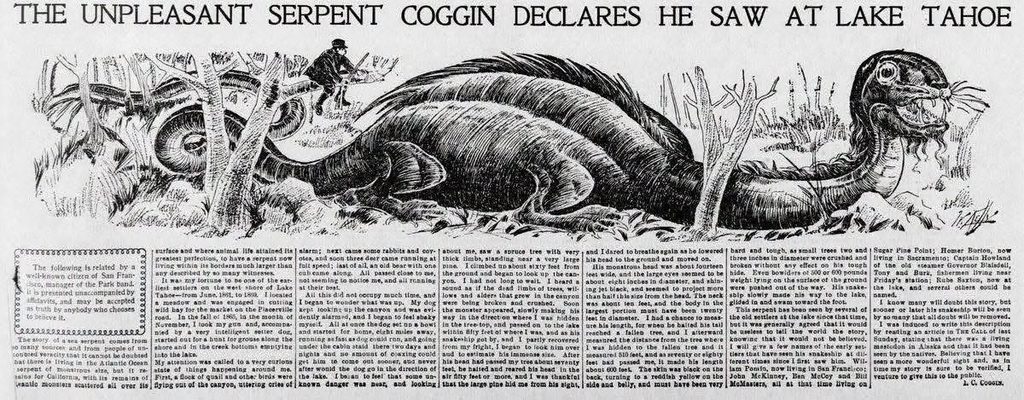
In 1897, an account credited to Coggin appeared as “Lake Tahoe’s Big Serpent.” The Washington Post reprinted it on December 12 and credited the San Francisco Call. Coggin presented the event as something that had happened decades earlier, when he lived near the lake.
He was hunting when the landscape began trying to leave. Quail and other birds flew out of the canyon. Rabbits and coyotes followed. Then deer came running at full speed, and finally an old bear with a cub. His dog howled, ran to the cabin, and refused to come out.
Coggin climbed a pine tree.
The creature advancing below him had a head fourteen feet wide, eyes eight inches in diameter, a neck ten feet long, and a body twenty feet across at its largest point. Small trees broke against its hide. Boulders weighing five or six hundred pounds were pushed aside. When the serpent paused, its tail extended beyond a fallen tree. Coggin later measured the distance and arrived at a total length of approximately six hundred feet.
It reached the lake, entered the water, and swam toward the foot.
This is the image now used to give Tahoe Tessie nineteenth-century depth. But calling it an “1860s sighting” quietly changes the document. The account was published in 1897. It asks readers to trust Coggin’s memory of an event much earlier. The creature begins on land, not in the lake. It is nearly twice the length of a football field. And the name Tahoe Tessie appears nowhere.
Coggin himself seemed to know how the story sounded. He said it had been useless to tell because the world would not believe it. He supplied names of other settlers who had supposedly seen “his snakeship” and predicted that eventually there would be too many witnesses to doubt.
The clipping establishes that this story had reached print by 1897. It preserves the claim. It cannot carry us back into the canyon with Coggin.
07
What the Washoe Sources Actually Say
This was the part of the investigation where the easy version of the story stopped working.
Modern Tahoe Tessie articles regularly turn toward the Washoe people and say the monster is much older than the newspapers. Water Babies become serpent-like guardians. Cave Rock becomes an underwater lair. The Ong is sometimes pulled in as another Tahoe monster. Place all of it together, and Tessie seems to have been waiting in Indigenous tradition until settlers supplied an English name.
The Washoe sources we found do not say that.
The Washoe, or Wašiw, are the original people of Da ow aga, Lake Tahoe, and the surrounding region. Their accounts do make the lake spiritually inhabited. They describe power, danger, healing, caves, travel beneath water, and beings tied to particular places.
They describe more than one being.
Water Babies
In Washo Religion, James F. Downs records Water Babies as small gray beings with human form, extremely long black hair, and bodies described as boneless, cold, and damp. They lived throughout bodies of water: lakes, streams, ponds, springs, marshes, and even irrigation ditches.
They could be dangerous. They could cause illness or unconsciousness. They could also convey power, especially healing power. Even within Downs’s account, the relationship was not simple. Some people avoided them. Another informant said an accidental encounter need not bring harm, though accepting their power might carry a terrible cost.
A Washoe tribal publication places Water Babies at Cave Rock, where healers consulted them, brought offerings, and renewed their powers. The beings could cause illness or death, but their appearance could also be a good omen.
Small, gray, humanlike, powerful, dangerous, healing. That is already extraordinary. Turning them into fish- or serpent-tailed Tessie ancestors does not make the tradition richer. It replaces what the source says with something easier to fit into a modern cryptid article.
A road beneath Lake Tahoe
In The Two Worlds of the Washo, Downs records that a Water Baby could give a person the power to walk underwater. He also describes a broad white road across the bottom of Lake Tahoe and a tunnel connecting the lake with Carson Valley through which Water Babies could travel.
I can see how a modern writer reaches an underwater cave system from there. But the difference matters. A road, a tunnel, Cave Rock, and an underwater cavern are not interchangeable simply because all of them lead below the visible surface.
The giant and the Ong
The tribal booklet also describes a man-eating giant living in a cave near Cave Rock and the Ong, a giant man-eating bird associated with Lake Tahoe. The Ong’s wings could bend trees along the shore. These are separate stories about separate beings.
I do not want to “solve” this by announcing that none of the Washoe material has anything to do with the later monster. That would flatten the record in the opposite direction. The lake was understood as powerful, dangerous, and inhabited long before English-language newspapers began placing serpents in it.
But that is not the same as saying the Washoe had always believed in Tahoe Tessie.
08
Following Hernandez
J. A. Hernandez’s “Tracking Tahoe Tessie Down” helped show me where to look next.
Hernandez separated the creature described by witnesses from the green mascot created by Bob McCormick. He also followed the story into Warren L. d’Azevedo’s work, Cave Rock, Water Babies, and a Washoe tribal booklet called WA SHE SHU: “The Washoe People” Past and Present. The booklet’s link was dead. I found it through the Wayback Machine.
Atlas Obscura led me to James F. Downs’s The Two Worlds of the Washo.
A secondary article can contain problems and still move an investigation forward. This one brought us to a book we might not otherwise have found. Once we opened the book, however, the story became less tidy.
Hernandez proposed that the Washoe description of the Donner Party’s wagon train as a “monster snake” might have blended with other stories and eventually become part of Tahoe Tessie. It is an interesting theory. The Washoe booklet confirms the wagon-train description; it does not make the later connection to Tessie.
The Atlas Obscura article is useful as evidence of the story’s present-day formulation, but it is not reliable enough to become the historical backbone. It compresses distinct traditions, treats Coggin’s 1897 retrospective as a mid-1860s archival account, and leaps too quickly from Washoe Water Babies to Tessie.
The primary newspapers and ethnographic sources allow us to understand the legend better.
This is one of the reasons I don’t like throwing sources away; even imperfect ones. The article shows us what the legend looks like now. Its citations show us where that version came from. Following them backward reveals where one being becomes another, where a publication date becomes an encounter date, and where a modern monster is given a much older ancestry.
It opened the right door. What was behind it was simply more complicated than the sign outside suggested.
09
When the Monster Became Tahoe Tessie
The nineteenth-century papers gave us a Tahoe sea serpent, a big fish, and the Terror of Tahoe. Bob McCormick gave the creature the name that stayed.
The problem is that McCormick remembered the beginning two different ways.
In a 2001 interview, he said the idea began during a moonlit kayaking trip on Tahoe’s east shore in 1979. He recalled a small local newspaper item about two people seeing a sea serpent near Tahoe Vista. Around a campfire, he retold the story to a friend. Loch Nessie supplied the rhyme, and the Tahoe creature became Tessie.
In a 2018 interview, he placed the kayaking trip in 1975.
I do not think we need to pick one memory and quietly erase the other. Both dates come from McCormick. Both interviews were given years later. The discrepancy is part of the record until something closer to the event settles it.
The 2001 account says Eileen Gay began drawing Tessie in December 1979. A proposed children’s book took longer to finish as marriage and children intervened. Then a new cluster of sightings in the early 1980s made the timing feel right.
One of the earliest newspaper appearances of the name we found came through United Press International in 1984. Its headline did not treat the name as fully established:
“Maybe they can call it Lake Tahoe ‘Tessie.’”
That “maybe” catches the name arriving.
10
Tahoe Tessie Sightings and Evidence
The modern sightings do not sound much like Coggin’s serpent. Nothing comes through the trees breaking timber. Most witnesses see something briefly at or just beneath the water and struggle to decide what category it belongs in.
Rick Osborne and the feeding creature
Rick Osborne said that he and three friends watched something hunting trout near a dock at Homewood during the winter of 1979. He described it as approximately the width of a telephone pole and thirty to sixty feet long. Fish jumped ahead of it while the creature rose and splashed back into the water.
The date needs a second date beside it. Osborne submitted the account to Weird California on October 15, 2009, thirty years after the alleged encounter. The surviving record is a named recollection, not a newspaper report from 1979.
Two Reno police officers
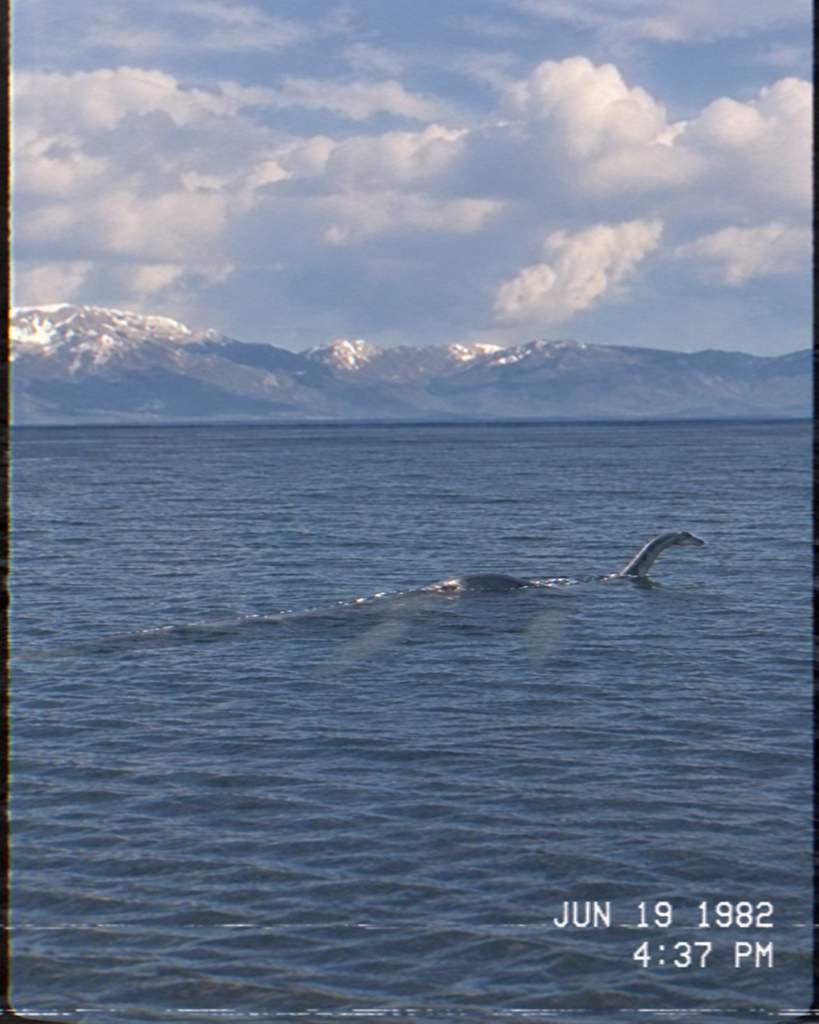
In June 1982, two Reno police officers reported seeing an unusually large creature while water-skiing on Lake Tahoe. Later accounts identify them as Kris Beebe and Jerry Jones and describe something dark or gray and at least ten feet long.
Their occupation followed the story everywhere. They were police officers, therefore trained observers. That does make the report more interesting than an anonymous rumor. It cannot tell us what animal—or combination of water, distance, and expectation—they saw.
Dan Pursley and the tail
Dan Pursley placed another encounter in the summer of 1982. He and his wife had stopped their twenty-two-foot boat about four hundred yards from shore near Emerald Bay. The water was calm. The boat began rocking, large bubbles reached the surface, and Pursley saw a dark green tail submerging about five feet behind them.
Pursley said the tail measured ten to thirteen feet across and moved in the opposite direction from a whale’s flukes. He kept the experience mostly private for years. His account appeared on Weird California on April 21, 2011. A later video says a serpent shook the boat; Pursley’s own account says the boat rocked and that he saw a tail.
Gene St. Denis and the fin prints
Gene St. Denis gave the Reno News & Review two accounts from 1982 or 1983. In the first, he and a friend saw a blotchy gray creature ten to fifteen feet long near Cave Rock. It turned a corner, produced a large V-shaped wake, surfaced, and swam away.
During a separate dive with another friend, St. Denis passed over a hole and felt something explode beneath them. He reported seeing a creature about sixteen feet long swimming away. When the disturbed silt settled, the divers found what he described as large fin prints.
Later summaries sometimes turn those divers into “Chris and Jerry.” The direct interview names only St. Denis. Kris Beebe and Jerry Jones belong to the police-officer story.
Patsy McKay and Diane Stavarakis
In 1984, Tahoe City residents Patsy McKay and Diane Stavarakis saw what McKay first took for a sinking boat. She described a seventeen-foot fish emerging like a submarine, moving in a circle, submerging, and returning to the surface. “It was definitely alive,” she said.
The UPI story paired that sighting with the 1982 officers and offered two possible identities: an enormous sturgeon or a prehistoric creature.
It also offered Tessie her name.
The 1984 monster seminar
That same year, the UC Davis Tahoe Research Group held a public seminar in Reno called “Unidentified Swimming Objects: Is There a Tahoe Monster?” Scientists considered a lineup of abnormally large fish. The candidate that survived the process was a sturgeon that might have entered the lake accidentally during stocking.
The weakness was obvious then and remains obvious now: no one had caught a Lake Tahoe sturgeon.
The sturgeon is a plausible explanation in search of its fish.
Mickey Daniels and the wake
Fishing guide Mickey Daniels described a different kind of encounter. He saw a wake six to eight inches high appear on the lake, move, and then drop out of sight. Daniels did not turn it into a detailed animal. He said he thought something was out there.
I keep returning to that account because it leaves the uncertainty intact. A wake occurred. Its source was not visible. The monster enters in the distance between those two statements.
The 1985 footage
In 1985, camera operators working on a Lake Tahoe tourism commercial at Zephyr Cove filmed a curious set of waves and movement about half a mile offshore.
A later Facebook compilation includes footage attributed to the Zephyr Cove incident. The images may be the closest thing this case has to surviving film, but their path from the original camera crew to the modern video has not been established. For now, they belong in the file as footage said to show the 1985 sighting.
The Lake Tahoe Marketing Council shelved the footage. Bureau manager Malcolm Pribyl told the press that Lake Tahoe was not Coney Island. Promoting a monster, he said, would turn the lake into a sideshow.
I love this complication. Tourism had already been part of the Tahoe serpent joke in 1884. A century later, the local marketing organization decided that a monster might market the wrong Tahoe.
11
How the Monster Became a Mascot
The 1984 newspaper creature was still an enormous fish. McCormick and Gay made it possible to meet Tessie without being afraid of her.
Gay’s drawings gave the monster expressions and poses. The Story of Tahoe Tessie gave her an adventure. The commercial material expanded quickly: postcards, baseball caps, patches, ski pins, shirts, sweatshirts, a coloring book, mugs, photo frames, tote bags, folding brushes, key chains, pocket knives, and dolls.
The book’s map placed Tessie in the center of Lake Tahoe and marked Cave Rock as her home. That is a revealing piece of the modern formulation. The character, the old serpent stories, and a sacred Washoe place now occupied the same illustrated geography.
By 1988, a newspaper profile described costumes appearing at schools, parades, and special events. McCormick said children became frightened when they read monster sightings, but loved Tessie when someone put on the costume and walked into the room.
That may be the most complete transformation in the entire file. Coggin climbed a sixty-foot tree to escape his serpent. Children posed for photographs with McCormick’s.
The commercial Tessie did not erase the threatening monster. She gave Tahoe two creatures that could be used at different times: something vast and unknown beneath the lake, and something friendly enough to print on a child’s shirt.
12
The Lake Tahoe Monster Museum
For about seven years, the legend had an address in Kings Beach.
Bob McCormick operated what later accounts describe as a Tessie gift shop or the Lake Tahoe Monster Museum. In a surviving video, McCormick introduces himself as the museum’s curator. The walls behind him are covered with newspaper clippings, photographs, artwork, and the competing shapes people had given the creature.
This was where the two versions of the monster occupied the same room. The newspaper creature was large, dark, and frightening. McCormick’s green Tessie appeared as books, dolls, costumes, and other collectibles. Visitors could read the sightings, consider the sturgeon theory, and then meet the creature children could hug.
McCormick also tells the creation story himself in the video. He says reports increased through the late 1970s and 1980s, children became afraid to enter the lake, and the National Enquirer arrived in 1984. He decided to make the monster less frightening. “Tahoe Tessie ensued after that,” he says.
That recollection does not fit neatly with the 1975 campfire origin McCormick later gave Moonshine Ink. We do not need to choose one memory and discard the other. Together they show that even Tessie’s creator remembered her beginning in more than one way.
The museum is closed. By May 2005, the Los Angeles Times reported that McCormick had shuttered both the museum and the telephone number used as a Tessie hotline. A visitor writing for the Museum of Hoaxes later went looking for it and found that the building had been demolished. An empty lot remained beside a video store.
The museum disappeared, but the version of Tahoe Tessie assembled inside it did not. The books, costumes, souvenirs, newspaper stories, and McCormick’s filmed account continued to circulate after the room that held them was gone.
13
Is Tahoe Tessie Real?
No verified body, bone, tissue sample, photograph, or repeatable sonar record has established that an unknown giant animal lives in Lake Tahoe.
That doesn’t mean every witness is lying.
An unexplained wake can be honestly reported and remain unexplained. A person can see something alive without being able to identify its species. Separate wakes can cross. A floating object can seem to acquire a head. Distance can remove the ordinary details that would make an animal recognizable.
The sturgeon theory remains possible but unverified. So do unusually large known fish, logs, wave patterns, boats beyond the witness’s sightline, and several different explanations for several different encounters.
I don’t think this file needs one answer capable of explaining every clipping. Caxton’s pine tree doesn’t have to be the same thing McKay saw. Coggin’s land serpent does not have to be the source of Daniels’s wake. The drowned men do not need to have encountered anything at all.
What connects them is not necessarily an animal. It’s Lake Tahoe: deep, cold, visually clear near the surface, dark farther down, dangerous in sudden weather, and already surrounded by stories telling people that what enters may not return.
Tahoe Tessie is real as a name, a character, a regional legend, a collection of reported experiences, and a way of interpreting the lake. Whether one unknown creature exists beneath all of those forms is the part the archive cannot establish.
Sophie’s assessment
Biological status
Unconfirmed
Historical status
Well documented as an evolving Lake Tahoe legend
Evidence quality
Strong for the circulation of stories; inconclusive for an unknown animal
Archive status
Open
14
Sophie’s Closing Note
I am less interested in getting to the bottom of Lake Tahoe than I was when I opened this file.
Not because the evidence does not matter. It matters enough that we went looking for four Canadians and refused to turn seven drowned men into monster victims when the newspapers described rough water, drinking, squalls, and capsized boats. It matters enough to keep Water Babies, the Ong, the Cave Rock giant, Coggin’s serpent, and McCormick’s Tessie from becoming one creature simply because a cleaner origin story would be easier to tell.
But the process of uncovering the story turned out to be the story.
A joke became local shorthand. Drownings became evidence that the lake did not return what it took. A giant fish inherited victims. Tourism mocked the serpent, used it, and later worried about looking like a sideshow. A retrospective newspaper account gave the lake a monster so large that wildlife fled before it. Modern writers reached into distinct Washoe traditions and fastened them to Tessie. Then a man and an illustrator gave the creature a name, a face, and a body children could embrace.
None of that tells me what moved across the water in front of Patsy McKay.
It does show me how a lake learned to hold a monster.
Status: Open.
— Sophie Vale
15
Frequently Asked Questions About Tahoe Tessie
What is the Tahoe Tessie legend?
Tahoe Tessie is a lake monster said to live in Lake Tahoe. The modern legend gathers together nineteenth-century sea-serpent and giant-fish stories, twentieth-century sightings, unexplained wakes, possible natural explanations, and a friendly green character developed by Bob McCormick and Eileen Gay.
Is Tahoe Tessie real?
Tahoe Tessie is real as a documented legend, commercial character, and collection of witness reports. No verified physical evidence has established that Lake Tahoe contains an unknown giant animal.
Did Tahoe Tessie cause deaths in Lake Tahoe?
An 1883 story claimed that Tahoe’s “big fish” attacked a boat and drowned four Canadians in 1866. We have not found a contemporary record confirming that event. Newspapers did report multiple real drownings in 1869, but those reports blame rough weather, alcohol, and capsized boats. They do not mention Canadians, a serpent, or a giant fish.
Why are there stories about bodies sinking in Lake Tahoe?
After several nineteenth-century drownings in which bodies were not recovered, newspapers began claiming that Tahoe did not return its dead. Cold water can slow decomposition, while depth, pressure, entanglement, clothing, and the circumstances of a death can affect recovery. The stronger claim that bodies never rise in Tahoe became part of the lake’s folklore.
What are the best-known Tahoe Tessie sightings?
Frequently repeated reports include two Reno police officers who saw a large creature while water-skiing in 1982; Patsy McKay and Diane Stavarakis’s seventeen-foot fish in 1984; Mickey Daniels’s unexplained wake; and unusual movement filmed during a 1985 tourism shoot at Zephyr Cove. None produced verified biological evidence.
Is Tahoe Tessie a sturgeon?
A large sturgeon accidentally introduced during fish stocking has been proposed because sturgeon can grow very large and appear prehistoric. No sturgeon has been verified in Lake Tahoe, so the idea remains a possible explanation rather than an identification.
Does Tahoe Tessie come from Washoe tradition?
Washoe traditions describe Water Babies, the giant bird Ong, a cave-dwelling giant, and a spiritually powerful Lake Tahoe landscape. The sources reviewed here do not identify those beings as one giant serpent or call any of them Tahoe Tessie. Presenting them as ancient Tessie sightings is a modern compression of distinct traditions.
Who created the friendly Tahoe Tessie?
Bob McCormick said he coined the name after retelling a local sea-serpent story during a kayaking trip. He dated that trip to 1979 in one interview and 1975 in another. Illustrator Eileen Gay created the familiar green character, which appeared in a children’s book and on Tahoe Tessie merchandise.
Are there real pictures of Tahoe Tessie?
No photograph has been verified as showing an unknown Lake Tahoe animal. Most recognizable Tahoe Tessie pictures depict the green fictional character. A 1985 film reportedly recorded unexplained waves and movement offshore, but it did not establish what caused them.
16
Sources and Case Notes
A newspaper clipping proves that a story appeared in print. It does not make every event inside the story true. Reprints are especially important here: several papers carrying the same account may reveal circulation rather than independent witnesses.
- Gold Hill Daily News, August 28, 1865, “A Big Snake.” The earliest Tahoe serpent item located here. Its “pine tree?” ending makes the joke visible.
- Gold Hill Daily News, November 6, 1865. Invokes the “Tahoe Sea Serpent” without explaining it.
- Daily Miner-Transcript, September 9, 1869, “The Drowning at Tahoe.” Names Steen, Riddle, Henley, and Anderson and reports drinking, wind, rough water, and a likely sinking or capsize. No monster appears.
- Carson Daily Appeal, December 16, 1869, “The Lake Tahoe Disaster.” Reports three men drowned in a squall and states that nine bodies had gone unrecovered since spring.
- Rochester Journal and the Post Express, August 2, 1870; Daily Rocky Mountain Gazette, September 2, 1870. Matching versions of the claim that Tahoe did not return bodies or timber.
- Sacramento Union, August 24, 1880. Describes the Carson Appeal as publishing Tahoe sea-serpent narratives.
- New York Times, May 23, 1883, “The Latest Fish Story from Nevada.” Contains the steamer battle and the unverified four Canadians.
- The Morning Times, December 9, 1884, “The Terror of Tahoe.” Names Pomin and Robinson and jokes about tourism.
- Daily Territorial Enterprise, August 3, 1888, “Cum Grano Salis.” Jokes about failing to find Tahoe sea serpents.
- San Francisco Call, November 21, 1897; Washington Post, December 12, 1897. Coggin’s retrospective account. Its publication date should not be converted into an encounter date.
- James F. Downs, Washo Religion, 1961. The ethnographic source for Water Babies as small humanlike beings associated with danger and healing.
- James F. Downs, The Two Worlds of the Washo, 1966. Contains the underwater road and tunnel. It does not describe Water Babies as Tessie or giant serpents.
- Washoe Tribe of Nevada and California, WA SHE SHU: “The Washoe People” Past and Present. Places Water Babies at Cave Rock and separately discusses the cave giant and Ong.
- United Press International, 1984, “Maybe They Can Call It Lake Tahoe ‘Tessie.’” One of the earliest newspaper uses of the name located so far.
- San Francisco Examiner, June 12, 1988. Reports the 1984 seminar, Daniels’s wake, the 1985 footage, the marketing council’s response, and commercial Tessie.
- “Tahoe Tessie,” Weird California. Preserves Rick Osborne’s 2009 submission about an alleged 1979 encounter and Dan Pursley’s 2011 submission about an alleged 1982 encounter. The submission dates are decades later than the events described.
- Cherie Louise, “Who Is Tahoe Tessie?” Reno News & Review, July 7, 2005. The direct interview identifying Gene St. Denis and preserving his surface sighting, diving encounter, and reported fin prints.
- Modern Tahoe Tessie video compilation, Facebook. Includes footage attributed to the 1985 Zephyr Cove incident and retells several sightings. Its narration combines details from separate reports, so the original sources are used for the written accounts above.
- Tahoe Daily Tribune, December 19, 2001. The key interview for McCormick’s 1979 account, Eileen Gay’s role, and the two Tessies.
- Ashley Powers, “It Came from the Deep,” Los Angeles Times, May 3, 2005. A modern profile joining sightings, science, and tourism.
- “Ever Heard of Tahoe Tessie?” Zomboo’s House of Horror Movies. Surviving footage of Bob McCormick inside the Lake Tahoe Monster Museum discussing the sightings, the sturgeon theory, and his reason for creating the friendly Tessie character.
- “Tahoe Tessie,” Museum of Hoaxes. A visitor’s account of searching for the closed museum in Kings Beach and finding that its building had been demolished.
- Catherine E. Magee, “The Cultural Production of Tourism at Lake Tahoe,” 2014. Provides context for tourism and cultural heritage at Tahoe.
- Moonshine Ink, June 14, 2018. The McCormick interview that dates the naming story to 1975.
- Julie Brown, “‘There’s Something Out There’: The Enduring Legend of Tahoe Tessie,” 2021. Useful for the modern legend and continuing encounters.
- J. A. Hernandez, “Tracking Tahoe Tessie Down,” Into Horror History. An important part of our research trail. Hernandez distinguished the reported creature from McCormick’s mascot and led us to d’Azevedo and the Washoe tribal booklet later recovered through the Wayback Machine. His proposed link between the Donner Party’s “monster snake” and Tahoe Tessie remains a theory.
- Suzie Dundas, “Is Tahoe Tessie Real?” Atlas Obscura. Important as a modern formulation and as the lead to Downs; its synthesis requires source checking.
17
The Case Is Still Open
The most useful missing record may be the smallest one: the local newspaper item Bob McCormick remembered reading before the kayaking trip on which he named Tessie. It reportedly described two people seeing a sea serpent near Tahoe Vista.
I would also like to find a contemporary source for the supposed four Canadians; the earliest printing of the Governor Stanford fish story; a publication history for Coggin’s account before the national reprints; the original copyright page of The Story of Tahoe Tessie; and a surviving copy of the 1985 Zephyr Cove footage.
Washoe interpretation should come from Washoe cultural authorities. An interview could materially change this section by clarifying how Water Babies, Cave Rock, the Ong, and the underwater road should—and should not—be discussed alongside a commercial cryptid.
If you have an earlier Tahoe serpent clipping, the remembered Tahoe Vista article, an original Tessie book, footage, a family account, or another surviving record, please include where it came from and when it was created.
The archive remains open because this story is still forming.